Font
Color
Graphics
Изображение точки

To see AR mode in action:

1. Install ARTEFACT app for iOS or Android;

2. Find the exhibition «Into the Depths of Centuries»

3. Push the «Augmented reality» button and point your phone's camera at the exhibit;

Скрыть точки интересаПоказать точки интереса
Показать в высоком качестве

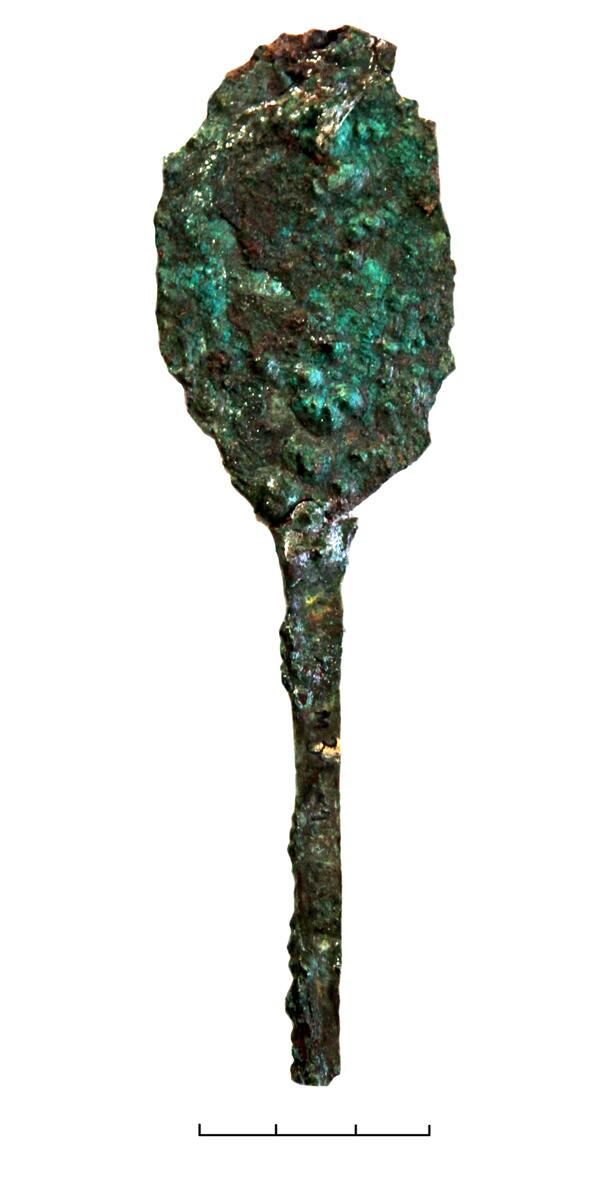
Mirror

Creation period
14th–9th century BCE
Place of сreation
Chernoozersk type of the Andronovo cultural and historical community
Dimensions
15x4x0,3 cm
Technique
bronze, casting
1
Open in app
#2

Metal mirrors were known in Siberia since the Bronze Age. They were found in the cultural layer of settlements, were included in the grave goods of some of the deceased, and some of them were accidental finds. The mirrors were disc or square in shape.

The mirror presented in the museum’s collection is oval in shape, and has a rectangular handle which smoothly tapers to the end. The object dates back to the early Bronze Age (14th–9th centuries BCE). Experts attribute this mirror to the Andronovo cultural and historical community. Such objects were quite widespread in the Bronze Age in the forest-steppe zone of Northern Eurasia, from the Ural Mountains to Mongolia.

The placement of mirrors in Andronovo burials is the following: in a man’s burial, it lay at the ribs on the right side, in a woman’s burial — at the right hand, in a baby’s burial, the mirror was at the left elbow.

According to ancient beliefs, metal — bronze, silver, gold — had protective and life-giving functions. This applied fully to mirrors. Mirrors are often associated with the cult of the sun and through it with fertility, which people always cared about and conducted various rituals to ensure it. The scholar Evgeniy Sergeyevich Bogdanov says the following about the connection of mirrors with this cult,

#5

The worship of the sun was shared by almost all cultures of the East and West. The idea of birth, connected directly with the sun (graphically symbolized by a circle), documented in all rituals without exception, was dominant in the traditional worldview. The sun gives life and authorizes every birth: the beginning of the year, the day, the creation of household items, the preparation of food, the birth of a child.

#6

Mirrors were made by casting in special molds. The quality of the item depended on the quality of the raw materials and the mold.

The mirror presented in the museum’s collection was found in the burial along with other objects made of bronze, wood and the operculum bone of a large fish. This burial featured the skeletons of two deceased, buried in an elongated position on their backs, with their heads facing southeast. According to the leaders of the excavations, all the numerous grave goods belonged to the burial of a shaman, a mature man with severe spinal pathology.

#4
read morehide
00:00
00:00
1x

Mirror

Creation period
14th–9th century BCE
Place of сreation
Chernoozersk type of the Andronovo cultural and historical community
Dimensions
15x4x0,3 cm
Technique
bronze, casting
1
Point your smartphone camera to open in the app
Share
VkontakteOdnoklassnikiTelegram
Share on my website
Copy linkCopied
Copy
Open in app
To see AR mode in action:
  1. Install ARTEFACT app for 
  2. iOS or Android;
  3. Find and download the «Paintings in Details» exhibition
  4. Push the «Augmented reality» button and point your phone's camera at the painting;
  5. Watch what happens on your phone screen whilst you flip through the pictures.
 
We use Cookies
Cookies on the Artefact Website. We use cookies to ensure that we give you the best experience on our website. If you continue without changing your settings, we'll assume that you are happy to receive all cookies on the Artefact website. However, if you would like to, you can change your cookie settings at any time.
Learn more about useHide
Content is available only in Russian

X

Нашли опечатку?...

%title%%type%