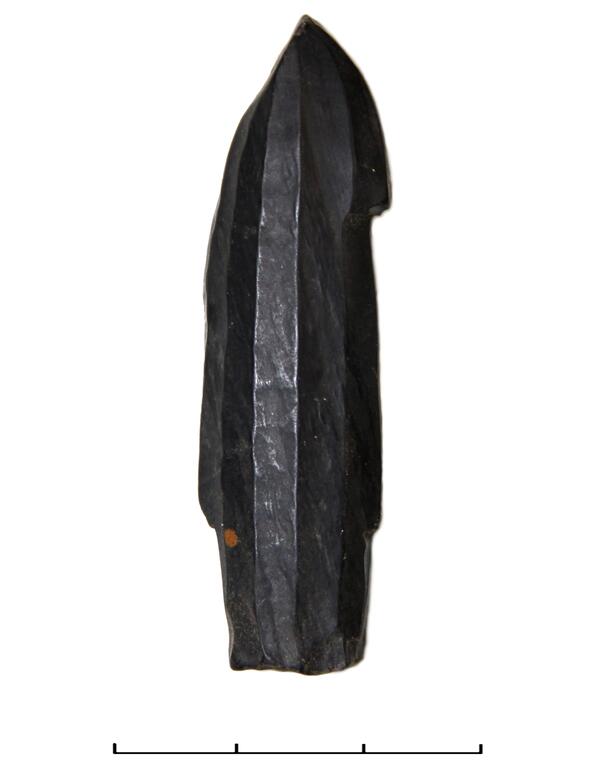
The location of this discovery is unknown. The artifact is a nucleus made of black flint. A nucleus is a fragment of stone at some stage of “primary splitting” in the production of stone tools. To create tools or chipped blanks, flakes and plates were used, chipped from the core. The nucleus itself could also be used as a tool, immediately or after some refinement.
The source material for the nuclei were nodules, boulders, pebbles, tiles or whole pieces of rock. Large flakes could also be used for so-called “secondary nuclei.”
The main morphological elements of the nuclei: the striking platform — the surface along the edge of which a force action was performed to detach flakes; its platform edge — the point of impact during chipping; the plane of cleavage — the surface from which the flake was separated; the base — the part which at the moment of splitting was opposite to the striking platform; the back— opposite at the moment of splitting to the plane of cleavage; lateral edges — sides of the plane of cleavage.
The artifact presented in the museum’s collection is the so-called “pencil-shaped” nucleus. These specimens are characterized by circular chipping, a strong degree of surface wear, often approaching the shape of straight thin rods. Such nuclei were used for circular chipping of plates. The resulting plates could be used for cutting meat and processing hides.
A distinctive feature of this nucleus is the strong wear of the surface. The top part of the striking platform has been preserved — the place from where the stone was split.
There are no natural deposits of stone on the
territory of the Omsk Irtysh region, so the raw materials for the tools were
transported from the Urals or Altai. Such items were widely used during the
Neolithic — early Bronze Age, after which the need for the manufacture of stone
tools disappeared: they were gradually replaced by functionally similar metal
tools.