Font
Color
Graphics
Изображение точки

To see AR mode in action:

1. Install ARTEFACT app for iOS or Android;

2. Find the exhibition «Gelendzhik: Past and Present»

3. Push the «Augmented reality» button and point your phone's camera at the exhibit;

Скрыть точки интересаПоказать точки интереса
Показать в высоком качестве

Dolmen stopper, Dolmen, Stone, Stopper

0
Open in app
#1
Dolmen stopper
#2
On the territory of the Northwest Caucasus — from Anapa to Ochamchire (Abkhazia) — there are ancient stone structures. They look like stone houses, with each wall weighing about a ton. These structures are called dolmens. Archaeologists attribute them to burial structures and date them to the Bronze Age.

In his monograph, Vladimir Ivanovich Markovin, a prominent researcher of dolmen culture, established the distribution of dolmens in the Caucasus region, studied them in detail and described 2,308 dolmens. The origin of dolmens is still unknown. Professor N.B. Anfimov wrote, “For the time being, we must limit ourselves to hypotheses, since there is no indisputable evidence in favor of any theory about the origin of dolmens on our territory.”

There are about 150 dolmen structures in the Gelendzhik region. The total number of dolmens on the Black Sea coast of the Caucasus is 2,500 structures. Sandstone — the most common stone in the Northwest Caucasus — was used for construction. It was easily shaped with bronze and stone tools, but was inferior in strength to marble and granite and was more susceptible to the influence of weather and climatic conditions.

This stopper was found near a destroyed dolmen near the village of Pshada in the Krasnodar Territory. M.G. Mineev, the head of the pre-revolutionary history department, and E.A. Kozlov, the head of the nature department, donated the plug to the museum in 1987. Although Caucasian dolmens are classified as part of the world megalithic culture, their appearance and design features are unique and there are not any structures in the world that would look the same. Dolmen culture is interesting and mysterious, and researchers have yet a lot to discover.

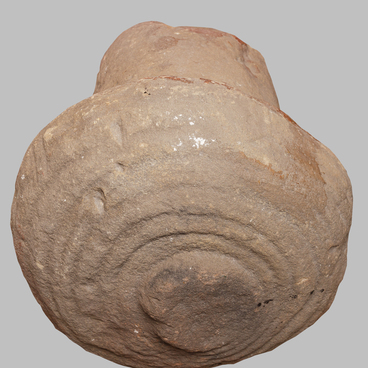
The stopper features a petroglyph carved in the form of a spiral. It was made rather for a magical than for an aesthetic purpose. This is a rare find for the monuments of the Bronze Age, since dolmen stoppers were rarely adorned with carved patterns.

The majority of dolmen stoppers were lost in the 19th and 20th centuries. Experts believe that about a third of all dolmen structures have survived to this day.
#3
Наименование: Dolmen stopper
Дата создания: the 2nd millennium BC
Техника: gray sandstone; chiseling, cutting, sanding
Размеры: 55×41 cm; head length — 21 cm, shank length — 34 cm
#4
Dolmen stopper
#5
Megalithic monuments are prehistoric structures of large stone slabs that were not mortared with cement or lime mortar. Similar structures are found all over the world. For example, in Europe it is Stonehenge in England, Carrowmore in Ireland, the Cromlech of the Almendres in Portugal; in Asia Minor the temples of Göbekli-Tepe and Nevalı Çori; in South America Machu Picchu, Puma Punku, Ollantaytambo, Pisac, Sacsayhuaman, Tiwanaku. No accounts of the methods used to build megaliths or information about their purpose have survived to this day.

In the forests of the Black Sea coast of the Northwest Caucasus, unique monuments of a distant era — dolmens — are hidden from human eyes. These are stone houses with a small round entrance. Usually they are made of slabs and stand separately. Dolmens are full of secrets that researchers have yet to discover. Specialists who study dolmens attribute them to burial structures erected for the most respected representatives of a clan or tribe. The things that the deceased might need in the afterlife were placed in the dolmen along with a dead body. The world of the dead was closely connected with the world of the living, and the burial places were treated with great awe and respect.

A special hole was made in the front plate of the dolmen, which could serve both for additional burials and for placing gifts for the ancestors, which, as it was believed, could help with a good harvest or protect from enemies. After the ceremony, the hole in the dolmen was closed with a stopper (plug).

The Gelendzhik Museum presents one of these stoppers. Its surface has been carefully processed. The head and shank have notches — traces of wedge-shaped tools in the form of notches, which allows researchers to suggest how sandstone was processed in the Bronze Age to create such impressive structures. At the base of the head, there is a rim. Most likely, this element allowed the stopper to fit more tightly into the hole of the facade slab.

This dolmen stopper was discovered by T.A. Zinovieva, the head of the museum’s modern history department, in June 2001 in the area of the Myagkaya Schel near the preserved slab dolmen with a cracked front slab. A.B. Grigoriev, a researcher of the Department of Ancient History, estimated the time of creation.
#6
Наименование: Dolmen stopper
Дата создания: the 3rd–2nd millennium BC
Техника: sandstone, pecking (handmade, chisel)
Размеры: 31×45 cm; head length — 15 cm, shank length — 30 cm
#7
Ritual stone
#8
Dolmens of the West Caucasus are ancient stone burial structures belonging to the category of megaliths. They are common from Anapa to Ochamchire in Abkhazia. Most of the dolmens have a rounded hole in the front wall, which is closed with a stone plug. Archaeologists attribute these structures to the Bronze Age.

Near the dolmens, a large number of stones make up the so-called dolmen courtyard. In ancient times, various rituals venerating the ancestors were performed there. People believed that both worlds — this world and the other world — are connected to each other. Leaving a dead body unburied was considered the most terrible punishment: in this case, the deceased person was unable to proceed to the afterlife, and their soul was doomed to eternal torment. If the rites were followed, then the person continued his existence in the afterlife and could influence the world of the living. Dead ancestors became the clan’s protectors and could communicate with gods and spirits on behalf of their descendants, helping the latter solve their problems. To ensure this, various offerings were made, which were placed both inside the dolmen and next to it in specially designated places.

In 1967, during a scientific expedition, the museum’s employees found a ritual stone, an “altar”, in one of the dolmen courtyards. Most likely, it was designed for such offerings. The “altar” was found on the right bank of the Zhane River, 10 km east of Gelendzhik, on the territory of the Zhane I dolmen group. It is made of sandstone, the most durable stone found in the Northwest Caucasus. Sandstone was much less hard than marble and granite, which is why it was actively used for building various structures even in ancient times. As a rule, bronze or stone tools were sufficient for processing sandstone. The ritual stone is dated to the 2nd millennium BC.
#9
Наименование: Ritual stone
Дата создания: the 2nd millennium BC
Техника: sandstone, cracking, cutting, sawing, polishing
Размеры: 32×79×40 cm
#10
Slab dolmen stopper
#11
All researchers consider dolmens to be burial structures. In many dolmens, the remains of people, animals with attributes of ritual burials were found.

The study of dolmens in the Caucasus officially started in 1818. That year, the geographer K. Tausch and the Frenchman, who served in the Russian army, Tebu de Marigny, discovered and described a group of dolmens in the Pshada River basin. Later, the Pshada dolmens were described in more detail by the director of the Kerch Museum, Anton Baltazarovich Ashik. The first systematization of the Caucasus dolmens was carried out by the Caucasian ethnographer Leonid Ivanovich Lavrov. And one of the most prominent researchers of dolmen culture is Vladimir Ivanovich Markovin.

Dolmens still attract the attention of researchers and raise many questions among scientists. How and where did the builders extract huge blocks of sandstone of the required size? How were these heavy blocks transported to the place of construction? What tools were used to process stone blocks? How did they make sure that the block would fit perfectly? How were the relief patterns made? Why was such advanced technology not used in the construction of houses? There have been no answers yet, but scientists formulate various hypotheses.

The study of dolmen parts allows researchers to understand how these structures were built and what function the hole in the dolmen’s facade slab performed. The Gelendzhik Museum has a collection of plugs (stoppers) used in ancient times to seal holes in the front chambers of dolmens. The size of each plug is unique: it was created for a specific structure and did not fit any other dolmen. In its own way, it was an ancient “key”.

The stopper with the “cross” petroglyph entered the museum in 2009. It was donated by the head of an archaeological expedition, Viktor Anatolyevich Trifonov. The plug was discovered during excavations of the Rastegaev dolmen group in the valley of the Achibs River in the village of Vozrozhdeniye.

Perhaps the “cross” is a symbol of a seal, used for “sealing” the entrance to another world. Such images are rare for the dolmen monuments of the Northwest Caucasus. Unlike the builders of the Egyptian pyramids, dolmen builders rarely decorated their structures.
#12
Наименование: Slab dolmen stopper
Дата создания: the second half of the 3rd millennium BC
Техника: grey sandstone, pecking (handmade, chisel)
Размеры: 42×59 cm; shank length — 40 cm, shank diameter — 27 cm
#13
read morehide
00:00
00:00
1x

Dolmen stopper, Dolmen, Stone, Stopper

0
Point your smartphone camera to open in the app
Share
VkontakteOdnoklassnikiTelegram
Share on my website
Copy linkCopied
Copy
Open in app
To see AR mode in action:
  1. Install ARTEFACT app for 
  2. iOS or Android;
  3. Find and download the «Paintings in Details» exhibition
  4. Push the «Augmented reality» button and point your phone's camera at the painting;
  5. Watch what happens on your phone screen whilst you flip through the pictures.
 
We use Cookies
Cookies on the Artefact Website. We use cookies to ensure that we give you the best experience on our website. If you continue without changing your settings, we'll assume that you are happy to receive all cookies on the Artefact website. However, if you would like to, you can change your cookie settings at any time.
Learn more about useHide
Content is available only in Russian

X

Нашли опечатку?...

%title%%type%