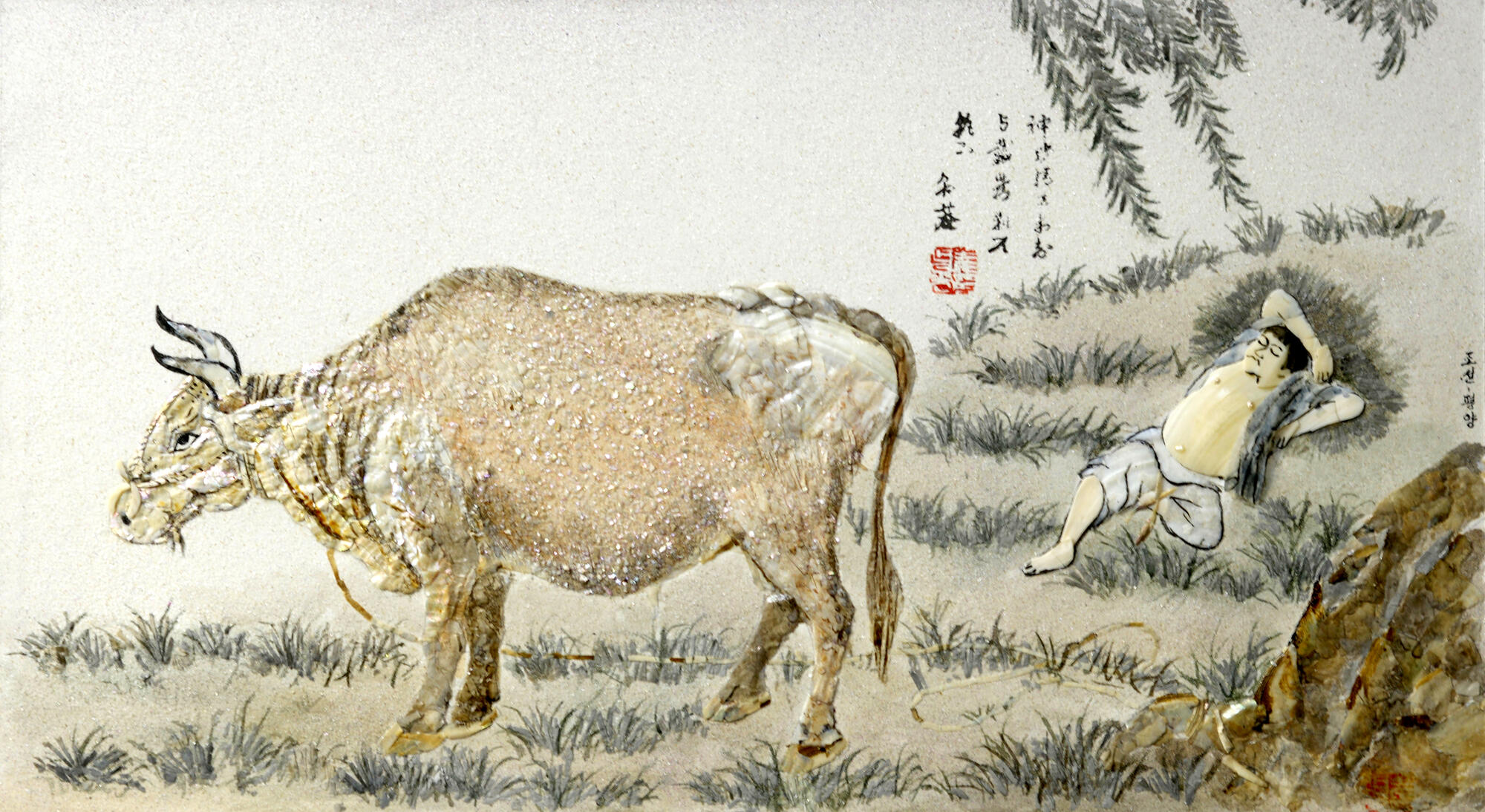


The painting is an application on a plot, copying the work of the Korean painter of the 18th century Kim Du Ryan, who did a lot to convey the village life in a realistic manner. His painting ‘Oxman’, depicting the real life of a peasant, is characterized by simplicity and clarity, concise and clear way of depicting. This artist belonged to the style of Korean ‘realistic landscape’, which was experiencing the heyday of everyday life genre.
The applique depicts an ox grazing in a clearing and a shepherd stretched out on the grass, sleeping with his leg tucked in and his hand over his head. He is dressed in light knee-length short pants and a vest unbuttoned at his chest. The day is, apparently, summer and hot, the sun got the shepherd drowsy. The ox stands motionless, its side shimmers with dots glowing in the sun. At the top, closer to the center, are the hieroglyphs and the artist’s red seal. The picture is inserted into a white passe-partout in a frame, on the reverse side it is sealed with paper.
The applique is made using the “najon chilgi” technique. This is the traditional Korean art of mother-of-pearl and varnish decoration. Mother-of-pearl it is the inner layer of shells of various mollusks, its color resembles gentle iridescent tints of different shades. Pearls are formed only in those shells whose mollusks can secrete mother-of-pearl.
This material has miraculously passed through the centuries from antiquity to the present day. In the early Christian catacombs, archaeologists discovered many mother-of-pearl amulets that warded off the spell of evil forces from a person, attracting patron spirits to him. Processing of mother-of-pearl came to Europe after the Crusades. Artisans began to make bowls and cups framed with gold and silver, jewelry, buttons, cufflinks, and purses from it.
First, the master carefully prepared the material for inlay, then cut the mother-of-pearl into plates and, using special tools, gave them different shapes. In the next step, he applied them to flat material or specially prepared recesses and covered them with a thick layer of varnish. In ancient times in the East the shell was immersed in tea to enhance the iridescence.
Currently, Korean museums exhibit luxurious inlaid objects from different eras. Products made of papier-mâché and wood, decorated with mother-of-pearl figurines, are sold in shops and small trades. Everyone can choose a piece of furniture, a jewelry box, chopsticks and other souvenirs.
The work was purchased at the exhibition “Decorative and Applied Arts of the DPRK”, held in the Amur Regional Museum of Local Lore in April 1990.
The applique depicts an ox grazing in a clearing and a shepherd stretched out on the grass, sleeping with his leg tucked in and his hand over his head. He is dressed in light knee-length short pants and a vest unbuttoned at his chest. The day is, apparently, summer and hot, the sun got the shepherd drowsy. The ox stands motionless, its side shimmers with dots glowing in the sun. At the top, closer to the center, are the hieroglyphs and the artist’s red seal. The picture is inserted into a white passe-partout in a frame, on the reverse side it is sealed with paper.
The applique is made using the “najon chilgi” technique. This is the traditional Korean art of mother-of-pearl and varnish decoration. Mother-of-pearl it is the inner layer of shells of various mollusks, its color resembles gentle iridescent tints of different shades. Pearls are formed only in those shells whose mollusks can secrete mother-of-pearl.
This material has miraculously passed through the centuries from antiquity to the present day. In the early Christian catacombs, archaeologists discovered many mother-of-pearl amulets that warded off the spell of evil forces from a person, attracting patron spirits to him. Processing of mother-of-pearl came to Europe after the Crusades. Artisans began to make bowls and cups framed with gold and silver, jewelry, buttons, cufflinks, and purses from it.
First, the master carefully prepared the material for inlay, then cut the mother-of-pearl into plates and, using special tools, gave them different shapes. In the next step, he applied them to flat material or specially prepared recesses and covered them with a thick layer of varnish. In ancient times in the East the shell was immersed in tea to enhance the iridescence.
Currently, Korean museums exhibit luxurious inlaid objects from different eras. Products made of papier-mâché and wood, decorated with mother-of-pearl figurines, are sold in shops and small trades. Everyone can choose a piece of furniture, a jewelry box, chopsticks and other souvenirs.
The work was purchased at the exhibition “Decorative and Applied Arts of the DPRK”, held in the Amur Regional Museum of Local Lore in April 1990.