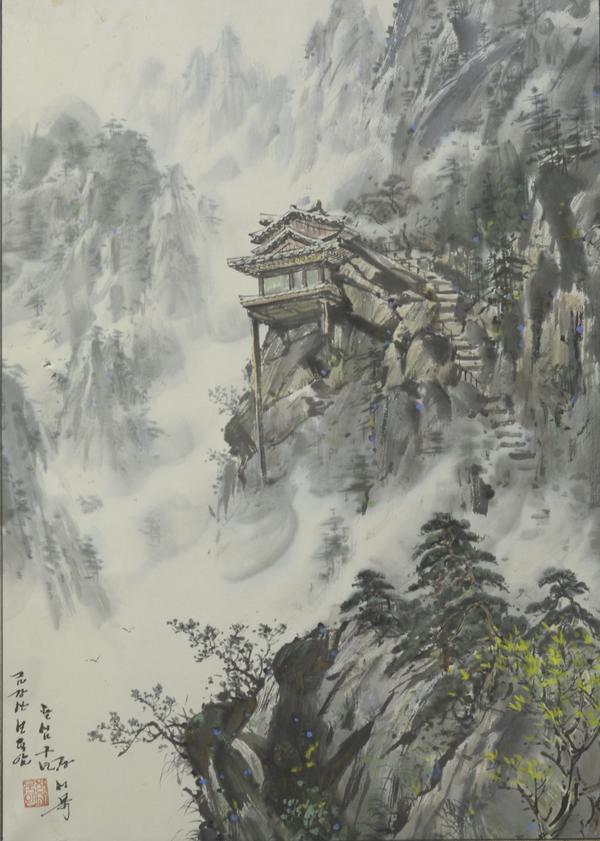
The Diamond mountains depicted on the scroll begin south of Wonsan and lengthen for many kilometers south towards the border with South Korea. This is one of the main natural treasures of North Korea.
The peaky mountains depicted in the scroll are painted using the watercolor technique, which has been used in the East for almost a thousand years and combines the nature of painting and graphics. The artist very realistically conveys the air filled with moisture, and against the background of fog, somewhere bright with clear lines, we see an object that we immediately pay attention to — a three-story pagoda, located on a rock, surrounded by rare trees and bushes. In the dense fog, the steps carved out of stone are barely visible. The rocks look austere and cold, even small deciduous and coniferous trees do not soften the general impression of hermitry, prayer and silence.
There were legends that pagodas could heal from various diseases, and made their owners invisible to invaders, thereby protecting them. In Asian tales, pagodas were mentioned as places for the ‘reeducation’ of evil spirits.
Korean graphic arts have their own characteristic features, it is very difficult to confuse them, since the way of creating a drawing on a canvas is very peculiar. Artists paint their works on silk, but sometimes they also use thin paper. In this technique, the author of the work must make sole clear lines. To accentuate the shadows and contours, they are painted with black paint. To make the image bright and saturated, artists use green paint.
There are many talented authors in Korean art, their paintings are distinguished by skill and a sense of style that can be noticed even by an amateur. The Korean graphic school has an unrivaled sense of space. To achieve this effect, artists use short and quick strokes to create a single, clean line that blends with delicate colors. All this conveys the spirit of emotional perception of nature and traditions of the Korean people.
At the bottom left of the painting there is an inscription in hieroglyphs in two columns and a red seal, traditionally showing that the painting belongs to the author.
The ‘Diamond Mountains’ painting was acquired by the Amur Regional Museum of Local Lore in 1989 from Pak Zon Sen, who was a representative of the North Korean ‘Vneshtorg Rynrada’ trading company.
The peaky mountains depicted in the scroll are painted using the watercolor technique, which has been used in the East for almost a thousand years and combines the nature of painting and graphics. The artist very realistically conveys the air filled with moisture, and against the background of fog, somewhere bright with clear lines, we see an object that we immediately pay attention to — a three-story pagoda, located on a rock, surrounded by rare trees and bushes. In the dense fog, the steps carved out of stone are barely visible. The rocks look austere and cold, even small deciduous and coniferous trees do not soften the general impression of hermitry, prayer and silence.
There were legends that pagodas could heal from various diseases, and made their owners invisible to invaders, thereby protecting them. In Asian tales, pagodas were mentioned as places for the ‘reeducation’ of evil spirits.
Korean graphic arts have their own characteristic features, it is very difficult to confuse them, since the way of creating a drawing on a canvas is very peculiar. Artists paint their works on silk, but sometimes they also use thin paper. In this technique, the author of the work must make sole clear lines. To accentuate the shadows and contours, they are painted with black paint. To make the image bright and saturated, artists use green paint.
There are many talented authors in Korean art, their paintings are distinguished by skill and a sense of style that can be noticed even by an amateur. The Korean graphic school has an unrivaled sense of space. To achieve this effect, artists use short and quick strokes to create a single, clean line that blends with delicate colors. All this conveys the spirit of emotional perception of nature and traditions of the Korean people.
At the bottom left of the painting there is an inscription in hieroglyphs in two columns and a red seal, traditionally showing that the painting belongs to the author.
The ‘Diamond Mountains’ painting was acquired by the Amur Regional Museum of Local Lore in 1989 from Pak Zon Sen, who was a representative of the North Korean ‘Vneshtorg Rynrada’ trading company.