Font
Color
Graphics
Изображение точки

To see AR mode in action:

1. Install ARTEFACT app for iOS or Android;

2. Find the exhibition «The fascinating natural world of Kuzbas»

3. Push the «Augmented reality» button and point your phone's camera at the exhibit;

Скрыть точки интересаПоказать точки интереса
Показать в высоком качестве

The mallard, The great crested grebe, The elk

0
Open in app
#4
The mallard, The great crested grebe, The elk
#7
Author unknown
The mallard
#9
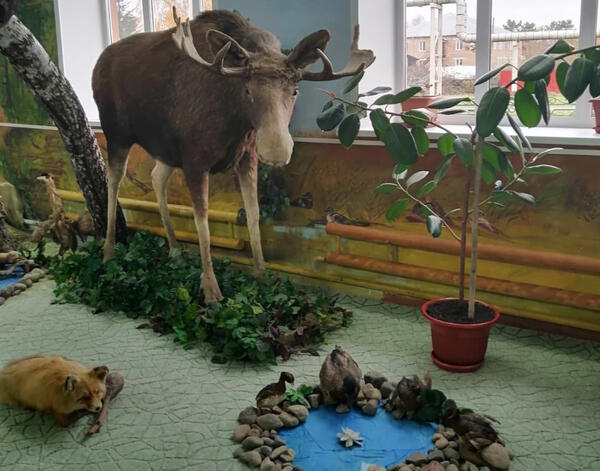
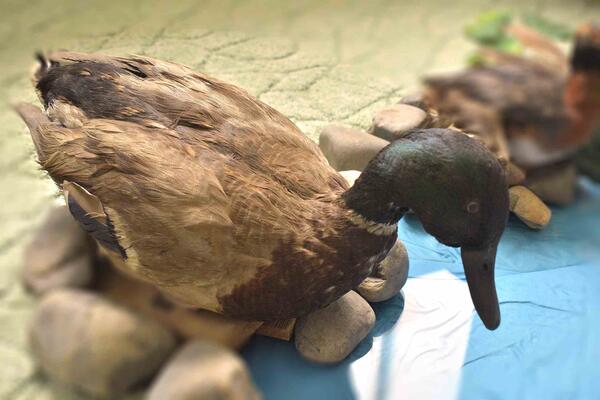
The mallard is the largest and most ubiquitous duck. This bird adapts to any natural environment so well that one can come across it on all the continents with the exception of the Antarctic. Mallards inhabit various water bodies with fresh, brackish or saline water. However, they do avoid lakes with completely bare shores, mountain rivers and other streams with a fast current. One can often encounter these birds in an urban environment. And if ponds and canals do not freeze, mallards remain in them even during colder seasons. The male is easy to spot owing to the distinctive colors of its plumage. It has a green head and neck, while the female’s body is uniformly chestnut brown. During the mating season, the male’s beak is an ochre-olive color, often yellow at the tip. The female’s bill is usually dark grey with orange edges, and there are always several black spots at its base. 
 
Mallards are not picky eaters, they are capable of adjusting their diets according to the conditions in the surrounding environment. They primarily eat aquatic plants, small invertebrates, insects, shellfish, tadpoles, crustaceans and even frogs at times. They feed in shallow waters. A plate of hard horny tissue in its beak helps it filter food. Mallards often raise their lower bodies and tails up while in a water body in order to reach plants at the bottom of it. 
 
Typically, mallards build their nests near the water and hide them really well in dense bulrush or reeds, under trees and bushes, and among wind-fallen trees and brushwood. Outside of the mating season, these birds stay in their flocks, which can consist of several hundred mallards. On land, they appear awkward because of their characteristic walk and slow movements. But if these birds sense danger, they quicken their pace substantially and disappear among dense vegetation as fast as possible. An injured mallard is capable of diving and swimming dozens of meters under water in order to escape. In the wild, its enemies include various predators. Eagles, falcons, Eurasian otters and reptiles all hunt these birds. Many of their eggs do not survive after the nest is attacked by dogs or foxes. The number of mallards has not reduced significantly in the wild owing to these birds’ ability to adapt their diet and lifestyle to surrounding conditions.
#8
Date: The end of the 20th century
Technique a stuffed bird
Collection: Natural science
Copyright: Promyshlennovsky District Museum of History and Regional Studies
Dimensions: 34*42*19
Goskatalog Number: 24178944
#10
Author unknown
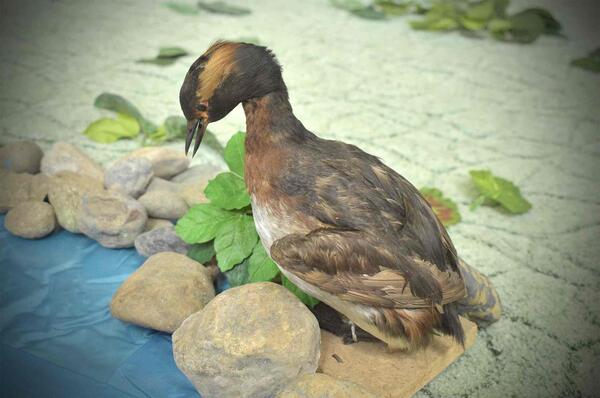
The great crested grebe
#12
The great crested grebe is common to practically all the regions of Eurasia. Its natural habitats include lakes and ponds. The bird uses water bodies with a large amount of vegetation, i.e. reeds and bulrush, as its breeding grounds. It is important for it that there are slow or no currents in these water bodies. 
 
Great crested grebes primarily eat fish. In addition, they also consume frogs, shellfish and aquatic insects.
These birds have an excellent eyesight. They can spot a fish swimming deep in the water and dive in, moving only their feet, with wings held at their sides to depths of up to 4 meters. 
 
The mating season of great crested grebes starts in April through May. Both males and females grow new feathers during this period, and tufts appear on their heads. They also have spectacular dark orange or cherry-burgundy ruffs around their necks during the breeding season. 
 
At such times of the year, females cry out loudly, thereby attracting males towards them. Potential partners approach these females with presents, such as freshly caught fish, which the latter eat immediately. Females choose their partners during a dance ritual. Afterwards, each pair begin building their nests using vegetation available in the water body. The male takes on a more active role during the construction. It brings materials necessary for building the nest, i.e. bits of bulrush, twigs, aquatic weeds and leaves. The couple try to construct their abode closer to bulrush. The floating nest has to be sufficiently sturdy and spacious. 

The female lays up to 7 snow white eggs. If a threat arises, it hastily covers up the nest with plants before leaving it. In 27 to 29 days, the eggs hatch. The barely dry newborns then leave their nest. They are able to swim and dive well in the first days of their lives. Their striped pre-pubescent plumage helps them hide among thick reeds. 
 
Parents transport the young on their backs for up to the first three weeks of their lives. Initially, they feed their offspring fish and small aquatic creatures. Ten to eleven weeks later, the young birds require less care and start to become more independent. Under favorable conditions, a pair of great crested grebes can have two clutches a season. 
#11
Date: The end of the 20th century
Technique a stuffed bird
Collection: Natural science
Copyright: Promyshlennovsky District Museum of History and Regional Studies
Dimensions: 24*13*23
Goskatalog Number: 24178940
#13
Author unknown
The elk
#15
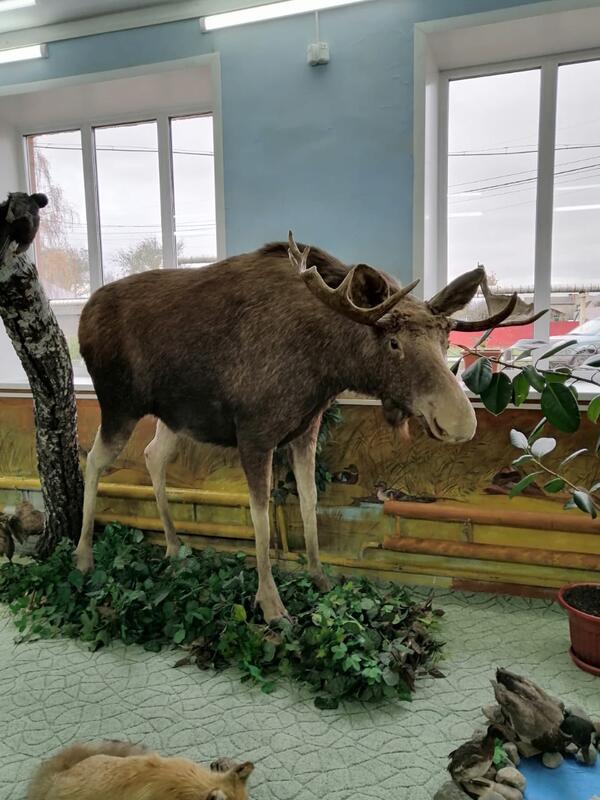
The elk is a hoofed ruminant mammal from the family Cervidae. One distinguishing characteristic is its palmate antlers resembling a ‘sokha’ (a wooden plow). In fact, this animal’s nickname in Russian, “sokhaty”, originates from that word. Its height at the withers can be 2.3 meters, while the length of its body is 3 m. A young elk weighs approximately 300 kilograms, while larger adults can exceed 800 kg. Females are lighter than males, a dainty cow can weigh as little as 200 kilograms. 
 
Elks are good runners. They can reach speeds of 70 km/h. These animals are also excellent swimmers. If the need arises, they can swim up to 20 km at a time and dive to depths of approximately 5 meters, holding their breaths for half a minute. The strike of its front leg is so powerful that it can kill a large animal.
The elk’s outer coat is relatively coarse but the underfur is soft. The animal’s body prepares for the winter well. Its coat grows by about 10 centimeters, and thus prevents the creature from getting cold in winter time. The hairs on its neck and withers is longer than usual, hence, the elk appears to have a mane. 
 
Its antlers are this animal’s pride and joy. They can weigh as much as 20 kilograms, with a spread of almost 2 meters. Usually elks shed their antlers by the beginning of winter. In order to rid themselves of their pride and joy, they actively rub against trees until the antlers fall off. In spring, the animals re-grow new antlers, which harden in July. Elks prefer cool coniferous forests, where there are swampy areas, and small rivers and streams. They feel most comfortable in a forest-tundra because there is a large variety of trees in such regions. These animals enjoy feeding on medium-sized and low shrubs, which is why in winter, they suffer from a lack of suitable food. The elk has eight sizable and sharp incisors on the lower jaw for chewing food. The ruminants only eat plants, thus their teeth are well suited for lengthy mastication of food. They prefer eating grass, bushes, moss, mushrooms and lichen. Elks also enjoy consuming juicy leaves of mountain ashes, birches, maples and ashes. They also like swamp water lilies, kingcups, alligator-bonnets and young sedges. As for grasses, these animals prefer fireweed, willowherbs and sorrels. Their diet also includes berries, i.e. lingonberries and blueberries, and in autumn, tree bark. 
 
In addition, elks consume fly amanitas without any fear. With the aid of these mushrooms, they rid their digestive systems of parasites. The animals mainly eat in the mornings and late in the evenings. In the middle of the day, they often rest in places that are free of bloodsucking insects. Elks live to about 25 years of age, but in the wild, their lifespans are about 10 years.

#14
Date: The end of the 20th century
Technique a stuffed
Collection: Natural science
Copyright: Promyshlennovsky District Museum of History and Regional Studies
Dimensions: 220*40*170
Goskatalog Number: 24200896
read morehide

The mallard, The great crested grebe, The elk

0
Point your smartphone camera to open in the app
Share
VkontakteOdnoklassnikiTelegram
Share on my website
Copy linkCopied
Copy
Open in app
To see AR mode in action:
  1. Install ARTEFACT app for 
  2. iOS or Android;
  3. Find and download the «Paintings in Details» exhibition
  4. Push the «Augmented reality» button and point your phone's camera at the painting;
  5. Watch what happens on your phone screen whilst you flip through the pictures.
 
We use Cookies
Cookies on the Artefact Website. We use cookies to ensure that we give you the best experience on our website. If you continue without changing your settings, we'll assume that you are happy to receive all cookies on the Artefact website. However, if you would like to, you can change your cookie settings at any time.
Learn more about useHide
Content is available only in Russian

X

Нашли опечатку?...

%title%%type%