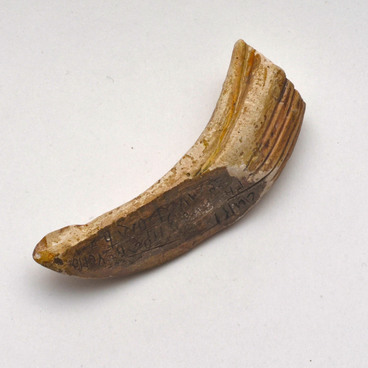
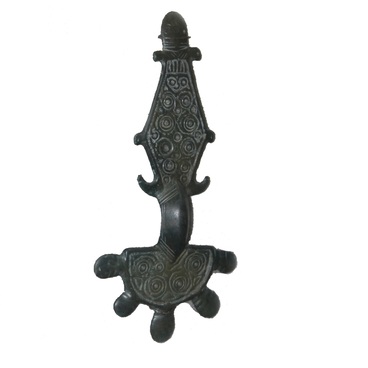
Temple rings were one of the most widespread types of jewelry in ancient times. They were generally fixed to the headdress using ribbons or straps. Sometimes they were hooked directly to the headdress fabric, braided into hair or threaded via piercings in earlobes, like earrings. However, such ways of wearing them were less common, and earrings were not widespread among the Slavs: they were worn only by those who were familiar with foreign traditions.


Temple rings, Coin Pendant, Pendants
Creation period
X–XIII century
Technique
Бронза, латунь, серебро, литье, чеканка, ковка
Collection
Exhibition
0
Open in app#1
Temple rings
#2
#3
Some women wore whole cascades rather than pairs of Temple rings. They were fixed to a ribbon so as to make a long chain that could come all the way down to the shoulders. Rings were sometimes supplemented by small charms, such as bells or coins.
#4
During the Middle Ages, such type of jewelry was popular in Byzantium and Western Europe, but it was most common among the Slavs. The shape of the rings differed from tribe to tribe. Rings with three beads were worn by the Dregoviches, twisted spirals by the Severians, sickle-shaped ones with tied-up ends by the Kriviches.
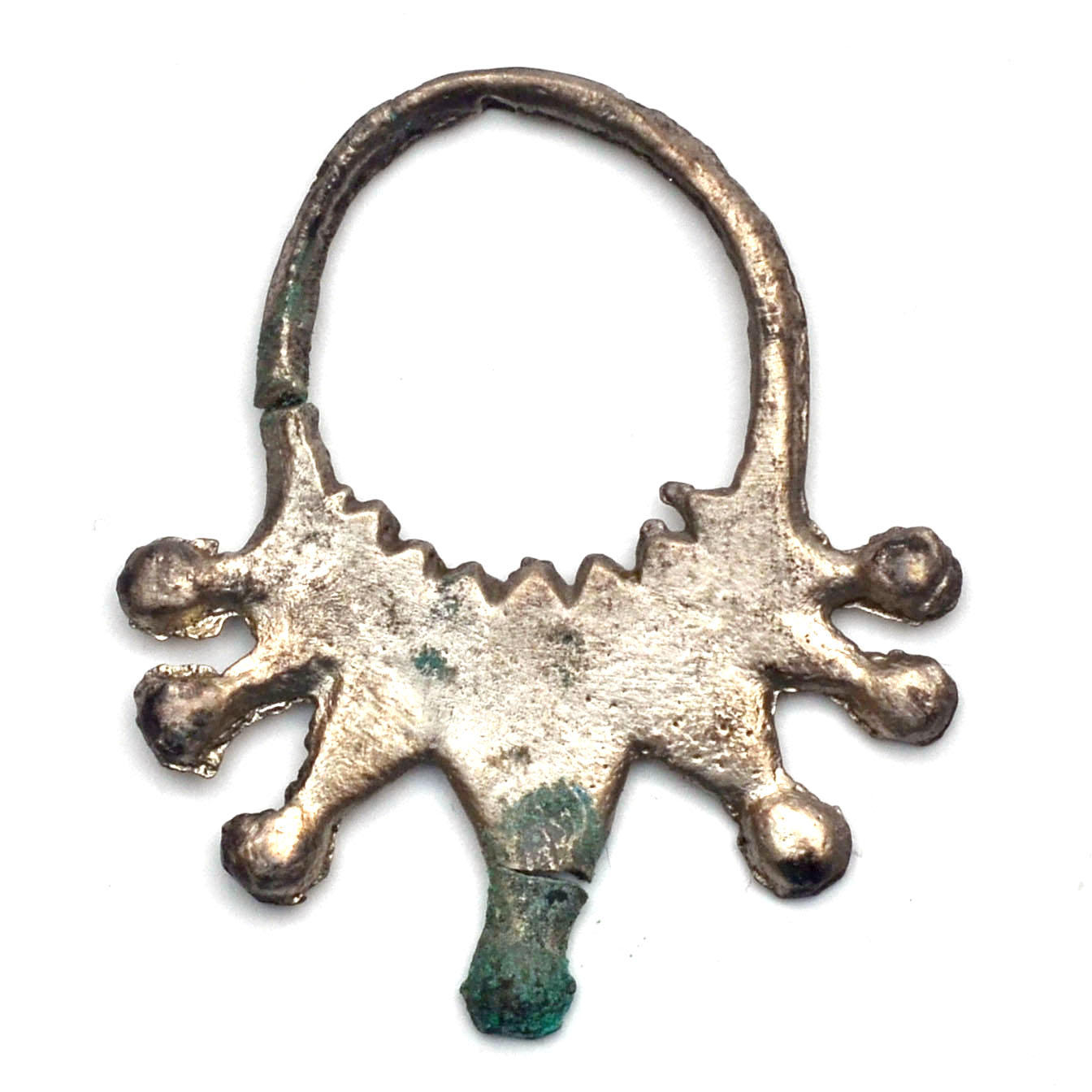
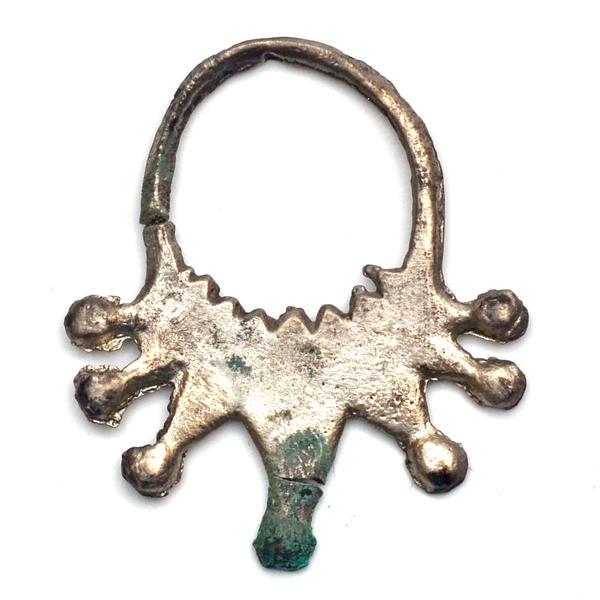
Seven-rayed temple rings were preferred by women from Radimichi tribe that lived on the territory of modern Kursk and Bryansk Regions. The first jewelry items of this type were found on Desna river bank in 1886. Since then, archaeologists have been calling this type of rings ‘Desna rings’.
#5
Like most other jewelry items, temple rings were considered to be charms that protected a woman from evil forces, helped her to be happy in her family life and give birth to healthy children. Teenage girls, who were too young to get married, usually did not wear such rings or wore very simple ones made of wire. Young unmarried and married women, by contrast, heavily decorated their headdresses with intricate metal jewelry. The older a woman became, the fewer rings she wore on her temples. Mothers passed down their jewelry to their daughters.
#6
Temple rings exhibited in Bryansk Local History Museum are cast from brass, an alloy of copper and tin. They were made between the 11th and 13th centuries. The rings’ outer edges are decorated with seven pointed blades, each of which has a ball on its tip. Their inner edges have seven small triangular-shaped points. The ring’s hoop is not solid, it has an opening, where there might have been a lock or the ring was attached directly to headdress edges.
#7
#8
Byzantine Coin Pendant
#9
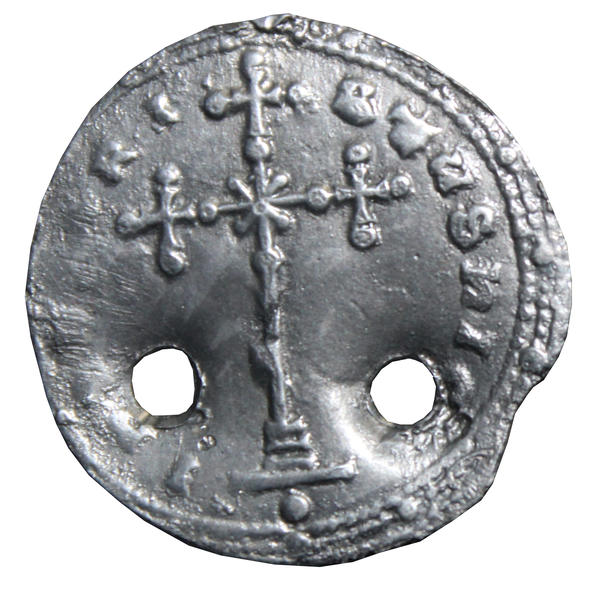
This silver coin pendant with two holes was found in a burial mound near Kvetun village, Bryansk Region. It was the area of Russia’s second largest Slavic necropolis containing over 260 graves. After World War II, Kvetun burial mounds were explored by archaeologists from the city of Trubchevsk. They were headed by Vasily Padin, director of Trubchevsk Museum of Local History. The excavations of 145 burial mounds yielded artefacts dating back to the 10th – 13th centuries.
#11
Women’s graves were particularly rich: Radimichian and Severian temple rings, finger rings, bracelets, brooches, beads made of glass and precious stones were found there. Men were buried more modestly: archaeologists found mainly metal belt buckles decorated with plates, weapons and tools.
The silver Byzantine miliaresion was found in the grave of a middle-aged woman buried according to the Christian rite. Her neck was adorned with a necklace made of small multi-colour beads and larger gilded glass beads. The coin was attached to it as a pendant with two bronze rings.
#12
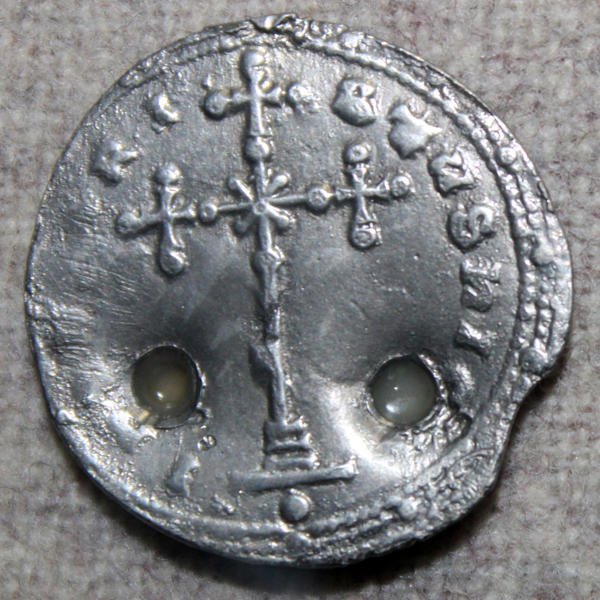
Byzantine Coin Pendant (front side).
#10
Byzantine money was available in Russia in the 9th – 12th centuries, but it was rarely used for payments. In most cases, gold, silver and copper coins were made into pendants for jewelry. They were also worn instead of cross pendants worn next to the skin, as such coins were minted with Christian symbols on the obverse (front side).
#13
The miliaresion found at Kvetun burial ground was made during the times of Constantine VII Porphyrogenitus. The emperor held the Byzantine throne twice — from 913 to 920 and from 945 to 959. At the time of his first coronation, Constantine was only 8 years old, and Patriarch Nicholas Mystikos acted as regent for him. In 920, the emperor’s father-in-law, Byzantine naval commander Romanus I Lakapinus, seized the power. Formally, he was declared co-ruler with Constantine. It was not until 25 years later that Porphyrogenetus ascended to the throne again.
#14
The silver coin from Kvetun burial ground shows almost no signs of wear. It helped the archaeologists to determine that the coin’s owner was buried no later than the last third of the 10th century.
#15
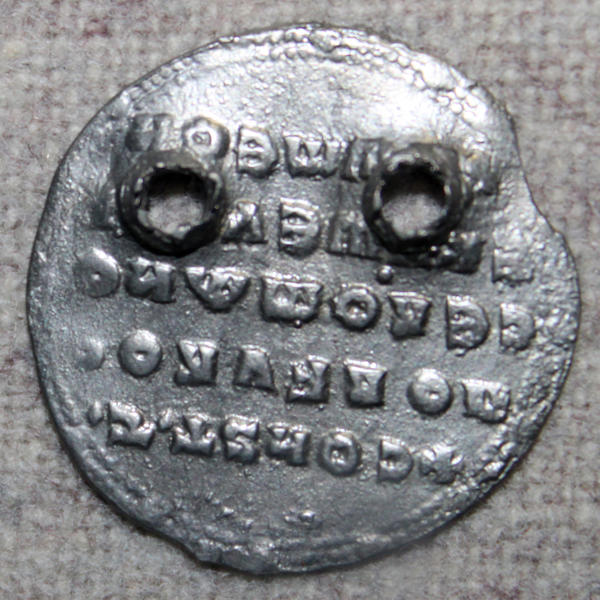
The chased inscription on the other side – the reverse
#16
The obverse of the miliaresion featured a trefoil Christian cross.
#17
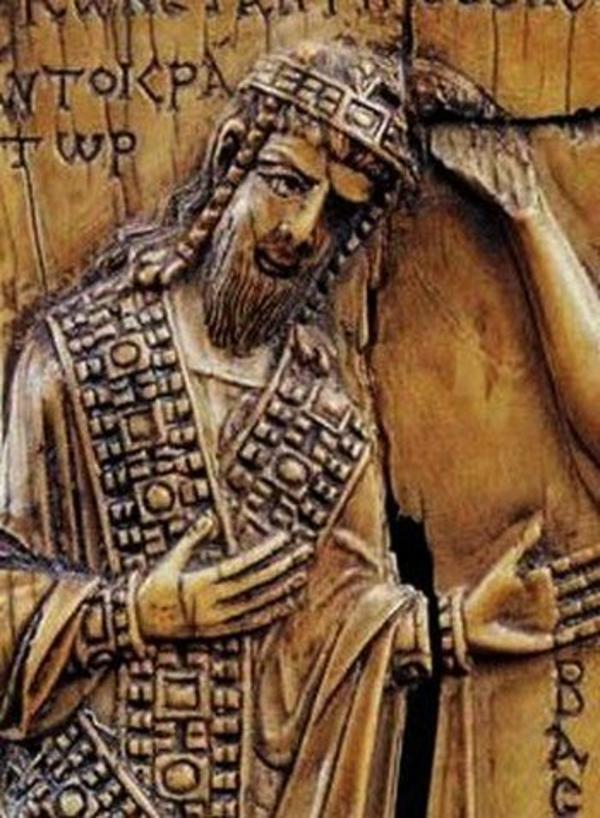
Portrait of Constantine VII Porphyrogenitus. Bone, carving, 945 A.D. Source: wikimedia.org
The chased inscription on the other side – the reverse – read ‘Constantine Porphyrogenitus and Caesar Romanus, in Christ, faithful basileuses of the Romans.’ The word ‘basileus’ meant ‘royal’, the title used by Byzantine emperors. Byzantines referred to themselves as ‘Romans’.
#18
The inscription on the coin had a small cross in front of it used according to the Christian tradition to indicate blessings conferred upon those mentioned in the inscription.
#19
#21
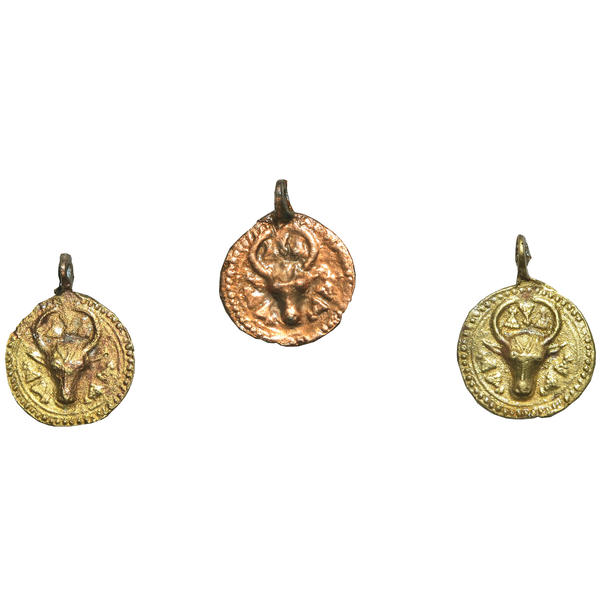
Pendants with an image of a bull head
#22
Archaeologists have found these round pendants depicting a bull’s head in the barrows of the Radimichs tribe. Such decorations served as additions to necklaces or temple rings; both men and women could wear them.
#23
The early Slavs revered the bull or aurochs as the embodiment of Perun - the presiding deity, the god of thunder and lightning.[1]. The bull also symbolised courage, virility, and fertility. Its horns were considered strong amulets from enemies, diseases, and poisons, which is why they were used to produce drinking vessels, knife handles, and bows. Women believed that amulets with the image of a bull’s head helped to give birth to healthy sons.
#24
Pendants were cast from brass – an alloy of copper and zinc – that was more durable than fine metal. In Rus, zinc was not mined: in those days it was bought from Scandinavian and Baltic tribes. The image was minted using special tools on finished pendants.
On such jewellery, the bull head occupies the entire centre of the circle. It is larger than the rest of the symbols. It was usually depicted with rather high level of detail: on each piece, the outlines of the bull neb, convex eyes, nostrils, and long horns are clearly visible. On the forehead there is a symbol in the shape of a double triangle, which is turned upside down.
#25
Along the edge, the pendants are decorated with faux granules - small half-spheres of brass wire. Historians have suggested that the number of balls corresponds to the number of weeks in a year.[2] A small loop on the top was meant for a metal ring or a cord to put through.
#28
Ancient craftsmen depicted seven female silhouettes around the bull head on the pendants. The figures are located randomly on the suspension field: some are alongside of the bull, others are between its horns, and one of the silhouettes is turned upside down.
#29
The archaeologist Boris Rybakov suggested that such pendants schematically depicted the ancient rite of turitsa, which was common among the South Slavic and Belarusian tribes. A holiday in honour of the aurochs was held in winter (around mid-January according to the modern calendar). On that day, young men used to dress up as bulls and perform special rituals symbolising fertility and health.
#30
#31
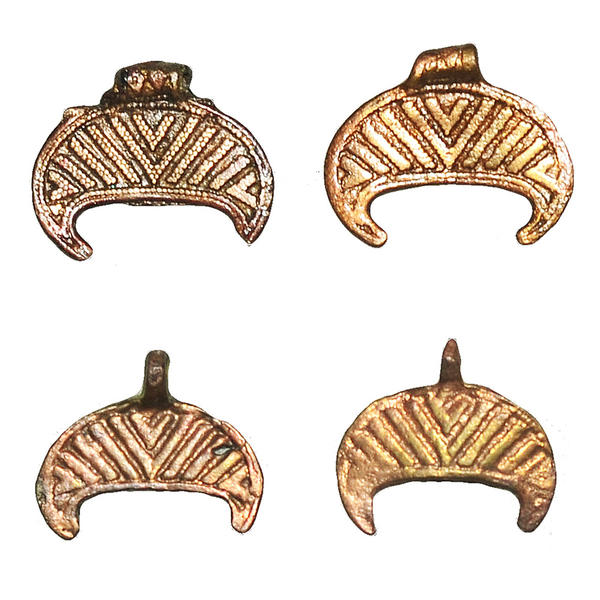
Lunula pendants and solar symbols
#32
Bryansk State Regional Ethnography Museum holds the collection of pendants with symbolic figures of the Sun and the Moon. In ancient times, they were considered averters for Slavic women. They often decorated necklaces, headgear and temple rings, sometimes they were worn as earrings. Archeologists used to find sets of 10-13 pendants in burial mounds.
#33
Fyodor Zavernyayev, and archeologist and local studies expert, passed the collection to the museum. He found all of those pendants in 1970-s during excavations of burial mounds near Peklino village of Dubrovsky district of Bryansk region. Zavernyayev determined that the pendants were made during the period of 10th – 12th centuries. In those times, Russian people became Christians, but continued some of the pagan practices: they could be wearing simultaneously ancient amulets and medallions depicting saints.
#34
Archeologists also found some other bronze jewelry in Peklino burial mounds: bracelets, necklaces, rings, clothes claspers. All of them were made during the 11th – 13th centuries. The archeologists delivered them to museum collections of Bryansk region.
#35
The crescent-shaped pendant with horns looking down was called lunula. It was considered a powerful averter for women symbolizing fertility. Lunula pendants could be of various shapes and sizes. The most popular ones in Bryansk region were cast pendants with broad ‘horns’. They were decorated with geometric ornament symbolizing the ploughed land. Some lunula pendants have granulation work — decorations of small globules. They were rolled manually from wire and then soldered to the pendant.
#36
After Christianization of Ancient Russia, women started wearing lunula pendants as symbols of Virgin Mary. Sometimes such averters carried the image of cross. Virgin Mary was worshiped as the patroness of the human race. In their prayers, women asked her for the wellbeing of their families, about giving birth to healthy children and about healing of the sick.
#37
Round pendants depicted the Sun, which was considered the symbol of light, warmth and life. Both women and men could wear pendants with solar signs. Sometimes children wore them as protection from evil forces, maladies and ill-wishers. Both solar and lunula pendants were decorated with carving and granulation work.
#38
Most often, the pendant amulets were made of bronze, because this was the commonest and the best accessible metal. Archeologists also found items of bronze and silver alloy in burial mounds. Lunula and solar pendants from pure silver were not common: only women from rich and noble families wore them.
#39
State budgetary cultural institution Bryansk State Regional Ethnography Museum
read morehide
00:00
00:00
1x
Temple rings, Coin Pendant, Pendants
Creation period
X–XIII century
Technique
Бронза, латунь, серебро, литье, чеканка, ковка
Collection
Exhibition
0
 Point your smartphone camera to open in the app
Open in app
Share