Font
Color
Graphics
Изображение точки

To see AR mode in action:

1. Install ARTEFACT app for iOS or Android;

2. Find the exhibition «Archaeology of the Kursk Region»

3. Push the «Augmented reality» button and point your phone's camera at the exhibit;

Скрыть точки интересаПоказать точки интереса
Показать в высоком качестве

Temple ring, Ring, Pendant, Fibula

0
Open in app
#1
Temple ring
#6
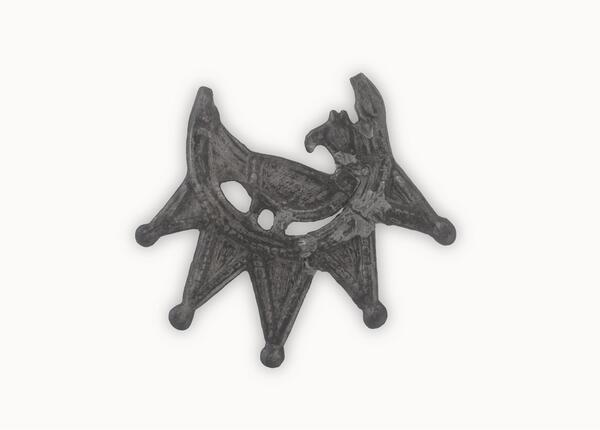
The Kursk Regional Museum of Archaeology keeps a temple ring with the image of a bird. The ring was discovered in the Belovo district of the Kursk region. The ornament was broken into three parts, and part of the bow is missing. Five of the rays have ends in the form of a drop. Relief faux-grain borders along the edge of the rays form inner triangles with a smooth surface. The upper part of the plane in the form of a smooth convex band is decorated with a figure of a bird turned to the right. The head of the bird, turned backwards, has a very curved beak, a large bulging round eye, and a crest in the form of double-toothed “horns”. Its head is in contact with the bow, which has clearly visible bulges at the junction with the bow. The space between the rays and the surface of the wing are filled with scratched lines. The reverse side of the ring is smooth.

In the European part of Russia and Ukraine, along with temple rings with a single bird, there were found rings depicting a pair of birds, facing each other and standing one after the other. The closest analogue to all these scenes is found on the territory of the Byzantine Empire: a single stylized image of an eagle is featured in the upper part of a stamped Byzantine earring from Macedonia. Also, figures of birds of prey with their heads turned back, similar to the images on the rings from Kursk region and Korosten, are depicted on bone plates of the 10th–11th centuries from Chersonesos.

It is likely that early medieval Byzantine art depicted birds not only for aesthetic reasons, but also for symbolic and religious purposes. For example, the eagle represented resurrection and a new life beginning with the baptismal font, as well as the soul of the Christian, which is strengthened through virtue.

The motifs and stylistic techniques of depicting birds on temple rings found on the Slavic monuments of South-Eastern Europe coincide with the samples of Byzantine decorative and applied art of the 6th–12th centuries, so it makes it possible to associate temple rings (including the rings from the Belovo region and Korosten) with the early medieval Byzantine jewelry tradition. This tradition was widespread not only within the Byzantine Empire itself, but also in the lands seized by the Arabs from the Byzantians. When East European jewelers got their hands on these temple rings, they probably used them for secondary castings or as models for jewelry that combined both foreign elements and those that were familiar to their purchasers.
#5
Name: Temple ring
Date of creation: the 9th century
Technique: casting
Dimensions: 4,9×4,3 cm
#7
Ring
#8
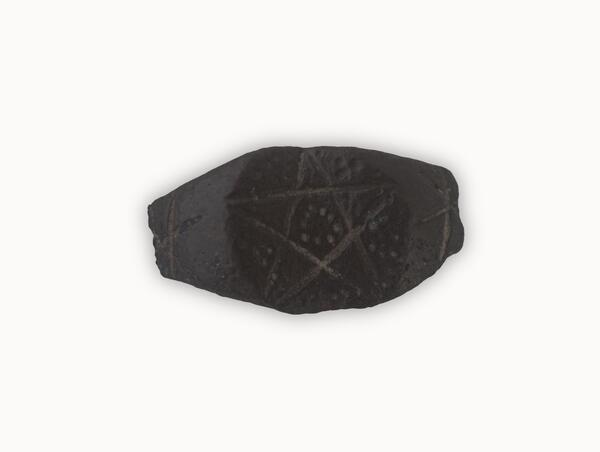
The Kursk Regional Museum of Archaeology presents a fragment of a cast bronze ring from the late 10th — 11th centuries. Four Old Russian rings with an image of a five-pointed star on the plate have been found on the territory of the Kursk region. The length of the preserved fragment is 2.5 mm, the width of the plate is 1.3 mm. An image of a five-pointed star with dots in the middle and on the sides is engraved on the ring plate. Three crisscrossing lines are carved on parts of the ring adjoining the plate.

The symbol of the five-pointed star (a pentagram or pentacle) has been known for a very long time. In the Near Eastern symbolism it was ascribed the properties of protecting from evil forces, and one of the most famous synonymous names of the pentagram was the “Seal of King Solomon”. Perhaps it was from those people of the eastern Roman provinces who embraced the new religion, and in the first place from the Jews, that the five-pointed star came to Christianity and became one of the Christian symbols.

The Kursk historian Andrei Gennadievich Shpilev cites a number of examples of using the pentagram to decorate Christian structures. They include a bas-relief with a five-pointed star enclosed in a circle surrounded by birds and flowers from the 11th century Church of Saints Peter and Moses in Solina (Croatia), as well as a bas-relief with two male figures with halos and a five-pointed star in the middle placed to the right of the entrance to the 12th century Saint-Hilaire Church in Salers-en-Toulon (France).

In Christian symbolism, the five-pointed star is usually associated with the five wounds of Christ, but no less popular is its identification with the Star of Bethlehem, which announced to the Magi the appearance of the Savior and showed them the birthplace of Jesus. It is known that in Christianity there is no established and generally accepted canon for the depiction of the Star of Bethlehem. There are six-ray stars, eight-ray and ten-ray ones, as well as twenty-five-ray stars on artworks and religious objects. If we take a look directly at Bethlehem, we see that the place of the birth of the Savior in the temple of Nativity is marked with a silver star with 14 rays. However, these rays symbolize the number of Stations of the Cross. However, the star of Bethlehem, which adorns Christian churches and monasteries, usually has five rays.
#4
Name: Ring
Date of creation: the late 10th — early 11th century
Technique: casting, engraving
#9
Pendant
#10
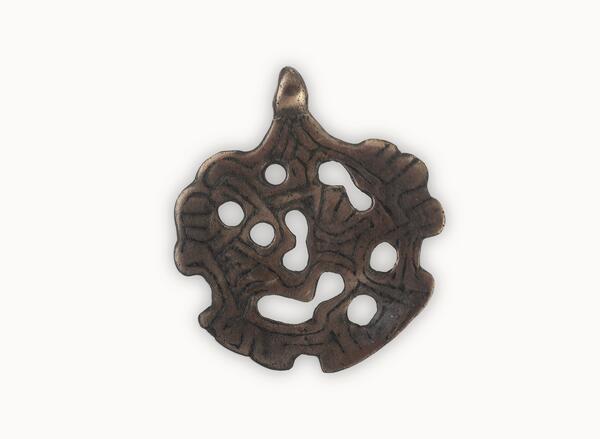
The Kursk Regional Museum of Archaeology holds a pendant dating from the first half of the 11th — the turn of the 12th centuries. It was discovered by Olga Nikolaevna Enukova, an expert in the history of Ancient Rus’, during archaeological excavations on the territory of the Lipinski archaeological complex in the Kursk region in 2001. The ornament was discovered during the sampling of soil from pit No. 70A. The fill consisted of gray layer material, in the lower part of which the remains of a clay oven were traced.

The museum exhibit is a cast openwork bronze pendant that has fully retained its shape, including the eye. The pendant was part of a woman’s costume. As a rule, such things were worn around the neck separately on a lace or as part of a necklace. The ornamental motifs on the piece are also wonderfully preserved: on the obverse there is a clear ornament with a stylized depiction of a beast leaning on a frame with two paws and a mask above the eye.

On the territory of the present-day Kursk region there are a few known finds that are stylistically close to the objects of the Scandinavian circle of antiquities. A typologically similar pendant was accidentally found in the Ratsky archaeological complex in the Kursk region. The ornament on the Lipinski pendant is only an imitation of the above-described find from the Ratsky complex. This is evidenced by both the overall shape of the item, and the similar location of the holes. However, the ornament does not show any connection with the zoomorphic motif of the prototype, it is more reminiscent of Old Russian entrelac design, a type of ancient ornament.

Outside the area of present-day Kursk, artifacts of this type were recorded in 2000 as part of the Kiev hoard, which is dated to the middle — the second half of the 5th century, and in Skemo (Norway). The ornaments from the burial mound No. 78 of the Shestovitsa Graveyard (Chernihiv Region, Ukraine), the Gnezdov Hoard of 1868 (Smolensk Region, Russia), the hoard from Verby (Sweden) and the burials No. 371 and No. 791 of the Birks Graveyard (Sweden) are typologically close. The only difference between these types of pendants is that in one case the animal’s head has no ears, and in the other, by contrast, they are quite large.
#3
Name: Pendant
Date of creation: the first half of the 11th — turn of the 12th centuries
Technique: casting
Dimensions: 3,5×3,2 cm
#11
Fibula with dragon heads
#12
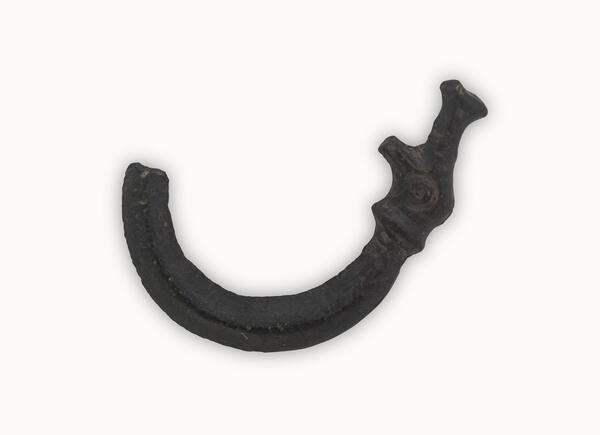
The Kursk Regional Museum of Archaeology displays a fragment of a bronze fibula of the 9th — the late 10th century. It was discovered in the course of archaeological exploration led by the historian and local history expert Gennady Yurievich Starodubtsev near the village of Dukhovets (the Kursk district of the Kursk region).

Fibulas, metal jewelry clasps of various shapes, were common from the Bronze Age to the late Middle Ages. The ends of the fibulas in the museum collection have the shape of dragon heads. The back side of the fibula has a notch formed during casting.

As suggested by the Kursk historian Andrey Gennadievich Shpilev, the voluminous ends of the fibula are stylized dragon heads in profile. The ancient jeweler focused particularly on the open mouth and the huge eye, while the body is represented by a narrow non-ornamented rod of the fibula. The decoration can be attributed to the group of items made in the Scandinavian Jelling style. In the territory of the modern Kursk region the items of the Scandinavian type are extremely rare. Andrey Gennadyevich Shpilev in his article “Ornaments of the circle of ‘Scandinavian antiquities’ from the Kursk region” cites only 22 items, which authentically come from the territory of the region. In his subsequent work another 16 items of this circle of antiquities were introduced into the academic circulation.

After the scientific analysis of the described artifact, Andrey Gennadyevich Shpilev gave an example of another item of a similar type, which was found on the territory of the settlement in the area of Soloven Bugor, located 4 km away from the village of Banishchi in Lgovsky district of the Kursk region. The entire fibula was covered with a thick layer of dark brown (almost black) patina. The heads depicted in profile have a smoothly elongated long nose with a round nostril, a small open lower jaw and large round eyes. The heads are separated from the main part of the fibula by a relief roller. There are no ornaments on the fibula. The back side of the fibula has a notch, formed during casting. Thus, it should be noted that all decorations associated with the Scandinavian descendants could get to the territory of the modern Kursk region after the final inclusion of the Severian Poseimie (the historical area in the Seim River basin, the area of settlement of the Eastern Slavic tribal union of the Severians) into the Old Russian state.
#2
Название: Фибула с окончаниями в виде драконьих голов
Дата создания: IХ — конец X века
Техника: литье
Размеры: 2,6×0,5 см, диаметр сохранившейся части — 26 мм, ширина прута — 5 мм, толщина — 2 мм, длина головы-навершия — 15 мм

Name: Fibula with dragon heads
Date of creation: the 9th — the late 10th century
Technique: casting
Dimensions: 2,6×0,5 cm, diameter of the preserved part — 26 mm, width of the rod — 5 mm, thickness — 2 mm, length of the finial — 15 mm
#13
read morehide
00:00
00:00
1x

Temple ring, Ring, Pendant, Fibula

0
Point your smartphone camera to open in the app
Share
VkontakteOdnoklassnikiTelegram
Share on my website
Copy linkCopied
Copy
Open in app
To see AR mode in action:
  1. Install ARTEFACT app for 
  2. iOS or Android;
  3. Find and download the «Paintings in Details» exhibition
  4. Push the «Augmented reality» button and point your phone's camera at the painting;
  5. Watch what happens on your phone screen whilst you flip through the pictures.
 
We use Cookies
Cookies on the Artefact Website. We use cookies to ensure that we give you the best experience on our website. If you continue without changing your settings, we'll assume that you are happy to receive all cookies on the Artefact website. However, if you would like to, you can change your cookie settings at any time.
Learn more about useHide
Content is available only in Russian

X

Нашли опечатку?...

%title%%type%