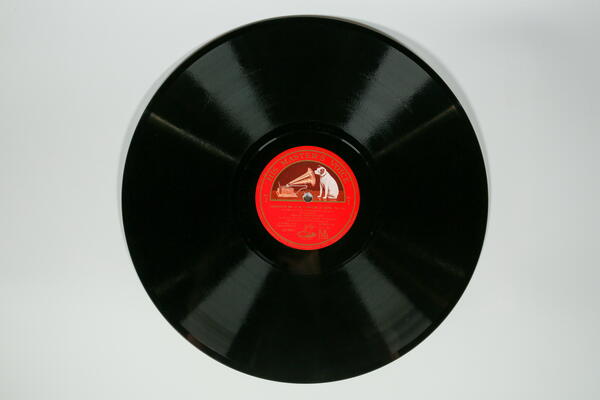
The phonograph record from the museum’s collection features “Piano Concerto No. 3” performed by its composer Sergei Prokofiev with an orchestra conducted by Piero Coppola. This is the only known record of Prokofiev playing with an orchestra. The concerto was recorded under the label “His Master’s Voice” at the famous Abbey Road studio in London on June 27 and 28, 1932.
It was Prokofiev’s first time in the studio, and he was slightly nervous. Later, he wrote in his diary, “I could not be completely relaxed and played with emotional tension. Nevertheless, the first side was good except that the clarinet played some wrong notes in the second subject. We repeated it, and this time the clarinet played correctly but my own playing was less good. This pattern continued for three hours. I found it very interesting but was glad when the session came to an end, as I was tired from all the concentration.” Comparing studio work with live performance, Prokofiev wrote, “My playing comes out vigorously and well in places, but elsewhere it can be mannered, especially where I am slightly hesitant or artificial. Generally, even the slightest hint of mannerism in the playing, which would be imperceptible in an ordinary performance, will be picked up and accentuated in a gramophone recording.”
He confessed that at times the process was difficult, “It is hard to perform a complete side of a record, that is to say four minutes of music, without making a single mistake. But the moment you begin to play more carefully your performance instantly becomes artificial and loses spontaneity.”
Each fragment was recorded two or three times. Later, the records were sent to Paris where Prokofiev was living at the time, so that the composer could choose the best takes. On the second day of recording, the studio was visited by Prince George who would later become George VI, King of the United Kingdom. Prokofiev described his meeting with Prince George, “The Prince is an obviously thoroughbred young man, an attractive but frail-looking figure. He shook hands with us all but did not seem, at first, to know what to say. He then picked me out for more conversation and asked me when I had composed the Concerto, had I played it before in England, and where I normally resided. I answered his questions good-humoredly and when he asked me where I lived it was on the tip of my tongue to say, ‘In Paris, but I often go to the Soviet Union.’ However, this would have been tactless, since here he is the host and I the guest, so I felt I had to confine my reply to Paris. In the Prince’s presence we recorded one phrase and then immediately played it back. After he left, we continued our work.”
It was Prokofiev’s first time in the studio, and he was slightly nervous. Later, he wrote in his diary, “I could not be completely relaxed and played with emotional tension. Nevertheless, the first side was good except that the clarinet played some wrong notes in the second subject. We repeated it, and this time the clarinet played correctly but my own playing was less good. This pattern continued for three hours. I found it very interesting but was glad when the session came to an end, as I was tired from all the concentration.” Comparing studio work with live performance, Prokofiev wrote, “My playing comes out vigorously and well in places, but elsewhere it can be mannered, especially where I am slightly hesitant or artificial. Generally, even the slightest hint of mannerism in the playing, which would be imperceptible in an ordinary performance, will be picked up and accentuated in a gramophone recording.”
He confessed that at times the process was difficult, “It is hard to perform a complete side of a record, that is to say four minutes of music, without making a single mistake. But the moment you begin to play more carefully your performance instantly becomes artificial and loses spontaneity.”
Each fragment was recorded two or three times. Later, the records were sent to Paris where Prokofiev was living at the time, so that the composer could choose the best takes. On the second day of recording, the studio was visited by Prince George who would later become George VI, King of the United Kingdom. Prokofiev described his meeting with Prince George, “The Prince is an obviously thoroughbred young man, an attractive but frail-looking figure. He shook hands with us all but did not seem, at first, to know what to say. He then picked me out for more conversation and asked me when I had composed the Concerto, had I played it before in England, and where I normally resided. I answered his questions good-humoredly and when he asked me where I lived it was on the tip of my tongue to say, ‘In Paris, but I often go to the Soviet Union.’ However, this would have been tactless, since here he is the host and I the guest, so I felt I had to confine my reply to Paris. In the Prince’s presence we recorded one phrase and then immediately played it back. After he left, we continued our work.”