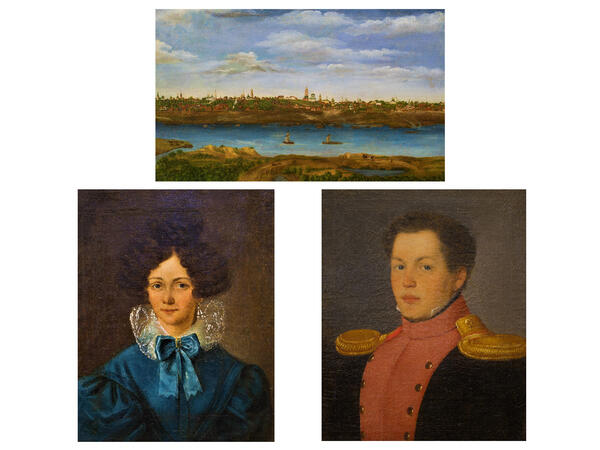

The picturesque panorama of Murom from the Oka River was created by an unknown artist. According to the painting style researchers attribute it to the first half — the middle of the 19th century. A more thorough study of the details allowed us to determine the date more precisely: the picture was painted before 1847.
Researchers suggest that it dates back to a panorama that had previously been created by a teacher of the Murom district school, G. Ryabikov. He depicted the crossing of Nicholas I across the Oka in 1834 on the background of the urban landscape. The panorama itself has not survived, but lithographs from it were found, including those printed in Murom in 1836. The author of the painting “View of Murom” may be based on this printed sample.
Unlike Ryabikov, the second master focused not on the depiction of the crossing of Nicholas I, but on the detailed view of Murom — the city became the main content of the picture, not just the background.
Murom was erected on seven hills above the Oka. On the left, at the very top of the picture, the master depicted the Pyatnitskaya and Vozdvizhenskaya churches. Both were destroyed, but in place of Vozdvizhenskaya later erected a new one. Near them are several temples of the 16th — 17th centuries, including the Spassky monastery, which is considered one of the oldest in Russia. It was built back in the 11th century.
At the top is the church of Nikola Mozhaisky of the 17th — 18th centuries, which is also not preserved to this day. Nearby is the Smolensk cathedral of 1838 with a high bell tower, and at the bottom of the hill is the tent church of Kozma and Demian of the reign of Ivan the Terrible. Its tent later collapsed in 1868.
The fourth and longest hill in the city panorama is called Bogatyrev Hill. In addition to churches, you can see stone mansions on it. One of them at the time belonged to the director of foreign trade, Major-General Yazykov, and it was built for the boyar Ivan Romanov, Tsar Mikhai’'s uncle.
In the center of the panorama, there is the fifth hill, or Voyevoda Hill. From antiquity to the times of Catherine II, there was a city fortress on it. In the center of the hill, there are the cathedral in the name of the Nativity of the Virgin Mary and the burial vault where the relics of Peter and Fevronia were kept. To the right of the picture can be seen one-domed churches: Churches of the Nativity, of Nicholas the Chariot and of John the Baptist.
On the sixth hill, you can see Trinity female and Annunciation male monasteries of the 16th — 17th centuries. On the bank of the river at the foot of the hill, the church of St. Nicholas Naberezhny is shown in 1717. In the picture the master depicted it snow-white with green roofs (now it is painted in yellowish-orange tones). It is by the appearance of its buildings that researchers determined that the painting had been painted before 1847.
On the last, seventh hill on the right side of the panorama, the artist painted stone merchant houses. To the right, there are the temples of the 17th century: the Resurrection and the Entry of a nunnery, closed under Catherine II. Now in its place the nunnery is reopened. Below is the church of St. George. It was built in the 17th century. On the site of the church, there is a memorial cross installed in modern Murom.
Researchers suggest that it dates back to a panorama that had previously been created by a teacher of the Murom district school, G. Ryabikov. He depicted the crossing of Nicholas I across the Oka in 1834 on the background of the urban landscape. The panorama itself has not survived, but lithographs from it were found, including those printed in Murom in 1836. The author of the painting “View of Murom” may be based on this printed sample.
Unlike Ryabikov, the second master focused not on the depiction of the crossing of Nicholas I, but on the detailed view of Murom — the city became the main content of the picture, not just the background.
Murom was erected on seven hills above the Oka. On the left, at the very top of the picture, the master depicted the Pyatnitskaya and Vozdvizhenskaya churches. Both were destroyed, but in place of Vozdvizhenskaya later erected a new one. Near them are several temples of the 16th — 17th centuries, including the Spassky monastery, which is considered one of the oldest in Russia. It was built back in the 11th century.
At the top is the church of Nikola Mozhaisky of the 17th — 18th centuries, which is also not preserved to this day. Nearby is the Smolensk cathedral of 1838 with a high bell tower, and at the bottom of the hill is the tent church of Kozma and Demian of the reign of Ivan the Terrible. Its tent later collapsed in 1868.
The fourth and longest hill in the city panorama is called Bogatyrev Hill. In addition to churches, you can see stone mansions on it. One of them at the time belonged to the director of foreign trade, Major-General Yazykov, and it was built for the boyar Ivan Romanov, Tsar Mikhai’'s uncle.
In the center of the panorama, there is the fifth hill, or Voyevoda Hill. From antiquity to the times of Catherine II, there was a city fortress on it. In the center of the hill, there are the cathedral in the name of the Nativity of the Virgin Mary and the burial vault where the relics of Peter and Fevronia were kept. To the right of the picture can be seen one-domed churches: Churches of the Nativity, of Nicholas the Chariot and of John the Baptist.
On the sixth hill, you can see Trinity female and Annunciation male monasteries of the 16th — 17th centuries. On the bank of the river at the foot of the hill, the church of St. Nicholas Naberezhny is shown in 1717. In the picture the master depicted it snow-white with green roofs (now it is painted in yellowish-orange tones). It is by the appearance of its buildings that researchers determined that the painting had been painted before 1847.
On the last, seventh hill on the right side of the panorama, the artist painted stone merchant houses. To the right, there are the temples of the 17th century: the Resurrection and the Entry of a nunnery, closed under Catherine II. Now in its place the nunnery is reopened. Below is the church of St. George. It was built in the 17th century. On the site of the church, there is a memorial cross installed in modern Murom.