#3
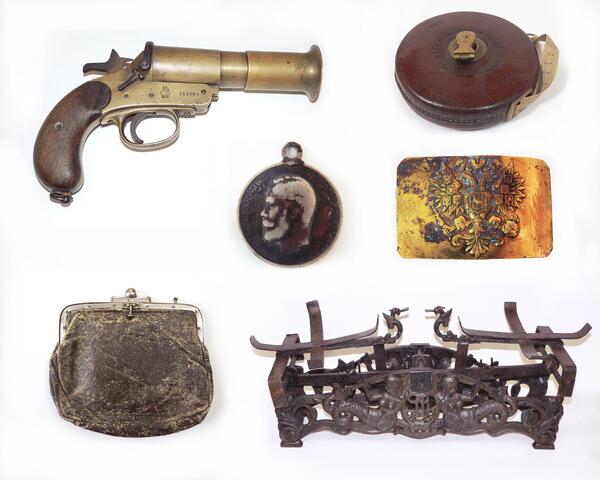
Table scales, Leather wallet, Medal ‘For Bravery’, Royal Combined Arms Infantry Buckle, English flare gun М1916, Measuring tape
#15
#4
#2
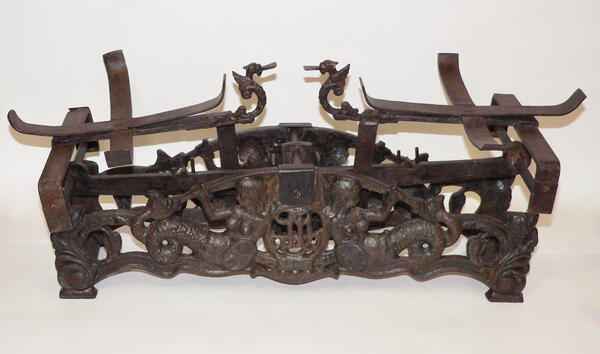
These Beranger-system desktop scales are one of the exhibits in the collection of the Kotlas Museum, and can hold up to 15 kilograms. They were produced by Polish factory Peysakh Gastman, and made in the second half of the XIX century. On the centre of the scales’ facade is a monogram in Russian: PG - Peysakh Gastman.
Table scales
These scales belong to the Beranger-system table scale type, popularly called “geese” or “ducks” because of the characteristic shape of the balance indicators. Such scales became popular in the second half of the 19th century and were widely used for over a century. Before the revolution, these scales were supplied to the trading establishments of the Russian Empire mainly from Poland and Odessa. Such scales were distinguished by the artistic design of the case - they were decorated with figures of dragons, griffins, and harpies. One of the most common decorations was mermaids.
The two-bowl balance system for scales, which did not require great precision, was invented by the French mathematician, astronomer, and physicist Gilles de Roberval (1602-1675). Later they were named after him. The scales were based on a rocking mechanism, but Roberval significantly improved their design. It was he who first came up with the idea to place a balance beam under the scales, and not above them. The bowls rested on two rods included in a system of interconnected levers. During oscillations during weighing, the system of levers had the shape of a parallelogram, and in equilibrium it acquired the shape of a rectangle. At the same time, the readings of the scales did not depend on where the load was located in the bowl.
Around 1850, the French inventor and owner of his own scales factory, Joseph Beranger (1802-1870), proposed adding small additional levers to the design of his predecessor and compatriot in place of the struts under the main double beam. Thanks to this, it was possible to reduce the action of external forces and friction, and, therefore, increase the sensitivity of the device. It was only in the 20th century that an innovative scales design with bowls over the rocker arm system was launched into mass production. These scales could long be found on the counters of Soviet stores.
Table scales
These scales belong to the Beranger-system table scale type, popularly called “geese” or “ducks” because of the characteristic shape of the balance indicators. Such scales became popular in the second half of the 19th century and were widely used for over a century. Before the revolution, these scales were supplied to the trading establishments of the Russian Empire mainly from Poland and Odessa. Such scales were distinguished by the artistic design of the case - they were decorated with figures of dragons, griffins, and harpies. One of the most common decorations was mermaids.
The two-bowl balance system for scales, which did not require great precision, was invented by the French mathematician, astronomer, and physicist Gilles de Roberval (1602-1675). Later they were named after him. The scales were based on a rocking mechanism, but Roberval significantly improved their design. It was he who first came up with the idea to place a balance beam under the scales, and not above them. The bowls rested on two rods included in a system of interconnected levers. During oscillations during weighing, the system of levers had the shape of a parallelogram, and in equilibrium it acquired the shape of a rectangle. At the same time, the readings of the scales did not depend on where the load was located in the bowl.
Around 1850, the French inventor and owner of his own scales factory, Joseph Beranger (1802-1870), proposed adding small additional levers to the design of his predecessor and compatriot in place of the struts under the main double beam. Thanks to this, it was possible to reduce the action of external forces and friction, and, therefore, increase the sensitivity of the device. It was only in the 20th century that an innovative scales design with bowls over the rocker arm system was launched into mass production. These scales could long be found on the counters of Soviet stores.
#21
Full name Table scales
Author unknown
Date second half of the 19th century
Technique art casting
Place Warshaw, Poland
Dimensions 65×24 cm
Collection Kotlas Museum of Local Lore
Copyright MUK “Kotlas Museum of Local Lore”
Author unknown
Date second half of the 19th century
Technique art casting
Place Warshaw, Poland
Dimensions 65×24 cm
Collection Kotlas Museum of Local Lore
Copyright MUK “Kotlas Museum of Local Lore”
#16
Leather wallet
#5
#6
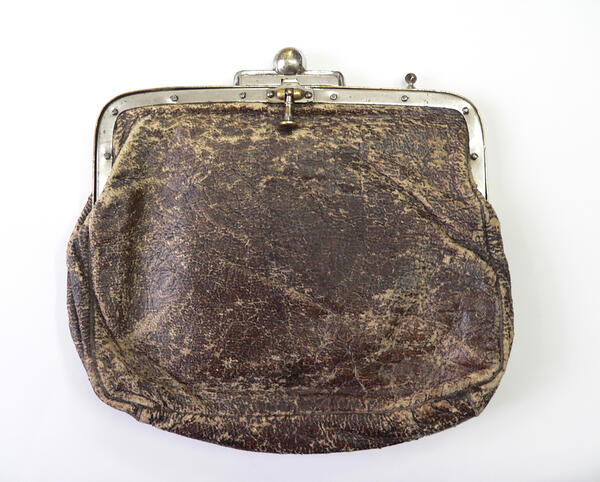
This early 20th century wallet, now in the collection of the museum, belonged to a participant in the Civil War, a resident of Kótlas, who had his own leather shop in the village of Zhernakóvo. It is a shabby wallet, made of brown leather, closed with a metal lock in the form of a ball.
For many centuries, a variety of objects served as money for mankind: stones, shells, beads, knots on ropes. And all of these needed a container for storage and transport. At a time when there were no wallets or pockets on clothes, people wore banknotes in a headdress, on their bosom or behind their bootleg, or even simply hung them around their necks or outer clothing.
The first wallets, in their size and function, were more like bags or pouches. Usually they were canvas, and made of a linen fabric. In Russia, such a bag was called a purse, and this word later began to symbolize great wealth. Corresponding turns of speech also appeared: shake the purse, fill the purse, a tight purse. Often, a thick leather belt the width of a palm, made with an inner lining, acted as a wallet. Money was kept inside it. The closure was a buckle, or sometimes a clasp. The ancient Romans were the first to make small leather wallets. For wealthy people, such wallets were encrusted with precious stones and embroidered.
From the 16th to 17th centuries, a wallet on a belt was typically an attribute of women’s clothing. Women wore a wallet under their top skirts, where a special cut was made for convenience. The men’s wallet changed dramatically when clothes with pockets appeared. A roomy wallet is a thing of the past.
In the XX century, small wallets appeared with clips or a factory-made button of artificial materials. Coin holders came into use, into which coins of different sizes and denominations were pushed with one finger. Handicraft also had not lost its popularity. For example, small wallets, knitted or embroidered with beads by needlewomen, were popular. Over time, wallets became more diverse in the types of models and materials. The most expensive ones were made of leather, including the skin of exotic animals, and often adorned with precious stones or loose Swarovski crystals.
For many centuries, a variety of objects served as money for mankind: stones, shells, beads, knots on ropes. And all of these needed a container for storage and transport. At a time when there were no wallets or pockets on clothes, people wore banknotes in a headdress, on their bosom or behind their bootleg, or even simply hung them around their necks or outer clothing.
The first wallets, in their size and function, were more like bags or pouches. Usually they were canvas, and made of a linen fabric. In Russia, such a bag was called a purse, and this word later began to symbolize great wealth. Corresponding turns of speech also appeared: shake the purse, fill the purse, a tight purse. Often, a thick leather belt the width of a palm, made with an inner lining, acted as a wallet. Money was kept inside it. The closure was a buckle, or sometimes a clasp. The ancient Romans were the first to make small leather wallets. For wealthy people, such wallets were encrusted with precious stones and embroidered.
From the 16th to 17th centuries, a wallet on a belt was typically an attribute of women’s clothing. Women wore a wallet under their top skirts, where a special cut was made for convenience. The men’s wallet changed dramatically when clothes with pockets appeared. A roomy wallet is a thing of the past.
In the XX century, small wallets appeared with clips or a factory-made button of artificial materials. Coin holders came into use, into which coins of different sizes and denominations were pushed with one finger. Handicraft also had not lost its popularity. For example, small wallets, knitted or embroidered with beads by needlewomen, were popular. Over time, wallets became more diverse in the types of models and materials. The most expensive ones were made of leather, including the skin of exotic animals, and often adorned with precious stones or loose Swarovski crystals.
#22
Full name Leather wallet
Author unknown
Date early XX century
Place Russia
Technique hand stitch, riveting, furrier
Dimensions 16,1×17,5 cm
Copyright MUK ‘Kótlas Museum of Local Lore’
Collection Kótlas Museum of Local Lore
Author unknown
Date early XX century
Place Russia
Technique hand stitch, riveting, furrier
Dimensions 16,1×17,5 cm
Copyright MUK ‘Kótlas Museum of Local Lore’
Collection Kótlas Museum of Local Lore
#17
Medal ‘For Bravery’
#7
#8
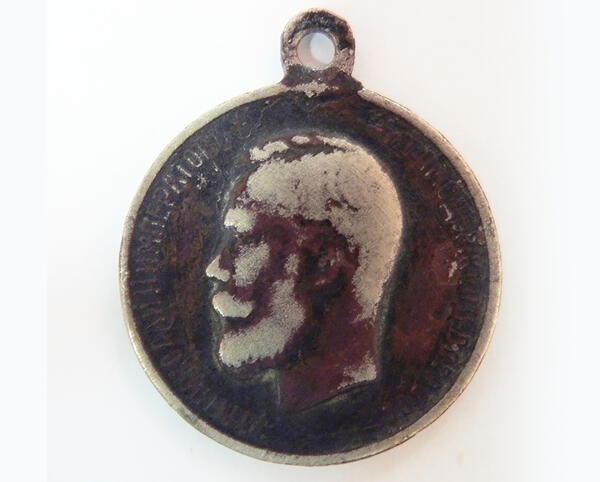
The medal ‘For Bravery’ is one of the awards of the state of the Russian Empire. There were several types of medals with such an inscription. Established in 1807, the medal was intended to be awarded to the soldiers of irregular troops and paramilitaries. In 1878, Emperor Alexander II instituted a separate award with the inscription ‘For Bravery’ to reward the lower ranks of the border guard.
However, more famous was the St. George Medal, awarded at four levels, with the inscription ‘For Bravery’, which was established on August 10, 1913 and minted from 1913 to 1917. It was awarded to servicemen from the lower ranks of the Russian army who showed courage both in peace and in combat. During the First World War, the St. George Medal, along with the St. George Cross, became the most ubiquitous award for the lower ranks of the Russian Imperial Army.
The institution of the St. George Medal nullified the earlier regulations on the medal with the inscription ‘For Bravery’. Until this point, the medal ‘For Bravery’ in wartime was awarded to persons who did not have class ranks - for feats performed in a combat situation and under enemy fire. These persons included the lower ranks of the border guards and employees of the Red Cross - nurses, orderlies and others, as well as civilian volunteers. The winners of the award were entitled to a cash payment, which was made once a year. In the event of the death of the owner of the medal, his or her relatives could receive this payment, but only once.
The medal ‘For Bravery’ presented in this exposition has no number and degree, and it is not made of precious metal - this was confirmed by the authentication that was carried out in Leningrad in 1990. There may be several explanations for this. For example, if the original was lost, the medal ‘For Bravery’ could be ordered from a private manufacturer without a number designation. In addition, during the First World War, a soldier could participate in a charity event to help the front, exchanging his silver awards for duplicates from other metals. The exchange of precious metals for cheaper ones was a common practice in European states during the First World War.
However, more famous was the St. George Medal, awarded at four levels, with the inscription ‘For Bravery’, which was established on August 10, 1913 and minted from 1913 to 1917. It was awarded to servicemen from the lower ranks of the Russian army who showed courage both in peace and in combat. During the First World War, the St. George Medal, along with the St. George Cross, became the most ubiquitous award for the lower ranks of the Russian Imperial Army.
The institution of the St. George Medal nullified the earlier regulations on the medal with the inscription ‘For Bravery’. Until this point, the medal ‘For Bravery’ in wartime was awarded to persons who did not have class ranks - for feats performed in a combat situation and under enemy fire. These persons included the lower ranks of the border guards and employees of the Red Cross - nurses, orderlies and others, as well as civilian volunteers. The winners of the award were entitled to a cash payment, which was made once a year. In the event of the death of the owner of the medal, his or her relatives could receive this payment, but only once.
The medal ‘For Bravery’ presented in this exposition has no number and degree, and it is not made of precious metal - this was confirmed by the authentication that was carried out in Leningrad in 1990. There may be several explanations for this. For example, if the original was lost, the medal ‘For Bravery’ could be ordered from a private manufacturer without a number designation. In addition, during the First World War, a soldier could participate in a charity event to help the front, exchanging his silver awards for duplicates from other metals. The exchange of precious metals for cheaper ones was a common practice in European states during the First World War.
#23
Full name Medal ‘For Bravery’
Author unknown
Date XIX - early XX century
Technique embossing
Place Russia
Dimensions 3,4×2,8 cm
Copyright MUK ‘Kótlas Museum of Local Lore’
Collection Kótlas Museum of Local Lore
Author unknown
Date XIX - early XX century
Technique embossing
Place Russia
Dimensions 3,4×2,8 cm
Copyright MUK ‘Kótlas Museum of Local Lore’
Collection Kótlas Museum of Local Lore
#18
Royal Combined Arms Infantry Buckle
#9
#10
Leather belts have been an important part of clothing and military equipment since people learned to make quality leather from animal skins. Today, despite the colossal evolution of military affairs in general and equipment in particular, it is impossible to imagine ordinary soldiers, officers, or generals without this element of uniform.
With the development of military affairs, a leather belt with a buckle has become a practical and necessary thing. The number of useful functions of a military belt differs from a civilian belt. The buckle of the civilian belt is convenient to fasten and unfasten, its additional functional load is decorative. On a military belt, which is worn over a uniform or overcoat, a holster for individual weapons — a pistol or revolver, a field officer’s bag, pouches for cartridges or grenades, a bayonet-knife, a sword belt or a dagger — can be attached.
The buckle of the military belt was designed with particular care, since buckles, like buttons, on military uniforms usually carry state symbols, or else symbols for the type of troops or type of activity of the organization. On the dress uniform, the soldiers had brightly polished silver buckles, and the officers had golden buckles. This tradition is followed by almost all armies in the world.
Before the 1917 revolution in Russia, many walked in uniform and wore belts: civilian departments as well as the military had their own uniforms and their own belts with special buckles. Belts with buckles were worn by high schoolers studying at actual as well as cadet schools, by university students, and even professors. Firefighters, postmen, railroad workers and engineers from various departments had buckles with their own symbols.
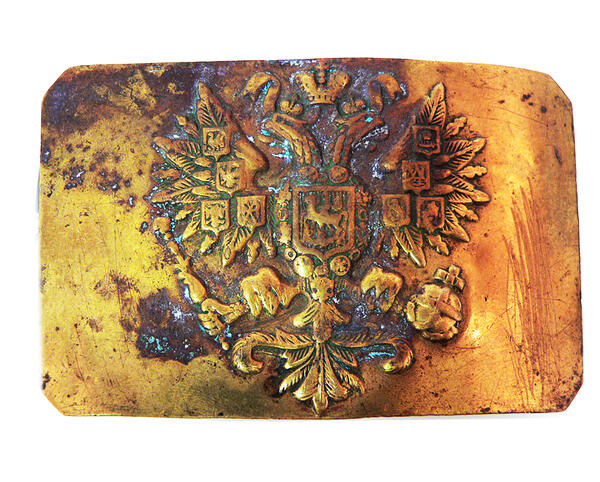
The exhibition of the museum features a brass buckle produced by the Society of Associated Factories of Lamps, Burners and Metal Products “Brunner Brothers, Hugo Schneider and R. Dietmar”. The buckle is rectangular with cut corners. On it is a two-headed eagle, in whose talons there is an orb and a sceptre - the image of the state emblem of the Russian Empire. The image is convex and occupies the entire central area of the front side of the buckle. On the back there is a curved metal plate with a rounded edge and a metal clip for fixing the belt, on the right side there is a stamp - the letters B.SH.D., meaning “Brunner, Schneider, Dietmar”.
With the development of military affairs, a leather belt with a buckle has become a practical and necessary thing. The number of useful functions of a military belt differs from a civilian belt. The buckle of the civilian belt is convenient to fasten and unfasten, its additional functional load is decorative. On a military belt, which is worn over a uniform or overcoat, a holster for individual weapons — a pistol or revolver, a field officer’s bag, pouches for cartridges or grenades, a bayonet-knife, a sword belt or a dagger — can be attached.
The buckle of the military belt was designed with particular care, since buckles, like buttons, on military uniforms usually carry state symbols, or else symbols for the type of troops or type of activity of the organization. On the dress uniform, the soldiers had brightly polished silver buckles, and the officers had golden buckles. This tradition is followed by almost all armies in the world.
Before the 1917 revolution in Russia, many walked in uniform and wore belts: civilian departments as well as the military had their own uniforms and their own belts with special buckles. Belts with buckles were worn by high schoolers studying at actual as well as cadet schools, by university students, and even professors. Firefighters, postmen, railroad workers and engineers from various departments had buckles with their own symbols.
The exhibition of the museum features a brass buckle produced by the Society of Associated Factories of Lamps, Burners and Metal Products “Brunner Brothers, Hugo Schneider and R. Dietmar”. The buckle is rectangular with cut corners. On it is a two-headed eagle, in whose talons there is an orb and a sceptre - the image of the state emblem of the Russian Empire. The image is convex and occupies the entire central area of the front side of the buckle. On the back there is a curved metal plate with a rounded edge and a metal clip for fixing the belt, on the right side there is a stamp - the letters B.SH.D., meaning “Brunner, Schneider, Dietmar”.
#24
Full name Royal Combined Arms Infantry Buckle
Author unknown
Date early XX century to 1917
Technique stamping, soldering, factory production
Place Warshaw, Poland
Dimensions 5,3×8,3 cm
Collection Kótlas Museum of Local Lore
Copyright MUK “Kótlas Museum of Local Lore”
Author unknown
Date early XX century to 1917
Technique stamping, soldering, factory production
Place Warshaw, Poland
Dimensions 5,3×8,3 cm
Collection Kótlas Museum of Local Lore
Copyright MUK “Kótlas Museum of Local Lore”
#19
English flare gun М1916
#11
#12
In military affairs, it is often required to transmit approved sound and light signals over a long distance. In the past, this was achieved with fires, smoke, drums and cannon shots. However, all of these methods required some training. To give a signal promptly required a small-sized technical device that was ready to work at any time. Such a device was created only in the second half of the 19th century. This device is called a ‘signaling pistol’, and in common parlance - a flare gun.
A flare gun is a pyrotechnic means of visual, or sometimes auditory communication, which was used to transmit short commands, to raise an alert, to designate, and for mutual recognition of troops. With the help of flare guns, troops can ask to fire on a target, relocate an attack, or cease fire. Flare guns assist in pointing to a target.
As a signal was given, consisting of several signal flares, the flares were fired at intervals of 8-10 seconds. The interval between individual signals must be at least one minute. Each signal was assigned its own flare color. For example, one green flare allowed movement and meant ‘everything is in order, we are continuing our work.’ The signal ‘rations required’ was given by green and red flares, and only red meant ‘help is needed.’ To request indication of a direction was three flares - red, green, red. To bring medicine - red and red. Emergency aid was demanded with three red flares in a row.
Flare guns have long been used for their intended purpose — to give signals. However, in the 20th century, they were also adapted for close combat with enemy infantry and tanks. In addition to giving signals, the fleet used flare guns to launch a thin ship’s cable — a line to the shore or to a ship in distress. This type of flare gun is called a line thrower.
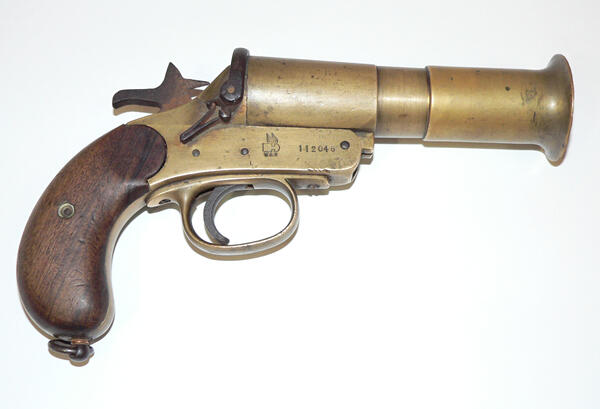
The Kotlas Museum received an English flare gun М1916 from the collection of the National Museum. This flare gun consists of a grip that blends seamlessly into the frame, breech and barrel. The handle is framed with walnut wood panels on both sides. On the bottom of the handle there is a steel ring for fixing on the belt. The breech - that is, the hammer, latch and trigger - is made of steel. The hammer smoothly turns into the firing pin, which has the shape of a pointed cone. The frame, the central part of the handle and the barrel are made of brass. To charge the flare gun, the barrel must be bent forward. The smooth barrel with two lugs terminates in a bell. All parts of the flare gun are attached with screws. On the left side of thе flare gun’s frame under the barre is the manufacturer’s signature: WEBLEY & SCOTT LTD LONDON & BIRMINGHAM.
A flare gun is a pyrotechnic means of visual, or sometimes auditory communication, which was used to transmit short commands, to raise an alert, to designate, and for mutual recognition of troops. With the help of flare guns, troops can ask to fire on a target, relocate an attack, or cease fire. Flare guns assist in pointing to a target.
As a signal was given, consisting of several signal flares, the flares were fired at intervals of 8-10 seconds. The interval between individual signals must be at least one minute. Each signal was assigned its own flare color. For example, one green flare allowed movement and meant ‘everything is in order, we are continuing our work.’ The signal ‘rations required’ was given by green and red flares, and only red meant ‘help is needed.’ To request indication of a direction was three flares - red, green, red. To bring medicine - red and red. Emergency aid was demanded with three red flares in a row.
Flare guns have long been used for their intended purpose — to give signals. However, in the 20th century, they were also adapted for close combat with enemy infantry and tanks. In addition to giving signals, the fleet used flare guns to launch a thin ship’s cable — a line to the shore or to a ship in distress. This type of flare gun is called a line thrower.
The Kotlas Museum received an English flare gun М1916 from the collection of the National Museum. This flare gun consists of a grip that blends seamlessly into the frame, breech and barrel. The handle is framed with walnut wood panels on both sides. On the bottom of the handle there is a steel ring for fixing on the belt. The breech - that is, the hammer, latch and trigger - is made of steel. The hammer smoothly turns into the firing pin, which has the shape of a pointed cone. The frame, the central part of the handle and the barrel are made of brass. To charge the flare gun, the barrel must be bent forward. The smooth barrel with two lugs terminates in a bell. All parts of the flare gun are attached with screws. On the left side of thе flare gun’s frame under the barre is the manufacturer’s signature: WEBLEY & SCOTT LTD LONDON & BIRMINGHAM.
#25
Full name English flare gun М1916
Author unknown
Date 1916 - 1918 years
Technique casting
Place Great Britain
Dimensions 9,8×24 cm
Collection Kótlas Museum of Local Lore
Copyright MUK “Kótlas Museum of Local Lore”
Author unknown
Date 1916 - 1918 years
Technique casting
Place Great Britain
Dimensions 9,8×24 cm
Collection Kótlas Museum of Local Lore
Copyright MUK “Kótlas Museum of Local Lore”
#20
Measuring tape
#13
#14
A measuring tape is a tool consisting of a narrow tape with indicated units of length. For ease of use, the tape is rolled up in tight rings and placed in some kind of solid body. In ancient times, instead of a measuring tape, people used a long rope with knots tied along the entire length to indicate increments of length. This was wound up on a ‘chelnok’ — an oblong block. The rope was unwound and rewound by hand.
The first versions of a metal measuring tape appeared only in the middle of the 19th century. James Chesterman of Britain invented the measuring tape. In 1865, he figured out how to join together five six-meter pieces of steel tape 3.5 centimeters wide, which he used for measurements. Chesterman wound this tape on a drum and ended up with a compact instrument for large-scale linear measurements, which immediately became very popular.
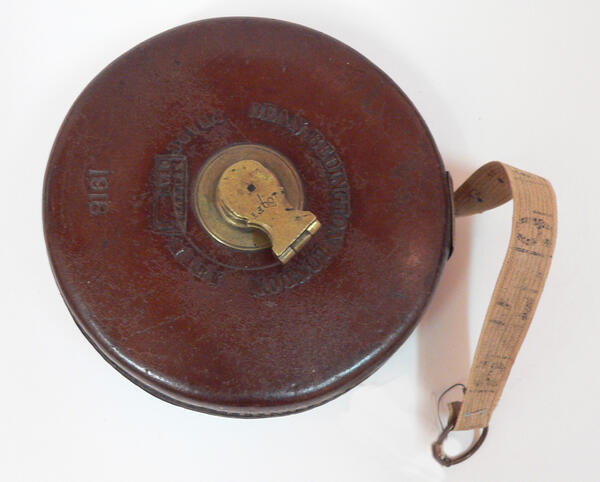
The casing of this measuring tape wheel from the museum’s collection is brown; it is made of two parts sewn along the edge with a seam forming a horizontal line. On the top cover of the casing there is a mechanism for winding the tape - in order to wind the tape back on the axle, it is necessary to rotate the metal handle. After that, the handle is returned to a special cavity. The axle is surrounded by valves on both sides. At the top of the tape, a folding handle is attached to the valve for rotating the axle. The handle has the inscription “100 Ft”. The ribbon of the measuring tape is pulled through the hole, which is decorated with a metal plate and equipped with two rollers, between which the ribbon passes. The ribbon is pulled out by a special ring. On the leather casing, around the handle, there is an inscription “DEAN BEDINGTON LONDON” on the top, “TRADE” at the bottom in a circle, then a rectangle in which it reads: “DEAN 1”, then “MARK”; below this inscription, is a number — most likely the year of manufacture: 1918
Measuring Tape
There are markings on both sides of the tape: on the inside in inches, and on the outside in centimeters. When the tape is fully extended, its length is 223.52 centimeters. The ribbon is a dirty beige color, the increments of measurement are in black and red paint, and the owner’s handwritten notes are made in graphite pencil and blue ink on the back of the ribbon. This measuring tape was found in Nízhnaya Tóyma and probably dates back to the British intervention in the North.
The first versions of a metal measuring tape appeared only in the middle of the 19th century. James Chesterman of Britain invented the measuring tape. In 1865, he figured out how to join together five six-meter pieces of steel tape 3.5 centimeters wide, which he used for measurements. Chesterman wound this tape on a drum and ended up with a compact instrument for large-scale linear measurements, which immediately became very popular.
The casing of this measuring tape wheel from the museum’s collection is brown; it is made of two parts sewn along the edge with a seam forming a horizontal line. On the top cover of the casing there is a mechanism for winding the tape - in order to wind the tape back on the axle, it is necessary to rotate the metal handle. After that, the handle is returned to a special cavity. The axle is surrounded by valves on both sides. At the top of the tape, a folding handle is attached to the valve for rotating the axle. The handle has the inscription “100 Ft”. The ribbon of the measuring tape is pulled through the hole, which is decorated with a metal plate and equipped with two rollers, between which the ribbon passes. The ribbon is pulled out by a special ring. On the leather casing, around the handle, there is an inscription “DEAN BEDINGTON LONDON” on the top, “TRADE” at the bottom in a circle, then a rectangle in which it reads: “DEAN 1”, then “MARK”; below this inscription, is a number — most likely the year of manufacture: 1918
Measuring Tape
There are markings on both sides of the tape: on the inside in inches, and on the outside in centimeters. When the tape is fully extended, its length is 223.52 centimeters. The ribbon is a dirty beige color, the increments of measurement are in black and red paint, and the owner’s handwritten notes are made in graphite pencil and blue ink on the back of the ribbon. This measuring tape was found in Nízhnaya Tóyma and probably dates back to the British intervention in the North.
#26
Full name Measuring tape
Author unknown
Date early XX century
Technique riveting, factory production
Place Arhangel’skaya oblast', Russia
Dimensions 13×13 cm
Copyright MUK “Kótlas Museum of Local Lore”
Collection Kótlas Museum of Local Lore
Author unknown
Date early XX century
Technique riveting, factory production
Place Arhangel’skaya oblast', Russia
Dimensions 13×13 cm
Copyright MUK “Kótlas Museum of Local Lore”
Collection Kótlas Museum of Local Lore
read morehide
00:00
00:00
1x
Scales, Wallet, Medal, Buckle, Flare gun, Tape
Collection
Exhibition
0
 Point your smartphone camera to open in the app
Open in app
Share