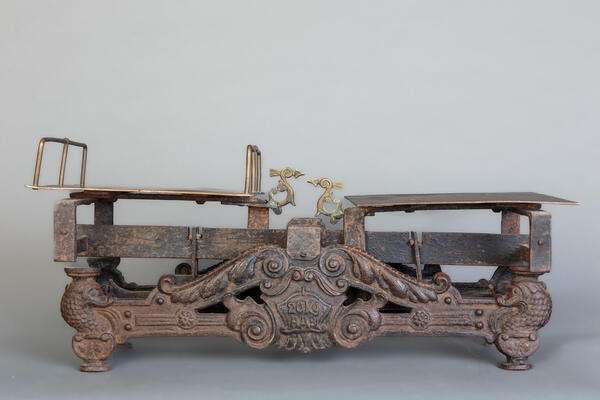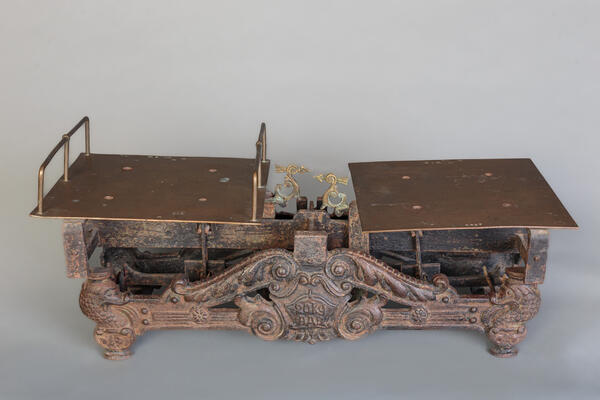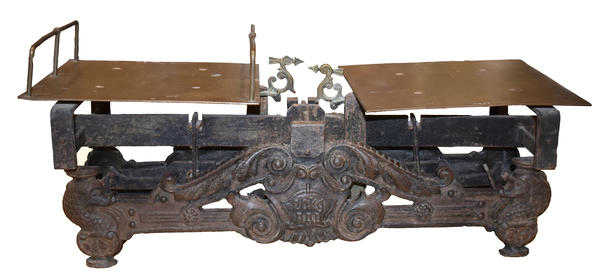
The oldest weighting scale (a beam with two cups on a stable support) were found by archaeologists in Mesopotamia and dated 5 millennium BC. This device was used by ancient Egyptians. This is evidenced by both the images on the papyri (images of weighing the heart of the deceased) and the discovered weights of a few grams. Scales as a measure of honesty are mentioned more than once in the Old Testament: “Can I be clean with wicked scales?” (Micah 6:11).
Weights — pieces of metal, cast-iron or stone of a certain mass — were an indispensable complement to scales. In ancient Greece bronze or lead weights of different shapes were used: rectangular and square plates, balls, cones and others. The Romans often shaped weights as animals, heads and figures of people or gods.
In Russia weights began to be used for weighing expensive spices and precious metals. In the 12th century the following measures were in circulation: grivna (160g), zolotnik (4.266g), pud (16.38kg), berkovets (163.8kg); later appeared “pochka” (0.171g), “funt” (1lb), “pirog” (0,04g), “dolya” (0.04g) and others. Up to the17th century they were made in the form of iron octahedron. Then cast-iron pieces with iron handles appeared, and later still there was a tendency to make the weights round. By the end of the 19th century they became cylindrical and were made of cast-iron, copper, bronze and even porcelain.
The prototype of Soviet scales was the invention of the French scientist and mechanic Gilles Personne Roberval. Roberval’s scale was a parallelogram consisting of four beams. The opposite sides of the construction were fixed by means of fixed pivots in the center; two beams with weights were attached to them at an angle of 90 degrees.
In 1847 that model of scales were improved (and in 1849 patented the product) by another French inventor — Joseph Beranger. He suggested installing additional levers in place of the supports under the main double beam. Thus, it was possible to reduce friction and, accordingly, to increase the sensitivity and accuracy of the device. Mass production of such scales began in the early 20th century, but they were the most popular ones. Because of the outward resemblance of the pointer to set the balance with a bird, the scales got the nickname “duck”. The “duck” was placed between two weighing plates.
Weights were needed to use the scales, and their accuracy was often the subject of debate. To adjust the scales, a special adjuster screw was used.
Weights — pieces of metal, cast-iron or stone of a certain mass — were an indispensable complement to scales. In ancient Greece bronze or lead weights of different shapes were used: rectangular and square plates, balls, cones and others. The Romans often shaped weights as animals, heads and figures of people or gods.
In Russia weights began to be used for weighing expensive spices and precious metals. In the 12th century the following measures were in circulation: grivna (160g), zolotnik (4.266g), pud (16.38kg), berkovets (163.8kg); later appeared “pochka” (0.171g), “funt” (1lb), “pirog” (0,04g), “dolya” (0.04g) and others. Up to the17th century they were made in the form of iron octahedron. Then cast-iron pieces with iron handles appeared, and later still there was a tendency to make the weights round. By the end of the 19th century they became cylindrical and were made of cast-iron, copper, bronze and even porcelain.
The prototype of Soviet scales was the invention of the French scientist and mechanic Gilles Personne Roberval. Roberval’s scale was a parallelogram consisting of four beams. The opposite sides of the construction were fixed by means of fixed pivots in the center; two beams with weights were attached to them at an angle of 90 degrees.
In 1847 that model of scales were improved (and in 1849 patented the product) by another French inventor — Joseph Beranger. He suggested installing additional levers in place of the supports under the main double beam. Thus, it was possible to reduce friction and, accordingly, to increase the sensitivity and accuracy of the device. Mass production of such scales began in the early 20th century, but they were the most popular ones. Because of the outward resemblance of the pointer to set the balance with a bird, the scales got the nickname “duck”. The “duck” was placed between two weighing plates.
Weights were needed to use the scales, and their accuracy was often the subject of debate. To adjust the scales, a special adjuster screw was used.