

Water boiling devices have been around since ancient times in Eastern countries. They were copper or clay structures that consisted of a water tank, a charcoal brazier and a pipe.
It is commonly believed that the homeland of Russian samovars is Tula, and the first one, according to the legend, was brought by Peter I from Holland. In fact, the first samovar of domestic manufacture is mentioned in customs documents in 1740 as belonging to Irga (Ural) merchants. The first record of a Tula samovar goes back to 1746. In 1778 the first samovar factory of brothers Ivan and Nazar Lisitsyns was patented: their products were famous for the variety of forms and intricate decoration.
The first kerosene samovars appeared in the late 19th — early 20th centuries: they were manufactured at the Berta Tejle Trading House and her sons in Tula. The kerosene burner was invented and patented by the company’s founder, Reinhold Tejle. Advertisements assured customers that kerosene samovars were completely safe and practical.
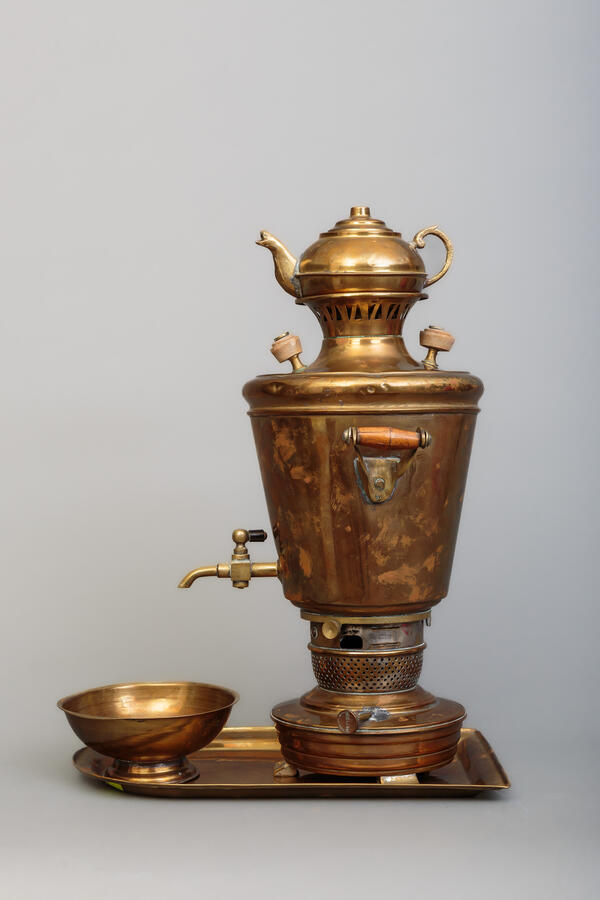
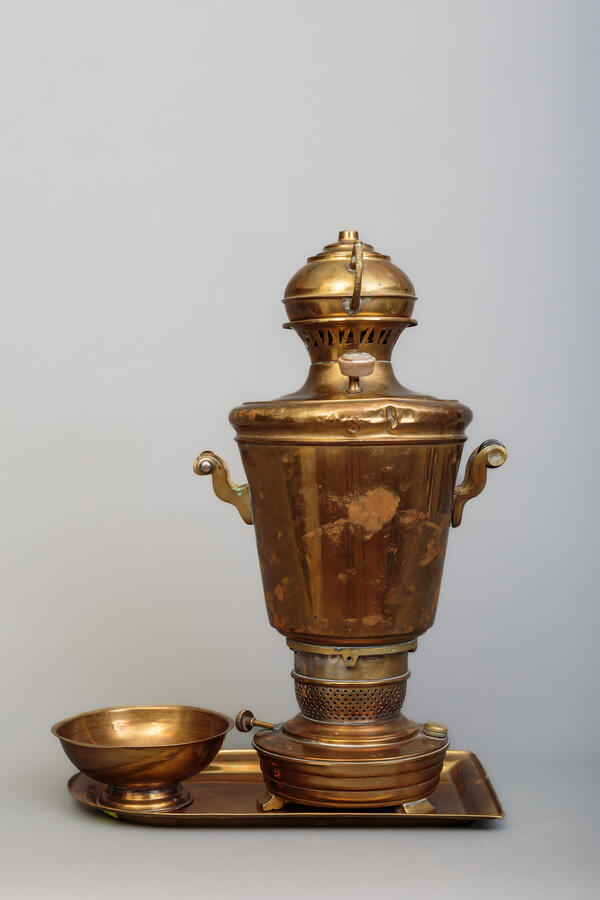
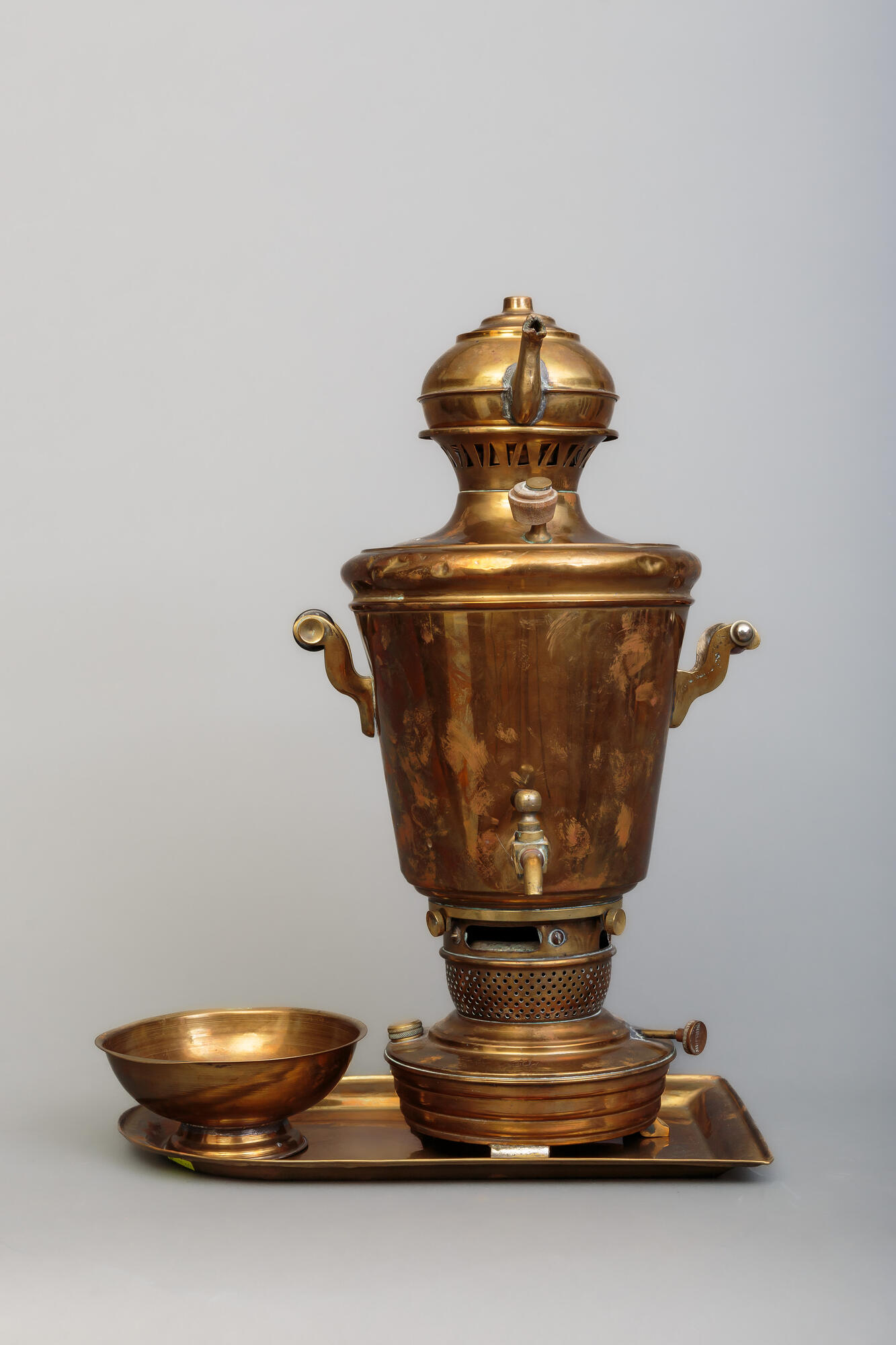
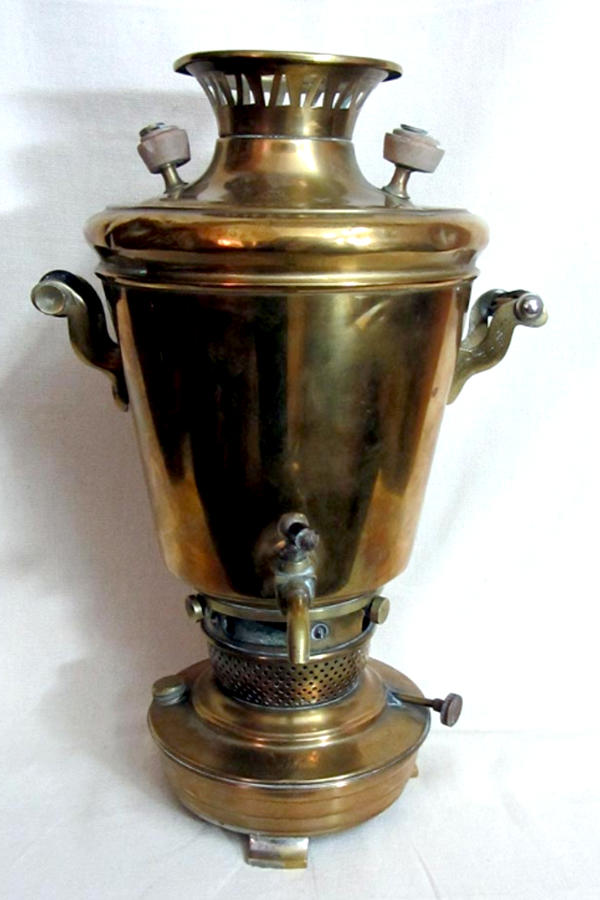
The bowl-shaped kerosene tank was mounted on three rectangular legs. A circular burner was attached to the tank and the body of the vessel rested on it. In the center of the tank there was a chimney pipe.
The kerosene samovar on display was made in Iran. It is believed that it was the fourth Shah of Iran, Nasser ad-Din Qajar, who brought the fashion for Russian samovars to his homeland in the 19th century. In the early 20th century, tea as a more accessible drink began to replace coffee, and demand for samovars increased. At first, they were imported from Russia, but soon craftsmen learned to make their own distinctive designs, decorated with oriental ornaments and Arabic script. A portrait of the “tea” shah was often placed on the teapot.
The center of Iranian samovar production was and still is the town of Boroujerd. The local craftsmen used a copper and nickel alloy, known as German silver, and a special decoration technique. Expers believe, that in terms of structure, there are no differences between the Iranian and the classic Tula samovar.
Because of the frequent border changes in this part of Asia, Iranian samovars are also called Persian samovars. They can serve as a decoration for tea-houses, or be placed in street stalls to quench the thirst of passers-by.
It is commonly believed that the homeland of Russian samovars is Tula, and the first one, according to the legend, was brought by Peter I from Holland. In fact, the first samovar of domestic manufacture is mentioned in customs documents in 1740 as belonging to Irga (Ural) merchants. The first record of a Tula samovar goes back to 1746. In 1778 the first samovar factory of brothers Ivan and Nazar Lisitsyns was patented: their products were famous for the variety of forms and intricate decoration.
The first kerosene samovars appeared in the late 19th — early 20th centuries: they were manufactured at the Berta Tejle Trading House and her sons in Tula. The kerosene burner was invented and patented by the company’s founder, Reinhold Tejle. Advertisements assured customers that kerosene samovars were completely safe and practical.
The bowl-shaped kerosene tank was mounted on three rectangular legs. A circular burner was attached to the tank and the body of the vessel rested on it. In the center of the tank there was a chimney pipe.
The kerosene samovar on display was made in Iran. It is believed that it was the fourth Shah of Iran, Nasser ad-Din Qajar, who brought the fashion for Russian samovars to his homeland in the 19th century. In the early 20th century, tea as a more accessible drink began to replace coffee, and demand for samovars increased. At first, they were imported from Russia, but soon craftsmen learned to make their own distinctive designs, decorated with oriental ornaments and Arabic script. A portrait of the “tea” shah was often placed on the teapot.
The center of Iranian samovar production was and still is the town of Boroujerd. The local craftsmen used a copper and nickel alloy, known as German silver, and a special decoration technique. Expers believe, that in terms of structure, there are no differences between the Iranian and the classic Tula samovar.
Because of the frequent border changes in this part of Asia, Iranian samovars are also called Persian samovars. They can serve as a decoration for tea-houses, or be placed in street stalls to quench the thirst of passers-by.