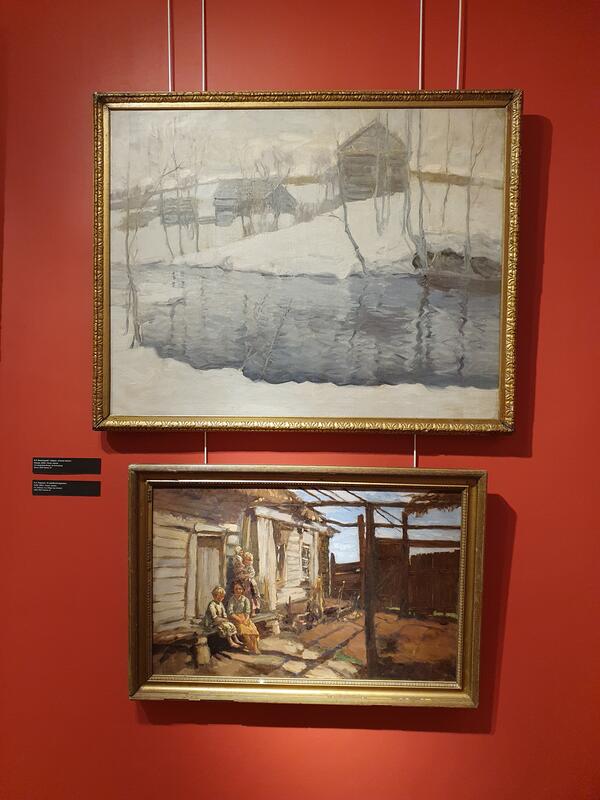
The landscaper Vitold Kaetanovich Byalynitsky-Birulya (1872–1957) studied at the Moscow School of Painting, Sculpture and Architecture under the guidance of masters-Itinerants. His teachers were Illarion Pryanishnikov, Sergei Korovin, Vasily Polenov. Isaac Levitan played a significant role in the formation of the master, with whom Byalynitsky-Birulya met in Moscow. The artist often worked in Levitan’s workshop.
Since 1897 Byalynitsky-Birulya set out his works at exhibitions of the Moscow Association of Artists and international competitions. From 1899 he participated in the Itinerants’ exhibitions, and from 1904 he joined the Itinerants Association. 4 years later Vitold Byalynitsky-Birulya was awarded the title of academician of painting. He was also a member of the Arkhip Ivanovich Kuindzhi’s Society of Artists and the Union of Russian Artists.
One of the most famous paintings of the master is the landscape “Hour of Silence. Lake Udomlya “(1911). It was awarded two medals: an honorary one in Munich and a bronze one in Barcelona.
Landscape is the leading genre in the artist”s work. This was influenced, on the one hand, by the painter”s sincere love for nature, and on the other, by the teachers and artists who surrounded Vitold Kaetanovich. Byalynitsky-Birulya endowed his landscapes with extraordinary lyricism.
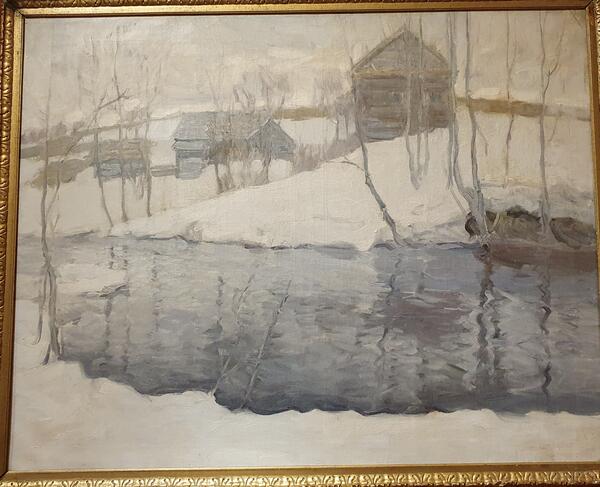
“Early Spring” belongs to the mature works of the artist and conveys the characteristic features of his style. Byalynitsky-Birulya chooses a favorite motive for his landscape - a spring river, on the banks of which thin birches grow, and in the distance the village buildings can be seen, organically inscribed in the landscape. Although this picture was created at a crucial time for Russia, there is no worrying inscribed in it. The artist uses a restrained color scheme of cold shades and paints a dull spring. Since the ice melted, the lazily flowing river is about to speed up its run as soon as the snow melts on its banks. Warm days are approaching. Nature is waking up and the hope for changes in the hearts of people also rises.
“I”m so used to refresh my soul in front of your living trends of truth, simplicity and freedom” – wrote Ilya Repin on artist’s works.
Since 1897 Byalynitsky-Birulya set out his works at exhibitions of the Moscow Association of Artists and international competitions. From 1899 he participated in the Itinerants’ exhibitions, and from 1904 he joined the Itinerants Association. 4 years later Vitold Byalynitsky-Birulya was awarded the title of academician of painting. He was also a member of the Arkhip Ivanovich Kuindzhi’s Society of Artists and the Union of Russian Artists.
One of the most famous paintings of the master is the landscape “Hour of Silence. Lake Udomlya “(1911). It was awarded two medals: an honorary one in Munich and a bronze one in Barcelona.
Landscape is the leading genre in the artist”s work. This was influenced, on the one hand, by the painter”s sincere love for nature, and on the other, by the teachers and artists who surrounded Vitold Kaetanovich. Byalynitsky-Birulya endowed his landscapes with extraordinary lyricism.
“Early Spring” belongs to the mature works of the artist and conveys the characteristic features of his style. Byalynitsky-Birulya chooses a favorite motive for his landscape - a spring river, on the banks of which thin birches grow, and in the distance the village buildings can be seen, organically inscribed in the landscape. Although this picture was created at a crucial time for Russia, there is no worrying inscribed in it. The artist uses a restrained color scheme of cold shades and paints a dull spring. Since the ice melted, the lazily flowing river is about to speed up its run as soon as the snow melts on its banks. Warm days are approaching. Nature is waking up and the hope for changes in the hearts of people also rises.
“I”m so used to refresh my soul in front of your living trends of truth, simplicity and freedom” – wrote Ilya Repin on artist’s works.