

Christian asceticism involved the use of metal chains or girdles which were worn directly on the naked body and usually hidden under garments, although occasionally put on display. It was believed, that chains helped to restrain the needs of the physical body and thus achieve spiritual enlightenment. There were other types of such devices, such as iron hats or soles, and metal icons with chains worn on the chest. Their weight could reach several tens of kilograms.
Believers who wore these chains were considered voluntary martyrs. They symbolically shared the suffering of Jesus Christ during the execution. In addition to wearing chains, the ascetics observed strict fasts and often refused to eat at all for long periods. They lived in poverty and spent their nights in prayer instead of sleep.
There were several types of shackles. The ones for the head looked like wrought iron hoops to which several strips of iron were attached. They were covered with cloth or velvet, and looked almost the same as the usual monastic headdress. Breast and waist chains were in the form of crosses with massive shoulder straps in the form of belts or chains. People carved images of eight-pointed crosses with the instruments of Passion on them and wrote, ‘I bear the wounds of my Lord on my body’, ‘King of Glory’, ‘Let God arise’, ‘Love’, ‘Obedience’, ‘Humility’, and ‘Patience.’ The devices could have date of creation and the stamp of the craftsman on them.
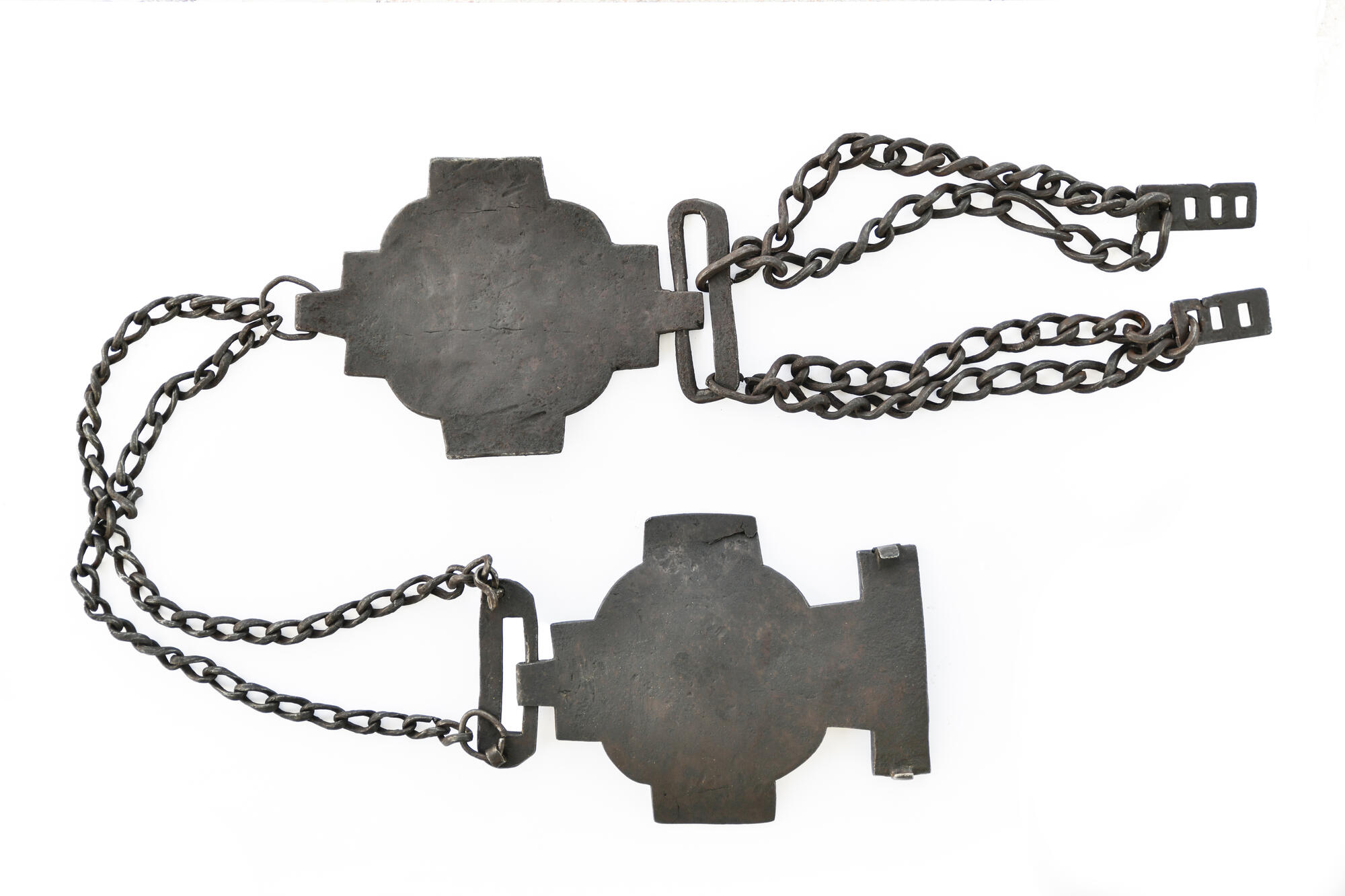
It is believed that the plates and chains from the collection of the Tobolsk Museum belonged to Metropolitan Philotheus (Leshchinsky), the famous Siberian spiritual enlightener who converted more than 40,000 indigenous people to Christianity. The shackles look like two cast iron plates joined together by double chains of bent wire rings. Each plate has several toothed fasteners, which help to fix the device to the body. The museum collection received this item in 1925 from the Ancient Objects Collection of the Assumption Cathedral of St. Sophia.
Believers who wore these chains were considered voluntary martyrs. They symbolically shared the suffering of Jesus Christ during the execution. In addition to wearing chains, the ascetics observed strict fasts and often refused to eat at all for long periods. They lived in poverty and spent their nights in prayer instead of sleep.
There were several types of shackles. The ones for the head looked like wrought iron hoops to which several strips of iron were attached. They were covered with cloth or velvet, and looked almost the same as the usual monastic headdress. Breast and waist chains were in the form of crosses with massive shoulder straps in the form of belts or chains. People carved images of eight-pointed crosses with the instruments of Passion on them and wrote, ‘I bear the wounds of my Lord on my body’, ‘King of Glory’, ‘Let God arise’, ‘Love’, ‘Obedience’, ‘Humility’, and ‘Patience.’ The devices could have date of creation and the stamp of the craftsman on them.
It is believed that the plates and chains from the collection of the Tobolsk Museum belonged to Metropolitan Philotheus (Leshchinsky), the famous Siberian spiritual enlightener who converted more than 40,000 indigenous people to Christianity. The shackles look like two cast iron plates joined together by double chains of bent wire rings. Each plate has several toothed fasteners, which help to fix the device to the body. The museum collection received this item in 1925 from the Ancient Objects Collection of the Assumption Cathedral of St. Sophia.