Font
Color
Graphics
Изображение точки

To see AR mode in action:

1. Install ARTEFACT app for iOS or Android;

2. Find the exhibition «The Ethnography of the Adyghe People»

3. Push the «Augmented reality» button and point your phone's camera at the exhibit;

Скрыть точки интересаПоказать точки интереса
Показать в высоком качестве

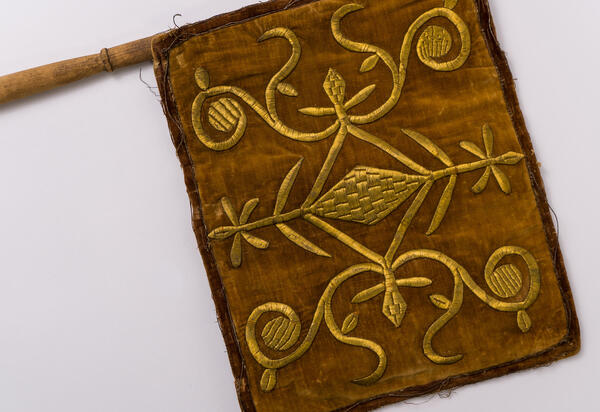
Velvet fan

Creation period
the 1930s
Place of сreation
the USSR
Dimensions
28x34,5 cm
Technique
velvet, golden thread; goldwork embroidery
0
Open in app
#3

The fan presented in the exhibition was transferred to the Adygeysk Museum of Local Lore in 1992 by Sulet Shamsudinovna Yahutl, a secondary school history teacher who worked in school No. 2 in Adygeysk.

The fan in Adyghe is called zhyf (from the word “zhy” — air). Fans appeared in the life of the Adyghe people at the turn of the 19th century. In the old days, only older family members could use a fan. Sometimes the fan was used to care for the sick or to fan babies in hot weather.

Various patterns, images of animals and birds, leaves and trees, as well as groves, mountains, streams and other elements of the surrounding landscape were embroidered on velvet fans. This way, the Adyghe people demonstrated their love and respect for the generous nature of the region.

Nowadays, the Adyghe fan has become a female accessory for the “Kafe” and “Zefak” princely dances performed on stage.

The movements in the “Kafe” dance are calm and smooth. The soloists — a princely couple — enter the circle. The man dances on in a half-toes position and the woman in special wooden buskin shoes, which were worn only by women of princely families as a sign of special respect and affection for the guests of her father, husband or brother. Only one couple danced inside the circle. The dance began with the partners passing by each other in circles as if they were assessing each other and presenting themselves in a dignified manner.

“Zefaku” translates as “going to a rendezvous”. It is a dance of invitation to an acquaintance and a first date. The dancer and dance director Mashud Beshkok describes the dance as follows:

#5

The dance begins with circular movements. The girl and the young man dance carefully and strictly, looking furtively at each other. They use transitions, change places, turn their faces and meet in the center of the circle, as if assessing each other, presenting themselves at their first acquaintance in a dignified manner. Relationships in dance reveal the meaning of the first communication — ‘meeting in public’ — and this determines the nature of the behavior of the young people dancing. The zefak in this case is unusually strict and traditional. This is essentially a public recognition of the independence of young people.

#6
Velvet fan
#4
View in the State Catalogue
read morehide
00:00
00:00
1x

Velvet fan

Creation period
the 1930s
Place of сreation
the USSR
Dimensions
28x34,5 cm
Technique
velvet, golden thread; goldwork embroidery
0
Point your smartphone camera to open in the app
Share
VkontakteOdnoklassnikiTelegram
Share on my website
Copy linkCopied
Copy
Open in app
To see AR mode in action:
  1. Install ARTEFACT app for 
  2. iOS or Android;
  3. Find and download the «Paintings in Details» exhibition
  4. Push the «Augmented reality» button and point your phone's camera at the painting;
  5. Watch what happens on your phone screen whilst you flip through the pictures.
 
We use Cookies
Cookies on the Artefact Website. We use cookies to ensure that we give you the best experience on our website. If you continue without changing your settings, we'll assume that you are happy to receive all cookies on the Artefact website. However, if you would like to, you can change your cookie settings at any time.
Learn more about useHide
Content is available only in Russian

X

Нашли опечатку?...

%title%%type%