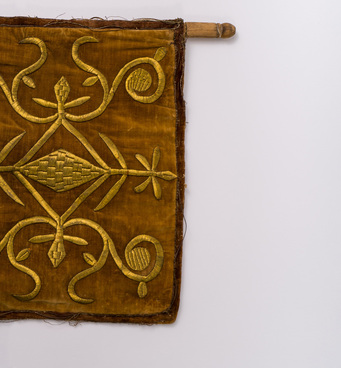
The “zhyf” fan made of straw has been kept in the funds of the Adygeysk Museum of Local Lore since July 1996. The object was presented to the museum by Galimet Tuovna Kabanova — a resident of Adygeysk. According to her, this fan belonged to her grandmother, who most likely made it herself. The fan is about 100 years old.
Since ancient times, the cult of fire was very important to the Adyghe people. Fire was perceived as a living entity and revered as a deity. The most terrible curse was the phrase “may the fire go out in your hearth” because the hearth was directly connected with the livelihood of the people living in the house. The fan, which was used to blow the fire inside the hearth, was considered a sacred item.
Fans appeared in the lives of the Adyghe people at the turn of the 19th century. These fans looked very different from European folding fans and resembled rectangular flags. Fan flags were made of either velvet or straw. They were made on a rigid 25 by 30-centimeter cardboard base. A thin carved wooden handle was inserted into the fan’s eyelet loops which allowed the fan to be rotated.
Straw fans were decorated with geometric patterns, most often symmetrical. Simple shapes, animals and birds, among other things and symbols, could be seen on the fan, which in turn could convey certain meanings.
However, researchers believe that over time, sacred meanings stopped being present in such patterns. The symbols were combined into a single pattern which was designed according to the maker’s taste and vision.
Adyghe craftswomen made zhyf fans embroidered with gold and silver, and decorated with braids and braided curly pendants. Such fans served decorative and practical purposes and were used to complement girls’ festive clothes. The zhyf fan could be seen in houses along with other decorations such as embroidered towel hangers and watch stands. A gold-embroidered fan with a family tamga (ancestral family sign) is a work of decorative and applied art.