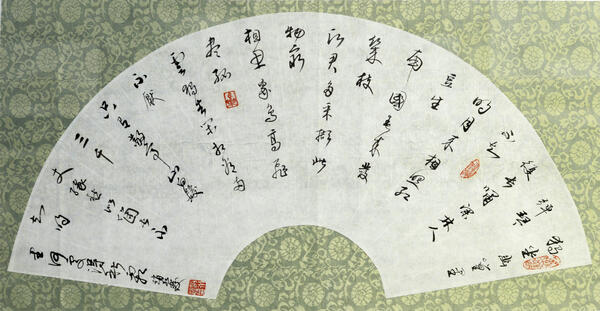
A semicircular white fan with black hieroglyphs and four red seals of the artist is depicted on a green background with a lighter floral ornament. The scroll is set in a white fabric passe-partout.
Chinese calligraphy, or writing in hieroglyphs, is an ancient art, mysterious to Europeans and sacred to the Chinese. According to legend, hieroglyphs were written on the back of a dragon that came out of the Yellow River to the Emperor Fu Xi, who ruled in the 28th century BC. The most ancient examples of hieroglyphic inscriptions were found on the turtle shells, they date back to the 17th — 13th centuries BC. Signs were written in columns from top to bottom, the first column was on the right, the rest — to the left. Unlike European writing in letters and syllables, Chinese characters are concepts. There are main hieroglyphs — radicals, of which all the rest are composed. For example, the word ‘mother’ consists of the radicals of a woman and a horse, the word ‘good’ — of the radicals of a woman and a child.
Hieroglyphic writing can be surely attributed to the world cultural heritage. The phenomenon of such writing is that it is not only a writing language and a means of communication, but also a tool using which a person can express his inner world — in this, calligraphy is very similar to painting. The Chinese warrior drew the hieroglyph ‘sword’ to set himself up for victory over the enemy.
The ability to paint with a brush has always been of emphasis in China. Inkpot, ink, paper and brush are objects that artists, scientists, poets and philosophers have always had at hand. They are called the ‘four jewels of the scientist’.
It is customary to distinguish several types of hieroglyphs. Pictograms are signs that in a schematic form depict some phenomena or things — this was the original writing. Ideograms are closely related to the first type, but they mean any idea. Phono-semantic compounds are based on two elements, one of which means ‘key’, and the second indicates its phonetic sound.
Initially, the hieroglyphs looked like a primitive drawing. Over time, the spelling of hieroglyphs changed, and modern Chinese no longer understand the signs that were in use in the 9th — 8th centuries BC. With the unification of China, there was a need for a quick and simple writing that could be understood in all provinces. A ‘running script’ began to appear, where several hieroglyphs are written together. Now in the Celestial Empire, the ‘exemplary script’ is widespread, which originated 1300 years ago. From this script the beginners start learning the basics of calligraphy, listening to the stories of old masters about the energy of ‘qi’ contained in hieroglyphs.
The painting was donated in 2003 to the Amur Regional Museum of Local Lore at the end of the exhibition of artists from Beijing.
Chinese calligraphy, or writing in hieroglyphs, is an ancient art, mysterious to Europeans and sacred to the Chinese. According to legend, hieroglyphs were written on the back of a dragon that came out of the Yellow River to the Emperor Fu Xi, who ruled in the 28th century BC. The most ancient examples of hieroglyphic inscriptions were found on the turtle shells, they date back to the 17th — 13th centuries BC. Signs were written in columns from top to bottom, the first column was on the right, the rest — to the left. Unlike European writing in letters and syllables, Chinese characters are concepts. There are main hieroglyphs — radicals, of which all the rest are composed. For example, the word ‘mother’ consists of the radicals of a woman and a horse, the word ‘good’ — of the radicals of a woman and a child.
Hieroglyphic writing can be surely attributed to the world cultural heritage. The phenomenon of such writing is that it is not only a writing language and a means of communication, but also a tool using which a person can express his inner world — in this, calligraphy is very similar to painting. The Chinese warrior drew the hieroglyph ‘sword’ to set himself up for victory over the enemy.
The ability to paint with a brush has always been of emphasis in China. Inkpot, ink, paper and brush are objects that artists, scientists, poets and philosophers have always had at hand. They are called the ‘four jewels of the scientist’.
It is customary to distinguish several types of hieroglyphs. Pictograms are signs that in a schematic form depict some phenomena or things — this was the original writing. Ideograms are closely related to the first type, but they mean any idea. Phono-semantic compounds are based on two elements, one of which means ‘key’, and the second indicates its phonetic sound.
Initially, the hieroglyphs looked like a primitive drawing. Over time, the spelling of hieroglyphs changed, and modern Chinese no longer understand the signs that were in use in the 9th — 8th centuries BC. With the unification of China, there was a need for a quick and simple writing that could be understood in all provinces. A ‘running script’ began to appear, where several hieroglyphs are written together. Now in the Celestial Empire, the ‘exemplary script’ is widespread, which originated 1300 years ago. From this script the beginners start learning the basics of calligraphy, listening to the stories of old masters about the energy of ‘qi’ contained in hieroglyphs.
The painting was donated in 2003 to the Amur Regional Museum of Local Lore at the end of the exhibition of artists from Beijing.