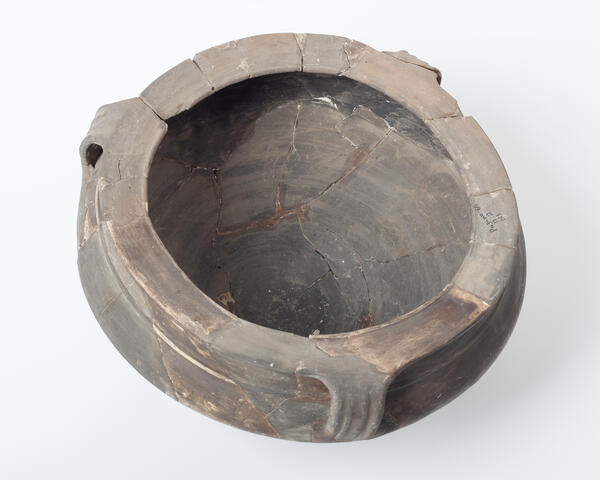
The vessel was found on the territory of the Kamianets-Podilskyi district of the Khmelnitsky region of the Ukrainian SSR, during the 1978–1979 archaeological excavations of the Dumaniv burial ground. The group was led by the Soviet archaeologist, Doctor of Historical Sciences Erast Symonovych.
The vase was created on a potter’s wheel from gray clay. There are traces of burnishing on the vessel, the rim is wide and flat, and the object features an inward slope and decorative patterns on the shoulder with a ridge. The foot of the vessel is hollow. It was created by the bearers of the Chernyakhov archaeological culture, who settled in the 2nd–4th centuries over a wide area from the Lower Danube in the west to the Seversky Donets in the east. A key characteristic of the Chernyakhov culture is its pottery.
The ceramic complex includes a small proportion of local pottery, which was an important ethnic indicator of the tribes within this community. The Chernyakhov population used a rich and diverse set of pottery: kitchen pots and bowls, table bowls, vases, pots, and jugs. In addition to household items, this set included a developed assortment of tableware forms, among which vessels for drinks — mugs and cups — played a significant role.
Later, new types of ceramics appeared: pithoi and amphorae. Jugs, vases, and cups became more numerous and typologically diverse. This was due to the adoption and adaptation of provincial Roman vessel forms in the local environment, as well as the social development of society. The three-handled vase belongs to table ceramics. Such ceramics are characterized by an undeveloped rim, a burnished gray surface, and may be ornamented with a wavy burnished line between horizontal ridges.
Three-handled vases are characterized by rims with
a wide flat surface, with the outer edge raised, or a recess on the flat
surface. As a result of the synthesis of the provincial Roman craft school and
the Gothic tradition, the original Chernyakhov style of ceramics was formed,
with its own range of forms, enriched by imitations of expensive imported
vessels made of glass, wood, and metal. According to scholars, three-handled
vases served the role of bronze basins.