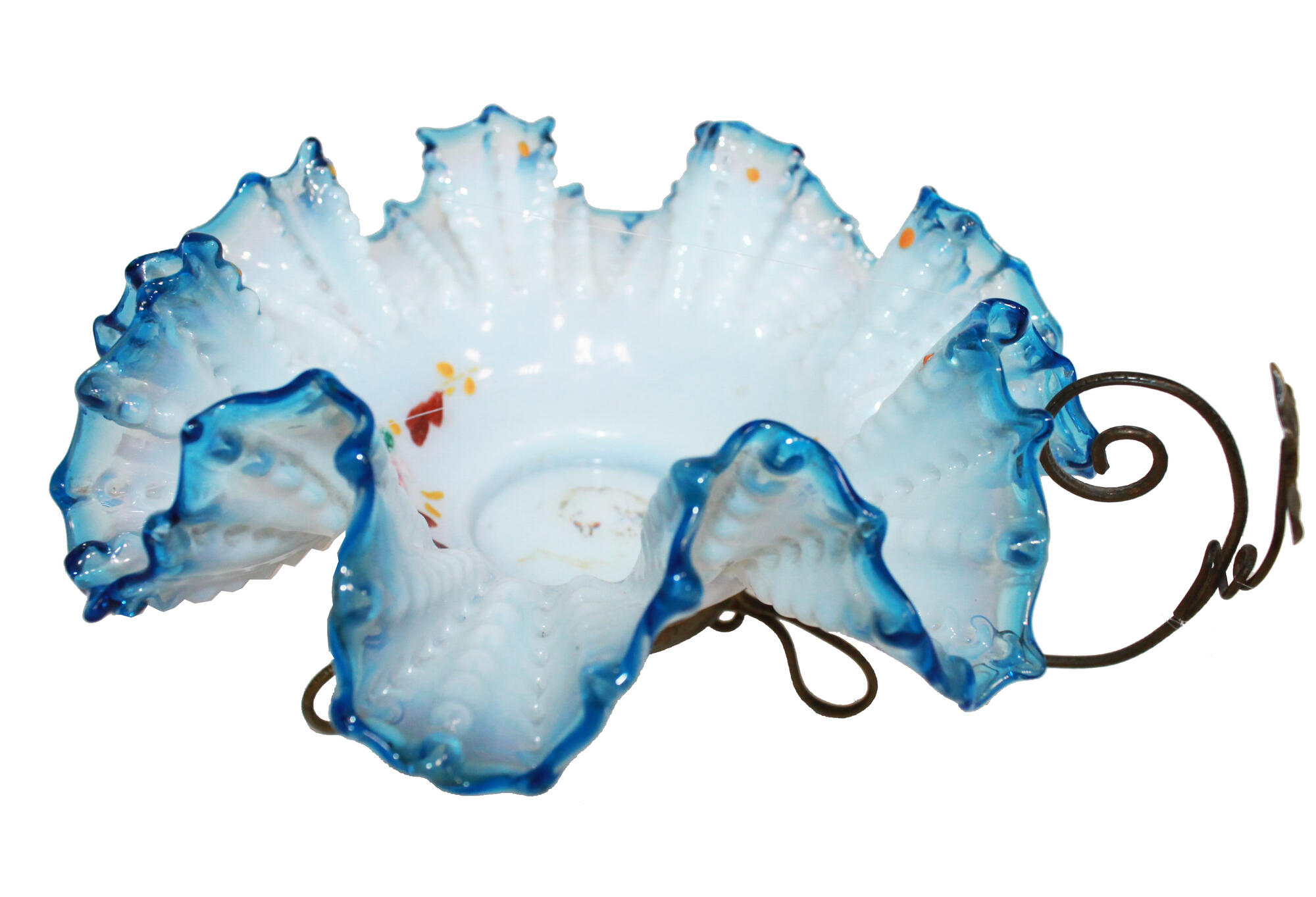
The ‘Merchant’s Drawing Room’ exhibition of the Tomsk History Museum features a glass candy dish. Along with other tableware — a cup and a saucer made of Kuznetsov porcelain and a sugar bowl — it adorns a side table in the room’s tea drinking area.


Candy dish
Creation period
Late 19th–early 20th century
Place of сreation
Western Europаe
Dimensions
9 x 18.5 cm
Technique
Glassblowing
Collection
Exhibition
1
Open in app#1
Candy Dish
#3
#5
The dish was made at a private glass factory in Europe. It was created using the glassblowing technique. This method involved melting the glass, after which it was manually given the desired shape. The tools used by glassblowers have not changed for over a thousand years. These include torches, crimps, shears, and tweezers, as well as other instruments. Such products were created right at the furnaces where the glass was melted. Artisans had to work with material that reached the temperature of 1,000 degrees Celsius. Furthermore, they had to possess a particular set of skills, as they needed to shape the product before the glass cooled down.
#6
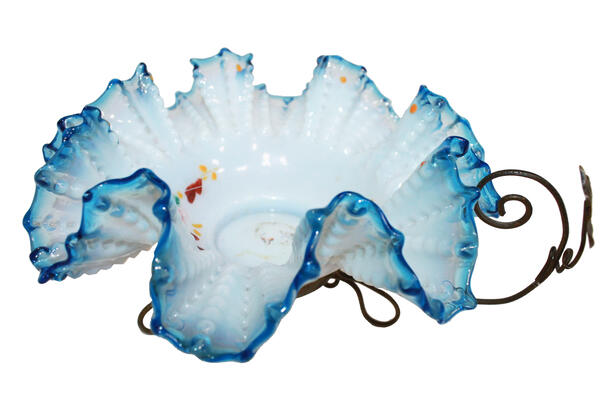
The ornately shaped item is made in the Art Nouveau style: the glassblower who created it rejected the more traditional designs and instead made a fantastically shaped dish that resembles a flower or a seashell. The artisans who worked in this style took inspiration from nature and its soft forms. The corrugated body of the dish is designed to mimic elegant folds, while the edge is embellished with festoons, which are decorative elements shaped like small triangles. The round base is set in a metal stand with three curved legs resembling ornate nooses.
#7
On the inside, the artisan painted the surface of the dish with colored enamel depicting a garland of pink flowers with brown and yellow leaves. It is possible that the center of the bottom part of the dish was originally decorated on the inside with a decal (decalcomania) image. This technique involves transferring images to plates, cups, or milk jugs from a masking sheet, rather than painting them by hand with a brush. Paper pre-masks used to be made through the application of the offset printing technique, however nowadays it is done by special laser printers. In order for a decal to take hold, the surface it is applied to is subjected to high heat. This method of tableware decoration was common in Russia and Europe in the late 19th and the early 20th centuries.
#8
Tomsk History Museum
read morehide
00:00
00:00
1x
Candy dish
Creation period
Late 19th–early 20th century
Place of сreation
Western Europаe
Dimensions
9 x 18.5 cm
Technique
Glassblowing
Collection
Exhibition
1
 Point your smartphone camera to open in the app
Open in app
Share