Font
Color
Graphics
Изображение точки

To see AR mode in action:

1. Install ARTEFACT app for iOS or Android;

2. Find the exhibition «The fascinating natural world of Kuzbas»

3. Push the «Augmented reality» button and point your phone's camera at the exhibit;

Скрыть точки интересаПоказать точки интереса
Показать в высоком качестве
#1
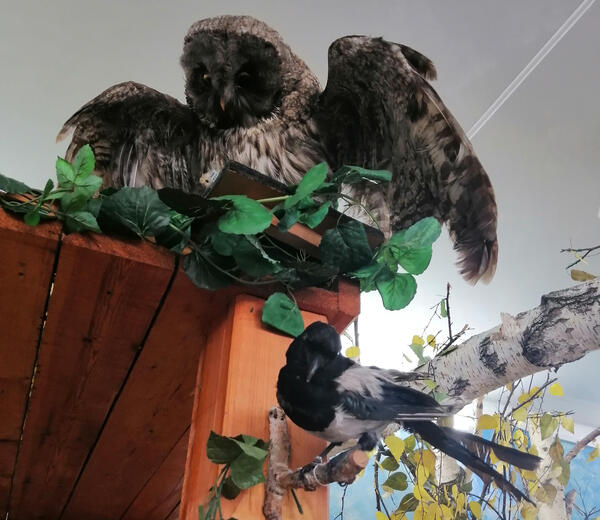
The owl, The Eurasian magpie
#5
Author unknown
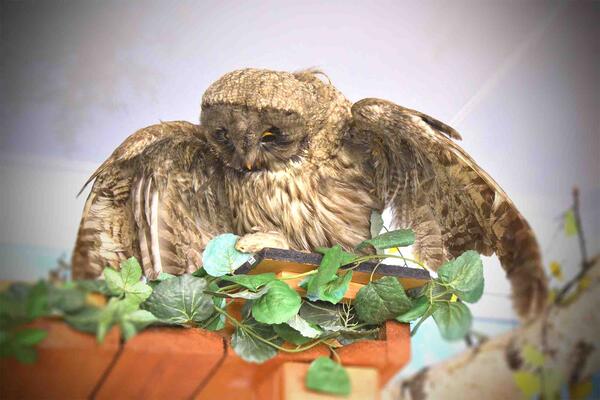
The bearded owl (Strix nebulosa)
#6
The bearded owl is a large bird of the genus Strix. Its wing span can reach 1.5 meters, and it weights on average 900 grams. The species can grow to up to 50 centimeters in length. 

It is regarded as one of the most beautiful birds among those that live in Europe. Its plumage is very dense and fluffy. Bearded owls are grey with different shades interspersed throughout. Owing to their color, these birds can hide their presence really well by blending into their surroundings. 
 
It got its name because of dark spots on the lower section of its beak. The bearded owl has a whitish collar or ‘bow tie’ around its neck, with a beard at the bottom. These birds have no ear tufts, a characteristic that distinguishes them from other birds in the owl family. Their beaks are positioned quite high and appear squeezed from each side. 
 
These species are creatures of the night, i.e. they are awake and hunt when it is dark. When these owls move around their territory at night, they use their hearing to find their bearings. They can sense threats as well as hear their potential prey from a great distance. 

These are very brave birds, which are prepared to fight the strongest of predators to protect their offspring and partners. 
 
Their nests are usually located in hollows of forest trees, most often in glades not far from mossy swamps or under roofs of abandoned buildings. There is a good view of surroundings from such locations, hence it is easier for the birds to catch their prey. A distinguishing characteristic of bearded owls is how quiet they are - these birds very rarely call out to each other. They usually stay within their territory, and still these owls are capable of leaving their home and migrating to other regions for the winter. 
 
If, in their opinion, a threat arises, these birds immediately compress the feathers against their bodies and become virtually invisible among the trees. They may then either attack or leave their hiding spots noiselessly. 
 
Bearded owls visit dense forest thickets at night. They glide between trees silently, searching for various small rodents. These birds quite often attack their unsuspecting victims from their hiding spots. In Ancient Rus’, they were called insatiable creatures, in fact, their Russian name originates from this description. 
#7
Date: The end of the 20th century
Technique a stuffed bird
Collection: Natural science
Copyright: Promyshlennovsky District Museum of History and Regional Studies
Dimensions: 62*70*30
Goskatalog Number: 24245809
#8
Author unknown
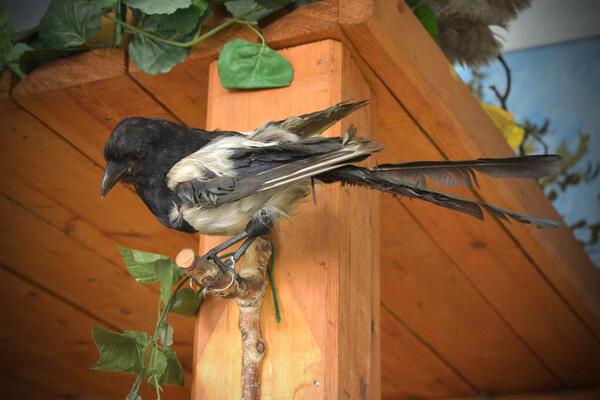
The Eurasian or common magpie
#10
The Eurasian magpie is a well-known bird in the crow family of the order Passeriformes. Its closest relatives are crows and Eurasian jays. The bird’s uniquely colored black and white plumage makes it easily recognizable. Its head, neck, back, chest and tail are black with a metallic and, at times, dark and light bluish hue, which is particularly noticeable in sunlight. The stomach area, sides and shoulders of the bird are white. Sometimes, the ends of its wings are also white. Eurasian magpies can reach up to 50 centimeters in length, although on average they are approximately 40-45 cm long. Their wingspan is 50-70 centimeters, and in rare cases, it can be up to 90 cm. The bird’s fairly long, tapering and nimble tail is almost 25 centimeters in length, accounting for half the size of the bird. Males, weighing approximately 230 grams as a norm, are slightly heavier than the females, which are on average about 200 grams. On the ground, the Eurasian magpie moves by hopping around on both of its legs, while holding its tail up high. In the air, the bird prefers to plan its movements, so its flight looks labored and meandering, at times, it has been compared to diving. 

The magpie’s usual habitat is open spaces where it is easier to find food. In essence, the bird is an omnivore. It can eat grains and seeds in the fields, peck out insects and parasites out of coats or fur of grazing cattle or large wild animals, or readily consume worms, caterpillars and larvae that it is skilled at digging out of the ground. Aside from insects, its diet includes small rodents, frogs, snails, fairly small lizards, fledglings of other birds and eggs from their nests. 
 
Eurasian magpies partner for life. They both always take part in the construction of their nest. Their domed abodes have an entrance at the side and an adjoining clay tray. Clay as well as hard branches and leaves are used to build the walls and the roof of the nest. In fact, twigs are essential for the roof. The inside is covered with hay, dry grass, small roots and bits of fur. The nests are built up high. Owing to the fact that their roofs are made of sticks, they are not easily accessible to birds of prey. 
 
Eurasian magpies are intelligent and have a good memory. Despite their curious nature, they are very careful and can evade traps. These birds learn with ease, acquire new skills and adapt to their changing environment. Out in the wild, their enemies mainly include large birds of prey, such as falcons, owls, Eurasian eagle-owls, true and sea eagles and hawks. In our climatic zones, squirrels, martens, foxes and, in extremely rare cases, wolves and bears can get into these birds’ nests. 
#9
Date: The end of the 20th century
Technique a stuffed bird
Collection: Natural science
Copyright: Promyshlennovsky District Museum of History and Regional Studies
Dimensions: 38*14*10
Goskatalog Number: 24245810
read morehide

The owl, The Eurasian magpie

0
Point your smartphone camera to open in the app
Share
VkontakteOdnoklassnikiTelegram
Share on my website
Copy linkCopied
Copy
Open in app
To see AR mode in action:
  1. Install ARTEFACT app for 
  2. iOS or Android;
  3. Find and download the «Paintings in Details» exhibition
  4. Push the «Augmented reality» button and point your phone's camera at the painting;
  5. Watch what happens on your phone screen whilst you flip through the pictures.
 
We use Cookies
Cookies on the Artefact Website. We use cookies to ensure that we give you the best experience on our website. If you continue without changing your settings, we'll assume that you are happy to receive all cookies on the Artefact website. However, if you would like to, you can change your cookie settings at any time.
Learn more about cookie useHide
Content is available only in Russian

X

Нашли опечатку?...

%title%%type%