An iron is a small appliance used to press clothes to remove wrinkles. It has a heavy metal base with a smooth heated surface and a handle at the top.
In Russia, people used different methods to smooth out their clothes after washing them. For example, they would stretch wet clothes on a flat surface and leave them to dry in this way. They also used glass balls, bottle bottoms, and iron mugs filled with hot water.
The first mention of irons being used in everyday life dates back to February 10, 1636. There is the following record in the book of expenses of the tsar’s court, “The blacksmith Ivashka Trofimov was paid 5 altyns for providing an iron for the Tsaritsa’s chamber.“
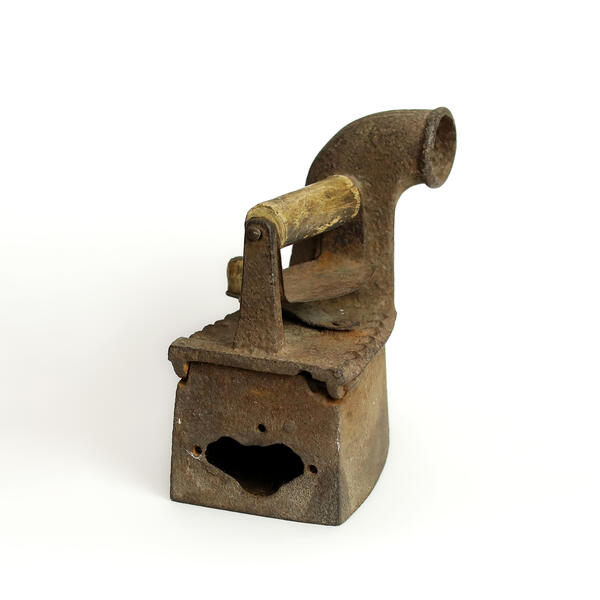
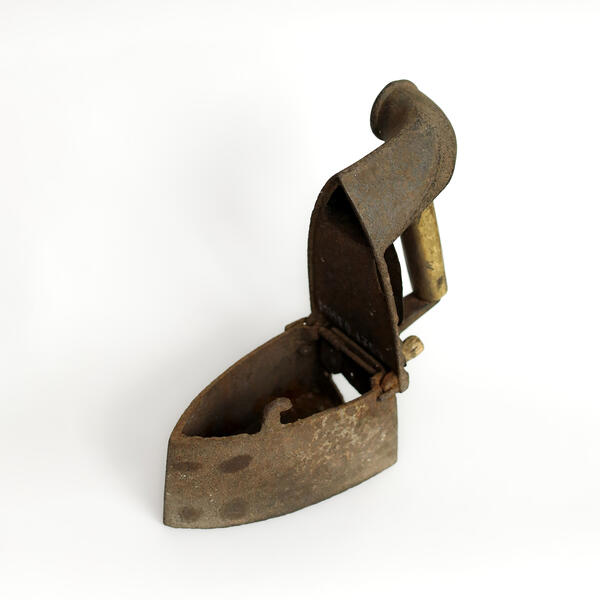
By the 18th century, the industrial production of different types of irons had been established. For example, the charcoal iron was used in the following way. The hollow body was filled with coals, which heated the device. To reheat coals, people would blow into the holes or wave the iron from side to side.
These irons were also classified into Swiss and English varieties. Swiss irons were simple hollow ones, while “English” irons were equipped with a pipe or holes on the sides for better air circulation.
Irons with heated inserts were also popular at that time. These had a hollow body with a flap on the back. The continuous process of ironing was ensured by two inserts that were heated on the fire in turn.
There were also cast irons. These were heated over an open fire or in a hot stove. Among them, special tailor’s irons stood out. They were larger and heavier than ordinary cast irons. They were used to smooth out the seams on clothes made of thick fabrics. Large cast irons could weigh up to 12 kilograms and were used for ironing coarse fabrics.
A cast iron took a very long time to warm up — at least 30 minutes. It could not be handled without a potholder when heated. Soon, their design was improved. Such irons began to be produced in pairs — with one detachable handle that could be used with either cast iron soleplate. While one soleplate was being used, the other was heating up, which significantly accelerated the ironing process.
In the late 19th century, gas irons appeared. A metal pipe was inserted into the body of such an iron. It was connected to a gas cylinder at the other end. There was a pump on the lid of the iron which pumped the gas inside, where it burned and heated the soleplate.