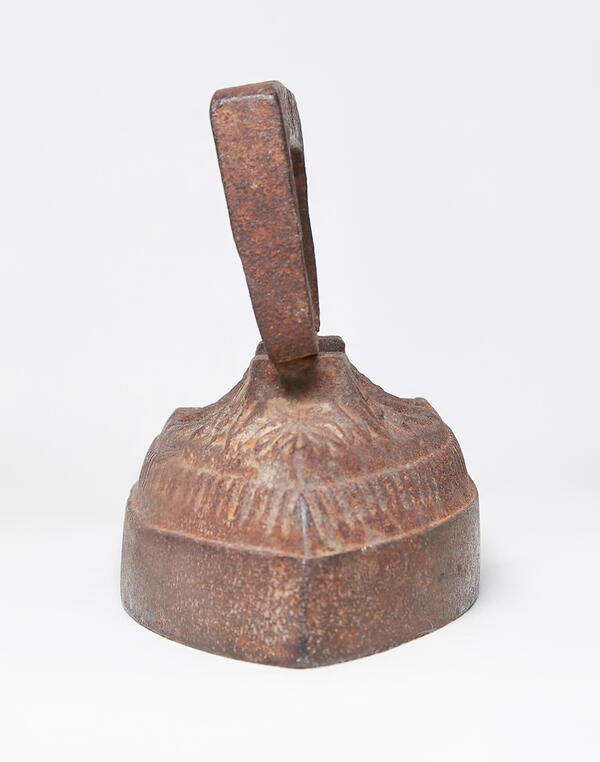
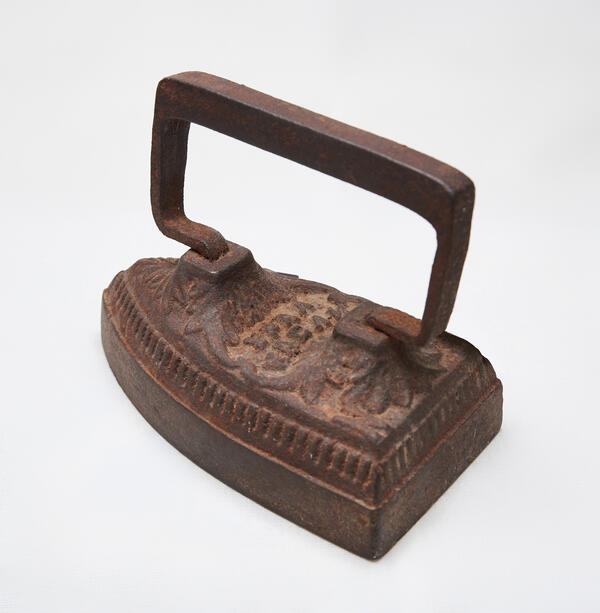
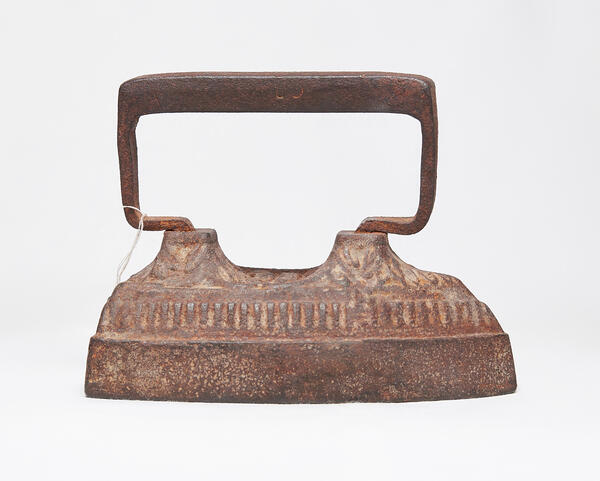
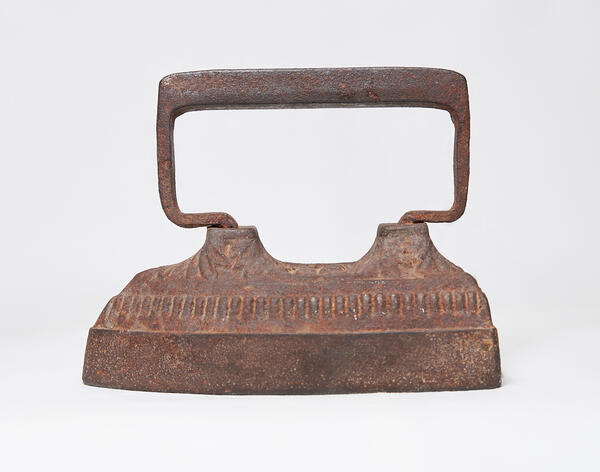
The first mention of an iron was recorded in the housekeeping book of the royal court from February 10, 1636. The history of the “shell for ironing linen and clothes”, as Vladimir Ivanovich Dal described it in his dictionary, dates back to the Stone Age. Back then, people used two cobblestones heated in the sun to iron clothes. The ancient Greeks smoothed their clothes and decorated them with neat folds using red-hot metal rods. The Romans “broke” the creases on the fabric with blows of a metal hammer. In Russia, ironers used a roller and a wooden board with carved grooves — a rubel…
The item, which appeared in 1636, was an “iron box with a handle” (Vladimir Dal), which combined both the “Greco-Roman” heating system and the “Russian” smoothing process.
Solid cast iron devices (sadirons) with a flat sole and without an internal heat source appeared in Russia in the 18th century. They were intended for ironing coarse fabrics. However, to press smaller garments (collars, cuffs, and gloves) made of more delicate materials, irons no larger than the palm of one’s hand were used.
Cast iron items used for ironing clothes were heated over an open fire or in an oven. The heating process took half an hour or more, but the device would cool down pretty quickly. It was difficult to handle a ten-kilogram cast-iron device, so every family tried to keep several irons: while one was working, the second was being heated to the desired temperature. Another problem was the non-removable handle: it was heated together with the iron and could only be held with a special mitt or gripper.
Over time, stacked irons with one removable handle were developed: only cast-iron bodies were placed on the flame, and the handle was simply moved from one to another as needed.
Despite all the inconveniences, the item remained popular for a long time. Back in the 1950s and 1960s, when electric irons appeared, the cast iron “shell” remained in almost every communal apartment in the USSR. The reason is simple: electric novelties were significantly more expensive, and sockets were not installed everywhere yet. In addition, solid irons could not be broken and could serve indefinitely.