Font
Color
Graphics
Изображение точки

To see AR mode in action:

1. Install ARTEFACT app for iOS or Android;

2. Find the exhibition «Masterpieces of the Andrei Rublev Museum»

3. Push the «Augmented reality» button and point your phone's camera at the exhibit;

Скрыть точки интересаПоказать точки интереса
Показать в высоком качестве

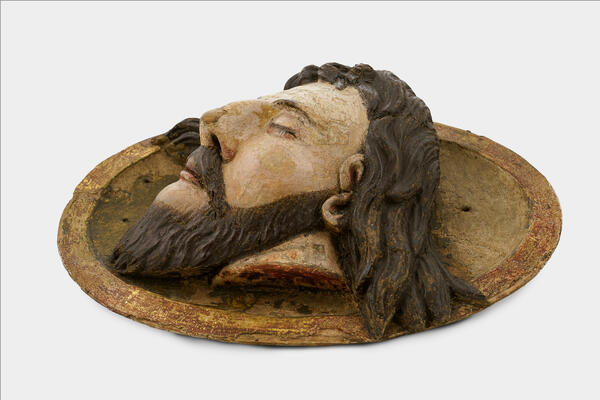
The Head of St. John the Baptist

Creation period
the late 17th century
Place of сreation
Russia
Dimensions
45x28,5x11 cm
Technique
wood, oil; carving
2
Open in app
#1

In the traditions of the Orthodox Church, the Finding of the Head of St. John the Baptist, also known as John the Forerunner, is celebrated three times a year. This is one of the most revered relics in the Christian world. According to the Gospels, Herodias took the head of Saint John after his death. Fearing his resurrection, she put his head into a vessel and buried it secretly in one of Herod’s properties, so that the body and the head were buried separately.

There are numerous legends concerning St. John’s head. According to one of them, it was buried in Jerusalem. Another says that Saint Joanna, who was married to Herod’s steward, stole the head from Herodias and buried it.

The fate of St. John’s head is also told in Byzantine legends. Allegedly, during the reign of Emperor Constantine the Great (306–337), it was discovered by two monks on a pilgrimage to Jerusalem. They saw a vision of John the Baptist who revealed to them the location of his head. On their way back from Jerusalem, the two monks encountered a potter from Emesa. He had left his home to work in another city. He had also seen a vision of John the Baptist who instructed him to retrieve his head from the two monks. This is how the relic ended up in Emesa. There, it was kept in the potter’s family and later passed from one generation to another by the pious citizens.

Once, a heretic by the name of Eustathius came into possession of the head. He used to deceive the citizens of Emesa by attributing the relic’s miracles and healings to himself. The deception was exposed, and the heretic was banished from the city. Eustathius left the city and hid the saint’s head in a cave, where monks soon founded a monastery, unaware of the hidden relic. In 452, the head was discovered by abbot Marcellus of this monastery. This event is celebrated as the second finding. For the third time, the head was discovered in the 9th century after the restoration of the veneration of icons in Constantinople.
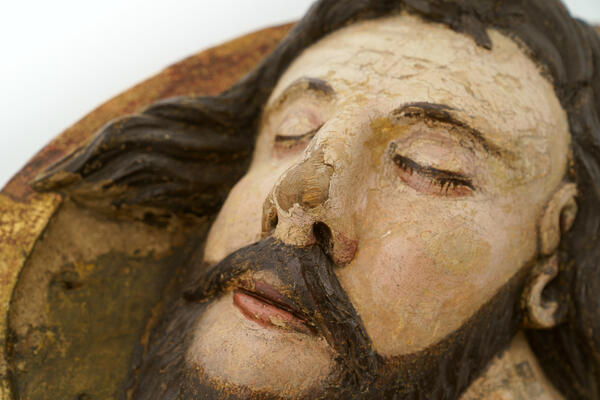
In Russia, carved, colorful images of John the Baptist’s head appeared during the last quarter of the 18th century. Wooden sculptures were especially popular in the Russian North. The names of most artists are unknown. Statues were painted with tempera and oil paints and were often quite naturalistic, influenced by Western European artistic traditions. In Western Europe, images of saints often show signs of martyr’s death on the face and neck, while in the Orthodox depiction of “The Beheading of John the Baptist”, the prophet’s face is usually calm and peaceful.

#3
The Head of St. John the Baptist
#2
read morehide
00:00
00:00
1x

The Head of St. John the Baptist

Creation period
the late 17th century
Place of сreation
Russia
Dimensions
45x28,5x11 cm
Technique
wood, oil; carving
2
Point your smartphone camera to open in the app
Share
VkontakteOdnoklassnikiTelegram
Share on my website
Copy linkCopied
Copy
Open in app
To see AR mode in action:
  1. Install ARTEFACT app for 
  2. iOS or Android;
  3. Find and download the «Paintings in Details» exhibition
  4. Push the «Augmented reality» button and point your phone's camera at the painting;
  5. Watch what happens on your phone screen whilst you flip through the pictures.
 
We use Cookies
Cookies on the Artefact Website. We use cookies to ensure that we give you the best experience on our website. If you continue without changing your settings, we'll assume that you are happy to receive all cookies on the Artefact website. However, if you would like to, you can change your cookie settings at any time.
Learn more about useHide
Content is available only in Russian

X

Нашли опечатку?...

%title%%type%