

Since the second half of the 17th century, the Volga region has gained the status of a leading center of Old Believers’ culture. The traditions and customs of the Old Believers have significantly influenced the trends in the region’s visual arts.
At the turn of the 18th century, Balakhna icon painters were highly appreciated for their skills both in the town and beyond. Among the most original monuments created by them is the icon “Beheading of John the Baptist”. Probably, this icon was also painted by an Old Believer.
The plot that served as the basis for the image is described in detail by the evangelists Mark, Matthew and Luke.
John the Forerunner, who baptized Jesus Christ in the waters of the Jordan River, is one of the most beloved and revered saints in Russia. He was known as a zealous defender of the faith and the Jewish law, who called people to repent and prepared them for the coming of the Messiah.
Having learned that Queen Herodias had entered into a criminal relationship with her husband’s half-brother, Herod Antipas, John came to the palace to reproach her, but was imprisoned. The queen wanted the accuser to die; she taught her daughter Salome to please Herod with a dance and demand the prophet’s head as a reward. And this was done.
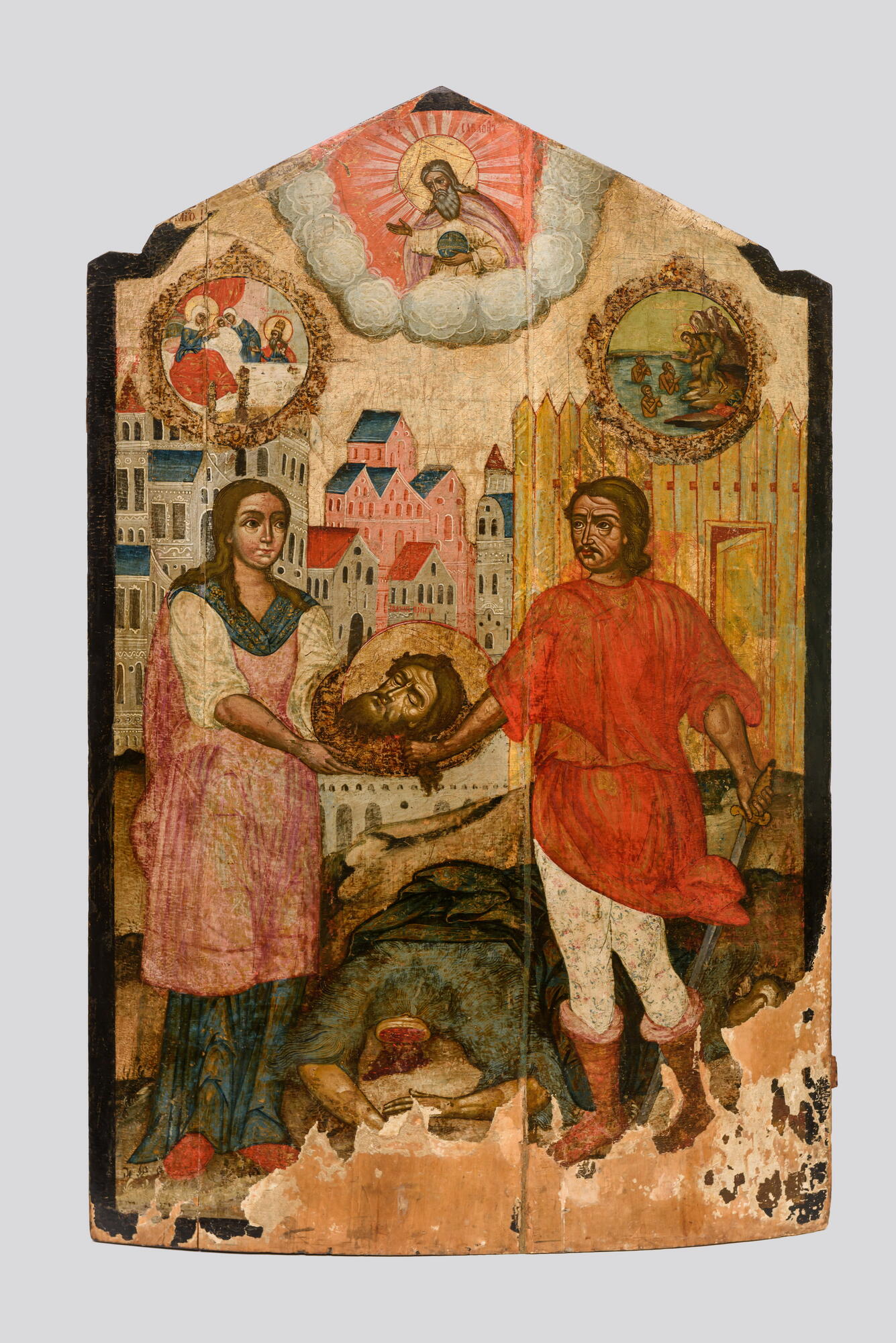
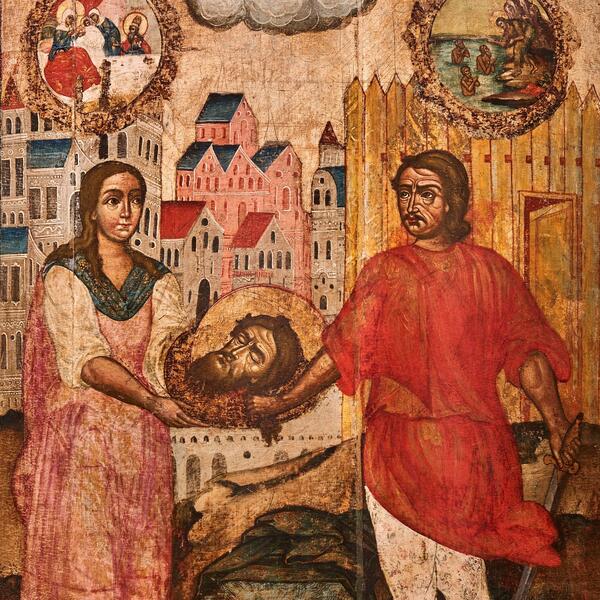
The iconographer depicted Salome receiving the head of John the Baptist from the executioner on a platter; the headless body lies at their feet. The houses and the fence in the background symbolically represent the city and the prison.
In the upper part of the icon, the master painted Sabaoth, the Lord of Hosts, holding a transparent sphere (a zertsalo) in his hand and blessing John. On the sides are two round framed images: the one on the left depicts the Nativity of John the Baptist and the one on the right — the scene of the baptism of people in the Jordan River. Such a composition is traditional for the Old Believer church tradition.
The most remarkable feature on this icon are the faces of Salome and the executioner, which resemble Princess Sophia and Peter the Great. The first Russian emperor in the eyes of the Old Believers truly was an executioner who violated the true faith.
The stone Ascension Cathedral in Balakhna, where this icon comes from, was erected in 1727. One of the main donors was the merchant-Old Believer Pyotr Ignatievich Osokin.
At the turn of the 18th century, Balakhna icon painters were highly appreciated for their skills both in the town and beyond. Among the most original monuments created by them is the icon “Beheading of John the Baptist”. Probably, this icon was also painted by an Old Believer.
The plot that served as the basis for the image is described in detail by the evangelists Mark, Matthew and Luke.
John the Forerunner, who baptized Jesus Christ in the waters of the Jordan River, is one of the most beloved and revered saints in Russia. He was known as a zealous defender of the faith and the Jewish law, who called people to repent and prepared them for the coming of the Messiah.
Having learned that Queen Herodias had entered into a criminal relationship with her husband’s half-brother, Herod Antipas, John came to the palace to reproach her, but was imprisoned. The queen wanted the accuser to die; she taught her daughter Salome to please Herod with a dance and demand the prophet’s head as a reward. And this was done.
The iconographer depicted Salome receiving the head of John the Baptist from the executioner on a platter; the headless body lies at their feet. The houses and the fence in the background symbolically represent the city and the prison.
In the upper part of the icon, the master painted Sabaoth, the Lord of Hosts, holding a transparent sphere (a zertsalo) in his hand and blessing John. On the sides are two round framed images: the one on the left depicts the Nativity of John the Baptist and the one on the right — the scene of the baptism of people in the Jordan River. Such a composition is traditional for the Old Believer church tradition.
The most remarkable feature on this icon are the faces of Salome and the executioner, which resemble Princess Sophia and Peter the Great. The first Russian emperor in the eyes of the Old Believers truly was an executioner who violated the true faith.
The stone Ascension Cathedral in Balakhna, where this icon comes from, was erected in 1727. One of the main donors was the merchant-Old Believer Pyotr Ignatievich Osokin.