In Rus, there was a special attitude towards the Mother of God — the Intercessor, Our Lady of Prompt Succor, and Mother. The believers have been coming to pray to her, at her images, with all their sorrows and sincere filial trust.


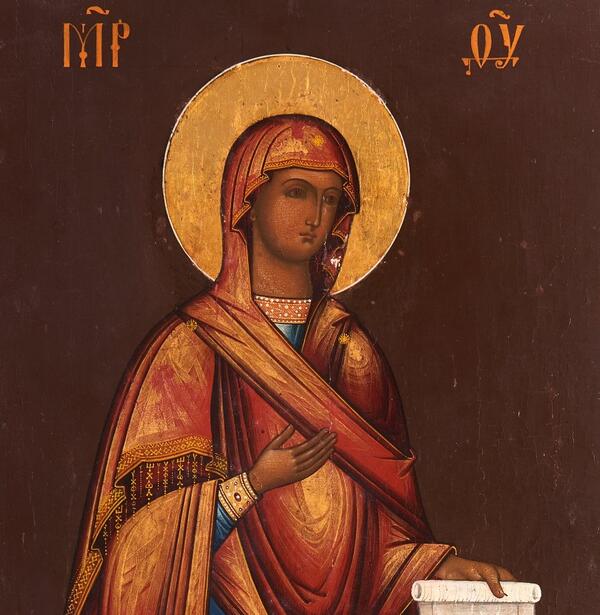
Mother of God with a Scroll
Creation period
the mid-19th century
Place of сreation
the Russian Empire
Dimensions
57x28,5 cm
Technique
wood, gesso, tempera
Collection
Exhibition
0
Open in app#2
#5
At that hour when She stood in silent maternal sorrow on the terrible Golgotha, where Her beloved Son, the Son of God, was dying in agony… She accepted from Him the task to be the Mother to the entire human race.
Archimandrite Tikhon (Agrikov)
#6
There are many images dedicated to the intercession of the Mother of God, including in the deesis composition. The presented icon is one of such images.
The displayed icon belongs to the iconographic type called Hagiosoritissa (in Greek it means “Intercessor”). The Mother of God is depicted in full-length, without the Christ Child, half-turned to the right (from the viewer), as the icon of the Savior would be placed to the right of this icon. In her hands she holds an unfolded scroll with the text of the prayer:
The displayed icon belongs to the iconographic type called Hagiosoritissa (in Greek it means “Intercessor”). The Mother of God is depicted in full-length, without the Christ Child, half-turned to the right (from the viewer), as the icon of the Savior would be placed to the right of this icon. In her hands she holds an unfolded scroll with the text of the prayer:
#7
The King of Heaven, accept every person who glorifies You and calls on Your holy name in all places.
#8
The face of the Virgin on Russian icons is always sad. Sometimes this sadness is combined with severity, sometimes with lyricism, but it is invariably full of wisdom and spiritual power.
This iconographic type is found not only on icons, but is also represented on frescoes and church mosaics; it can be full-length or shoulder-length.
The vestments of the Mother of God on the icon are canonical. The light blue color of the tunic symbolizes purity and chastity, it is traditionally associated with the Virgin colors. Sometimes blue was replaced with dark blue or dark green. The red color of the maphorion denotes the Divine predestination of the Mother of God. The term “deesis” (from the Greek δέησις — “prayer”) was used in Russia to refer to both a three-part icon (Christ with the Mother of God and John the Baptist standing before Him) and a row of icons. Until the 17th century, this word was synonymous with “iconostasis”.
Professor Yevgeny Yevsigneyevich Golubinsky believes that it was the case because church builders would leave the inscription on the kosmitis (altar barrier): “deisis tu dulu Feu” (“Prayers of the servant of God”).
In the Russian tradition, the word “deesis” changed into “deisus”. According to Professor Alexander Ivanovich Uspensky, the Greek word was translated as a compound and was believed to mean “the work of Jesus”, which explains why the word was used to refer to the entire iconostasis.
The presented icon comes from the Nativity Church in the town of Balakhna. In 1993, it was restored in the Moscow Interregional Scientific and Restoration Department.
This iconographic type is found not only on icons, but is also represented on frescoes and church mosaics; it can be full-length or shoulder-length.
The vestments of the Mother of God on the icon are canonical. The light blue color of the tunic symbolizes purity and chastity, it is traditionally associated with the Virgin colors. Sometimes blue was replaced with dark blue or dark green. The red color of the maphorion denotes the Divine predestination of the Mother of God. The term “deesis” (from the Greek δέησις — “prayer”) was used in Russia to refer to both a three-part icon (Christ with the Mother of God and John the Baptist standing before Him) and a row of icons. Until the 17th century, this word was synonymous with “iconostasis”.
Professor Yevgeny Yevsigneyevich Golubinsky believes that it was the case because church builders would leave the inscription on the kosmitis (altar barrier): “deisis tu dulu Feu” (“Prayers of the servant of God”).
In the Russian tradition, the word “deesis” changed into “deisus”. According to Professor Alexander Ivanovich Uspensky, the Greek word was translated as a compound and was believed to mean “the work of Jesus”, which explains why the word was used to refer to the entire iconostasis.
The presented icon comes from the Nativity Church in the town of Balakhna. In 1993, it was restored in the Moscow Interregional Scientific and Restoration Department.
#9
Ministry of Culture of the Russian Federation
read morehide
00:00
00:00
1x
Mother of God with a Scroll
Creation period
the mid-19th century
Place of сreation
the Russian Empire
Dimensions
57x28,5 cm
Technique
wood, gesso, tempera
Collection
Exhibition
0
 Point your smartphone camera to open in the app
Open in app
Share