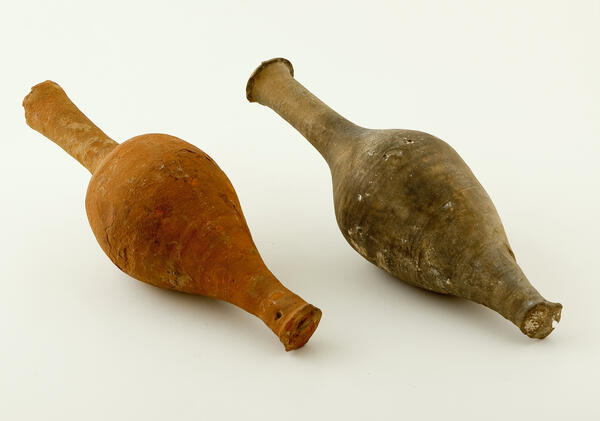
A significant portion of Hellenistic pottery in the burials of nomads in Asian Sarmatia from the 2nd to 1st centuries BCE is represented by spindle-shaped flasks. These are predominantly found in the burials of adult or elderly male warriors in the area between the Don and Volga rivers and in the Transvolga region. They could have been considered status items by their owners, even after their contents were used, which was not always the case, given the findings of contents within the flasks. It means that these vessels were unlikely intended for long-term storage or reuse given their extremely small volume. In burials with unguentaria, items and elements of the burial rite of Eastern origin are often found. It is evident that the owners of the ancient pottery, utterly or partially, were nomads who had arrived from the East.
The vessel was found near the Zaplavnoye village in the Sredneakhtubinsky district of the Volgograd region. The vessel is black-polished with two loop handles featuring vertical perforations. The surface of the vessel is dark gray and polished.