In the art of the early Sarmatians (2nd-1st centuries BC), where zoomorphic motifs are sparsely represented, one of the few manifestations of zoomorphism is found in buckles depicting animals. These items are labeled as buckles or belt plates, but they do not always serve such a purpose. Often, these objects performed a decorative function.
Scenes of predation reflected the ideology of warlike tribes, whose lives primarily involved raids, nomadic livestock farming, and hunting. More such scenes are known from items made by Greek craftsmen. However, items crafted by local artisans are more commonly found in the burials of nomads.
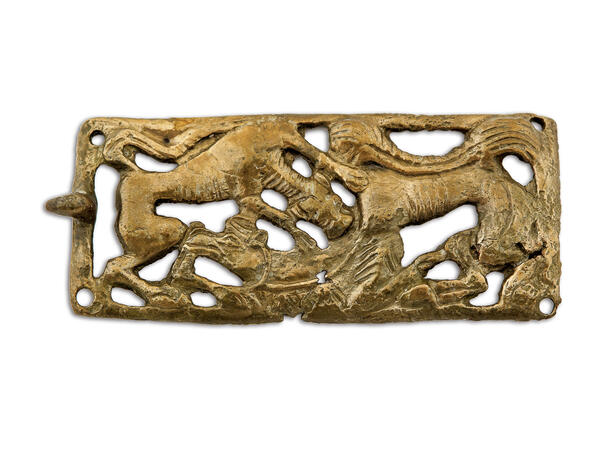
The buckle found near the village of Pisareva in the Kabalevsky District of the Volgograd Region is rectangular and made by casting, decorated with a raised edge around the perimeter. The corners of the buckle have pierced holes for attaching it to a belt. One narrow side has a high hook for securing the belt loop. The inner area of the buckle is filled with a relief depiction of fighting animals — a panther and a camel.