Font
Color
Graphics
Изображение точки

To see AR mode in action:

1. Install ARTEFACT app for iOS or Android;

2. Find the exhibition «Sochi: From Prehistoric Times to This Day»

3. Push the «Augmented reality» button and point your phone's camera at the exhibit;

Скрыть точки интересаПоказать точки интереса
Показать в высоком качестве

Boss — the center of a shield

Creation period
the 1st–5th centuries
Place of сreation
the Roman Empire
Dimensions
17x13,5x10 cm
Technique
bronze; casting, gilding
3
Open in app
#5

Monuments characterizing the late antique period in the vicinity of Sochi are represented by the ruins of Roman-Byzantine fortifications, several remarkable burial complexes (in Loo, Matsesta and Krasnaya Polyana), and individual finds.

A boss (a metal plate located in the center of a military shield) was found in a burial destroyed when a trench was dug on the northeastern outskirts of Krasnaya Polyana in 1942, at the fork in the road to the “hunting lodge” and to the village of Estosadok. At a depth of one meter, the bottom of a burial pit lined with fairly large stones was discovered. There were remains of a skeleton with the head pointed to the southeast. The burial revealed a mostly decayed double-edged sword with a pommel in the form of a multifaceted crystal bead, three iron spearheads, a knife, and an iron battle axe of the Tsebelda type. The displayed gilded bronze umbo (the central part of a shield) with a spiral-shaped knob was found at the feet of the skeleton. A silver dish with an image of a Persian nobleman hunting a bear was laid near the head. Next to the dish were three silver coins, apparently of Caesarean mintage, one of which belonged to the Emperor Hadrian (122–121 BCE).
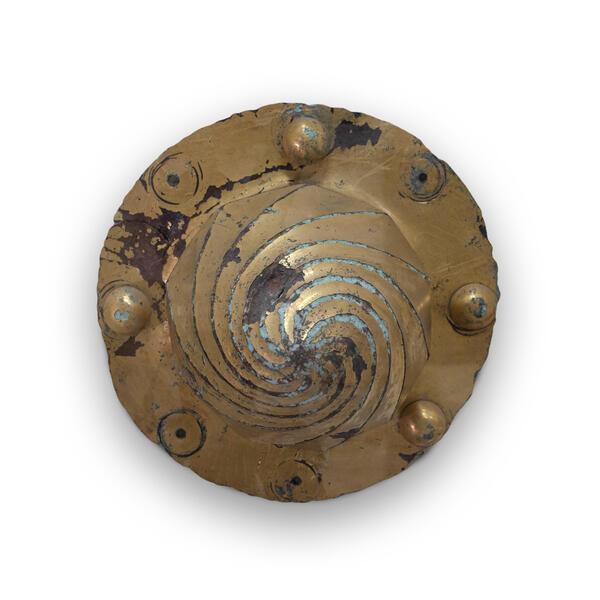
Boss shields were typical of the Germanic peoples, and their design was borrowed by the Romans. The Roman presence in the territory that today comprises the city of Sochi was primarily linked to the need to defend the empire’s borders against invasions from the east. This explains the predominance of military contingent in those lands. The armament of the Roman legionnaires influenced local military traditions. In particular, similar bosses appeared on the round shields of warriors from local tribes. The boss in the strongest part — the center of the shield — allowed the warrior to be protected from a chopping blow: the enemy’s sword would slip or even break upon hitting the boss. The gilded bronze surface also points to the decorative role of the boss, which demonstrated the high status of the owner. The boss presented in the exhibition of the Museum of the History of the City-Resort of Sochi was created using the casting technique and gilding.

#6
Boss — the center of a shield
#4
read morehide
00:00
00:00
1x

Boss — the center of a shield

Creation period
the 1st–5th centuries
Place of сreation
the Roman Empire
Dimensions
17x13,5x10 cm
Technique
bronze; casting, gilding
3
Point your smartphone camera to open in the app
Share
VkontakteOdnoklassnikiTelegram
Share on my website
Copy linkCopied
Copy
Open in app
To see AR mode in action:
  1. Install ARTEFACT app for 
  2. iOS or Android;
  3. Find and download the «Paintings in Details» exhibition
  4. Push the «Augmented reality» button and point your phone's camera at the painting;
  5. Watch what happens on your phone screen whilst you flip through the pictures.
 
We use Cookies
Cookies on the Artefact Website. We use cookies to ensure that we give you the best experience on our website. If you continue without changing your settings, we'll assume that you are happy to receive all cookies on the Artefact website. However, if you would like to, you can change your cookie settings at any time.
Learn more about useHide
Content is available only in Russian

X

Нашли опечатку?...

%title%%type%