#1
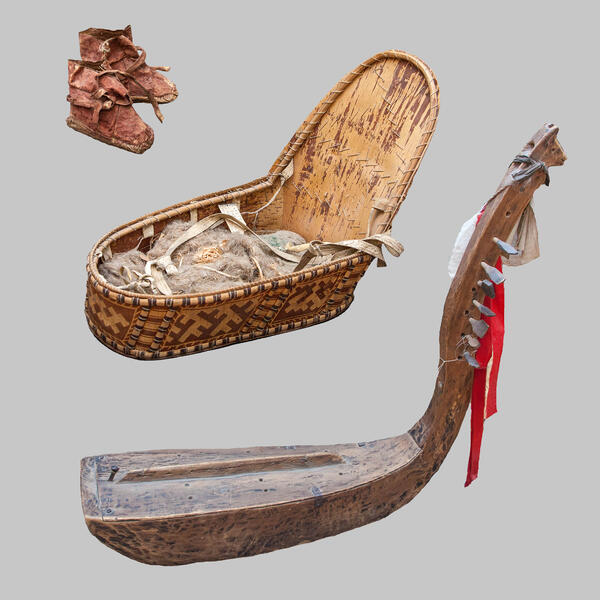
Corner harp, Baby day cradle, Children’s shoes
#4
#2
#5
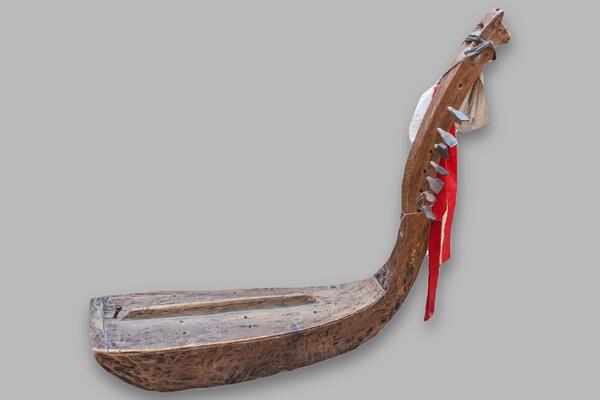
The harp is a seven-stringed musical plucked instrument of ancient origin, the simplest types of which were known in Ancient Egypt and Babylon. In the North of Western Siberia, it was widespread among the Selkups, Ob Ugrians, Mansi, and Khanty. Researchers suggest that the simplest harps, which include the Tobolsk specimen, originate from hunting and combat bows. The invention of a plucked musical instrument could have been prompted by the sound of a bowstring vibrating after a shot.
The corner harp entered the museum’s funds in 1905 from a resident of Surgut N.V. Yevseyev. The master cut out the body of the instrument from a single piece of wood and gave it the shape of a floating bird with the head of a horse, i.e. a trapezoidal muzzle with small rectangular appendix ears. Flattened trapeze-platform neck smoothly turns into a hollow trunk body. On instruments of this type, the neck most often ended with a carved bird’s head, and the horse was extremely rare.
Among the Mansi peoples, the harp is called toorsapt-yuh literally translated from the Mansi language as ‘tree with a crane’s neck’, or “crane”s neck made of wood”. The Northern Khanty people call this instrument tor-saplyukh. It is very similar to its Mansi counterpart. The main secret of harp makers is how to choose the right tree. These secrets have been passed down from generation to generation. Usually, the musicality of a tree, mostly cedar or pine, was determined in winter with a wooden hammer. Then a suitable tree was cut down, floated down the river in spring or summer, dried, and then made into a harp.
They played this harp with two hands. They played the melody with the left, and plucked one of the lower strings with the right, thus having made monotonous low sounds that gave the music solemnity. The strings of the instrument were stretched using pegs in the form of spatulas located on the neck. According to ethnographic literature, from 5 to 13 strings of copper, bronze, or animal veins could be stretched between the pegs and the soundboard. The Tobolsk exhibit has no strings or crossbars.
The timbre-sound capabilities of the harp allowed it to be used in combination with other musical instruments. The harp was often used for bear festivals. They are now almost not played. You can only imagine and recreate the musical culture of the Khanty people with the help of preserved copies.
The corner harp entered the museum’s funds in 1905 from a resident of Surgut N.V. Yevseyev. The master cut out the body of the instrument from a single piece of wood and gave it the shape of a floating bird with the head of a horse, i.e. a trapezoidal muzzle with small rectangular appendix ears. Flattened trapeze-platform neck smoothly turns into a hollow trunk body. On instruments of this type, the neck most often ended with a carved bird’s head, and the horse was extremely rare.
Among the Mansi peoples, the harp is called toorsapt-yuh literally translated from the Mansi language as ‘tree with a crane’s neck’, or “crane”s neck made of wood”. The Northern Khanty people call this instrument tor-saplyukh. It is very similar to its Mansi counterpart. The main secret of harp makers is how to choose the right tree. These secrets have been passed down from generation to generation. Usually, the musicality of a tree, mostly cedar or pine, was determined in winter with a wooden hammer. Then a suitable tree was cut down, floated down the river in spring or summer, dried, and then made into a harp.
They played this harp with two hands. They played the melody with the left, and plucked one of the lower strings with the right, thus having made monotonous low sounds that gave the music solemnity. The strings of the instrument were stretched using pegs in the form of spatulas located on the neck. According to ethnographic literature, from 5 to 13 strings of copper, bronze, or animal veins could be stretched between the pegs and the soundboard. The Tobolsk exhibit has no strings or crossbars.
The timbre-sound capabilities of the harp allowed it to be used in combination with other musical instruments. The harp was often used for bear festivals. They are now almost not played. You can only imagine and recreate the musical culture of the Khanty people with the help of preserved copies.
#6
Date: 19th century
Technique: wood, iron, fabric, carving, drilling, hollowing
Place: Surgut, Russia
Dimensions: 71×18 cm
Collection: Ethnography of Siberian Tatars and the Peoples in the Russian Far North
Copyright: Tyumen Province State Autonomous Cultural Institution “Tyumen Museum and Educational Association”, Structural Division “Tobolsk Historical and Architectural Museum Reserve”
Goskatalog Number: 4109718
Place: Surgut, Russia
Dimensions: 71×18 cm
Collection: Ethnography of Siberian Tatars and the Peoples in the Russian Far North
Copyright: Tyumen Province State Autonomous Cultural Institution “Tyumen Museum and Educational Association”, Structural Division “Tobolsk Historical and Architectural Museum Reserve”
Goskatalog Number: 4109718
#7
Children’s shoes made of sturgeon skin
#8
#9
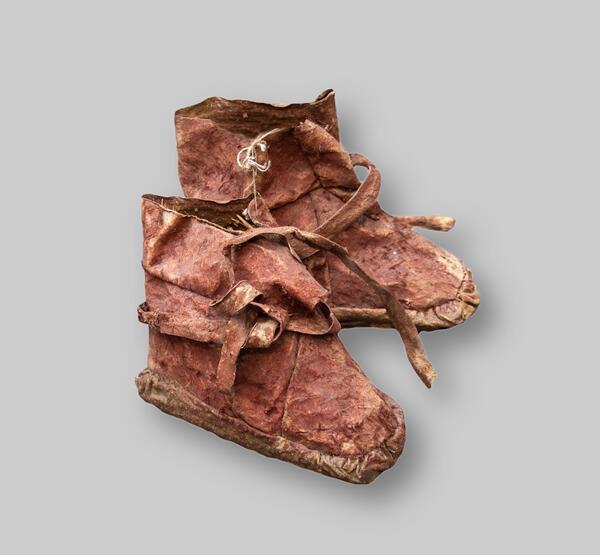
A children’s pair of shoes from the collection of the Tobolsk Provincial Museum is sewn by hand with a small oblique seam made of sturgeon skin. Researchers call such shoes plunger-shaped. They consist of the lower part, that is, the plunger, and the shaft sewn thereto. The master connected the parts and stitched them with tendon threads. The plunger was cut out of a single piece of sturgeon skin. It makes up the sole, goes around the foot and toe, and is slightly kilted up on the toe. The top of the shoes is low. The master left the upper section untreated.
Processing of fish skins was mentioned in the annals of the 17th century. They said that Ostyaks “… had clothing and shoes made from fish skins, sturgeon, sterlet, burbot, or catfish…”. The peoples of the Siberian North hunted fish without waste. Fish meat was used for food, while fish oil and tripe - for leather and homemade glue. Fish scales were used for clothing, shoes, and other household items. Fish skin had all the necessary qualities for commercial clothing. It is light, strong, protects from the wind, does not get wet, and retains heat well. The skin of individual fish species is several times stronger than other materials. Fish oil or liver, as well as dry ash, were used for fish skin dressing. Shoes made of fish skin are water-resistant and well-breathable.
The fish itself was of great importance in the spiritual life of the Khanty. Everyone had their own spirit. For example, before eating a particular fish, the Khanty asked the spirit to touch the food, and only then they started eating. Fish were divided into male and female species. This was determined by external and internal qualities. Female fish included burbot. It is smooth with a special skin. Sturgeon, sterlet, nelma, and muksun are male species. They should not be cut by a woman, especially sturgeon. Each fish was treated differently. For example, pike was called black and treated with disdain, although they ate it quite often.
The process of making fish skin was laborious and time-consuming. First, the scales were removed from the fish, then the skin was thoroughly cleaned on both sides and washed several times in water, laid out on a smooth surface, and left to dry for a while. The dry fish skin became very hard. To make it softer, the fish skin was crushed for several hours on a special machine with bone knives, but as a result it lost many valuable properties. Now, many traditional crafts of the indigenous peoples of the Khanty and Mansi are almost lost, including the technology of making fish skin.
Processing of fish skins was mentioned in the annals of the 17th century. They said that Ostyaks “… had clothing and shoes made from fish skins, sturgeon, sterlet, burbot, or catfish…”. The peoples of the Siberian North hunted fish without waste. Fish meat was used for food, while fish oil and tripe - for leather and homemade glue. Fish scales were used for clothing, shoes, and other household items. Fish skin had all the necessary qualities for commercial clothing. It is light, strong, protects from the wind, does not get wet, and retains heat well. The skin of individual fish species is several times stronger than other materials. Fish oil or liver, as well as dry ash, were used for fish skin dressing. Shoes made of fish skin are water-resistant and well-breathable.
The fish itself was of great importance in the spiritual life of the Khanty. Everyone had their own spirit. For example, before eating a particular fish, the Khanty asked the spirit to touch the food, and only then they started eating. Fish were divided into male and female species. This was determined by external and internal qualities. Female fish included burbot. It is smooth with a special skin. Sturgeon, sterlet, nelma, and muksun are male species. They should not be cut by a woman, especially sturgeon. Each fish was treated differently. For example, pike was called black and treated with disdain, although they ate it quite often.
The process of making fish skin was laborious and time-consuming. First, the scales were removed from the fish, then the skin was thoroughly cleaned on both sides and washed several times in water, laid out on a smooth surface, and left to dry for a while. The dry fish skin became very hard. To make it softer, the fish skin was crushed for several hours on a special machine with bone knives, but as a result it lost many valuable properties. Now, many traditional crafts of the indigenous peoples of the Khanty and Mansi are almost lost, including the technology of making fish skin.
#10
Date: second half of the 19th - beginning of the 20th century
Technique: sturgeon skin, hand sewing
Place: Berezovskiy District of the Tobolsk province, Russia
Dimensions: 15×8 cm
Collection: Ethnography of Siberian Tatars and the Peoples in the Russian Far North
Copyright: Tyumen Province State Autonomous Cultural Institution “Tyumen Museum and Educational Association”, Structural Division “Tobolsk Historical and Architectural Museum Reserve”
Goskatalog Number: 10585037, 10585270
Technique: sturgeon skin, hand sewing
Place: Berezovskiy District of the Tobolsk province, Russia
Dimensions: 15×8 cm
Collection: Ethnography of Siberian Tatars and the Peoples in the Russian Far North
Copyright: Tyumen Province State Autonomous Cultural Institution “Tyumen Museum and Educational Association”, Structural Division “Tobolsk Historical and Architectural Museum Reserve”
Goskatalog Number: 10585037, 10585270
#11
Baby cradle
#12
#13
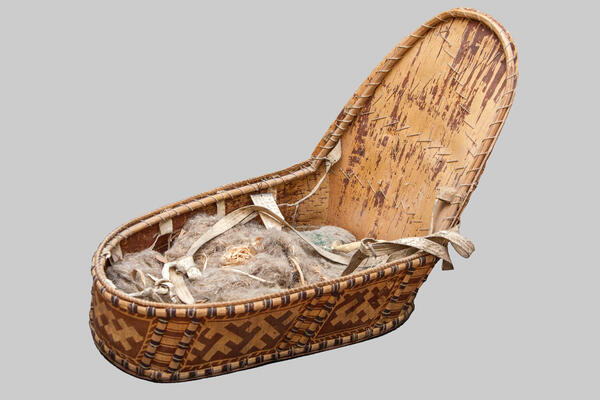
The Khanty baby day cradle from the ethnographic collection of the Tobolsk Provincial Museum is made of birch bark and decorated with simple geometric ornaments. As a rule, permanent cradles, in which the child could live up to three years, were made by men after the birth of the baby. Before that, babies lived in the temporary cradles made by their mothers.
Such cradles were made of three parts, i.e. birch bark oval bottom, sides, and back. The master laid a strip of rawhide on the edges of the flat bottom. The upper and lower edges of the sides, as well as the back were reinforced with bird cherry rods and additional slats. There were loops attached to the cradle, through which leather straps could be threaded. The patterns that adorn the cradle are made in the scraping technique that is one of the most common among the Khants.
There were two types of day cradles, i.e. wooden with a back and birch bark with a back decorated with patterns. A soft skin was attached on the back, under the child’s head. Inside the cradle, the mother put crushed wood rot on the birch bark mat. They absorbed moisture well and left a pleasant smell. When wet, they were removed, but they could only be stored in certain places. You cannot, for example, put them under a growing tree. Otherwise, the child will swing from the wind. The cradles were treated in a special way. The happy one was cherished and passed down from generation to generation, and the one in which the children died was taken away to the forest. The image of the capercaillie, the guardian of sleep, was applied to the birch bark cradle along with other patterns.
The child practically lived in the cradle until the age of three. They not only slept in it, but often sat during the day. To feed the child, the mother put the cradle on her lap, and when it was necessary to leave, she hung it by belt loops to the pole of the chum or to a hook in the ceiling of the hut. You could sit and work side by side, thus rocking the cradle with your foot through the loop. When walking, it was carried behind the back connecting the belt loops on the chest, and during a stop in the forest, it was suspended from a sloping tree higher from the ground where there are fewer midges and a snake cannot crawl. When riding deer or dogs, the mother put the cradle on her sled. If the child was left at home alone, then the symbol of fire, i.e. a knife or matches, was placed in the cradle to protect it from evil spirits.
Such cradles were made of three parts, i.e. birch bark oval bottom, sides, and back. The master laid a strip of rawhide on the edges of the flat bottom. The upper and lower edges of the sides, as well as the back were reinforced with bird cherry rods and additional slats. There were loops attached to the cradle, through which leather straps could be threaded. The patterns that adorn the cradle are made in the scraping technique that is one of the most common among the Khants.
There were two types of day cradles, i.e. wooden with a back and birch bark with a back decorated with patterns. A soft skin was attached on the back, under the child’s head. Inside the cradle, the mother put crushed wood rot on the birch bark mat. They absorbed moisture well and left a pleasant smell. When wet, they were removed, but they could only be stored in certain places. You cannot, for example, put them under a growing tree. Otherwise, the child will swing from the wind. The cradles were treated in a special way. The happy one was cherished and passed down from generation to generation, and the one in which the children died was taken away to the forest. The image of the capercaillie, the guardian of sleep, was applied to the birch bark cradle along with other patterns.
The child practically lived in the cradle until the age of three. They not only slept in it, but often sat during the day. To feed the child, the mother put the cradle on her lap, and when it was necessary to leave, she hung it by belt loops to the pole of the chum or to a hook in the ceiling of the hut. You could sit and work side by side, thus rocking the cradle with your foot through the loop. When walking, it was carried behind the back connecting the belt loops on the chest, and during a stop in the forest, it was suspended from a sloping tree higher from the ground where there are fewer midges and a snake cannot crawl. When riding deer or dogs, the mother put the cradle on her sled. If the child was left at home alone, then the symbol of fire, i.e. a knife or matches, was placed in the cradle to protect it from evil spirits.
#14
Date: second half of the 19th - beginning of the 20th century
Technique: birch bark, bird cherry
Dimensions: 26×12×40 cm
Collection: Ethnography of Siberian Tatars and the Peoples in the Russian Far North
Copyright: Tyumen Province State Autonomous Cultural Institution “Tyumen Museum and Educational Association”, Structural Division “Tobolsk Historical and Architectural Museum Reserve”
Goskatalog Number: 13502786
Technique: birch bark, bird cherry
Dimensions: 26×12×40 cm
Collection: Ethnography of Siberian Tatars and the Peoples in the Russian Far North
Copyright: Tyumen Province State Autonomous Cultural Institution “Tyumen Museum and Educational Association”, Structural Division “Tobolsk Historical and Architectural Museum Reserve”
Goskatalog Number: 13502786
read morehide
00:00
00:00
1x
Corner harp, Baby day cradle, Children’s shoes
Collection
Exhibition
2
 Point your smartphone camera to open in the app
Open in app
Share