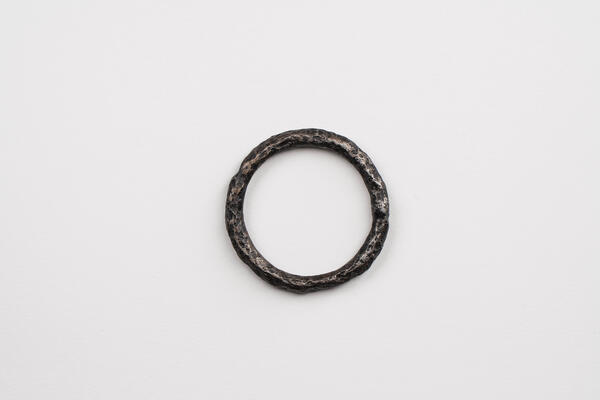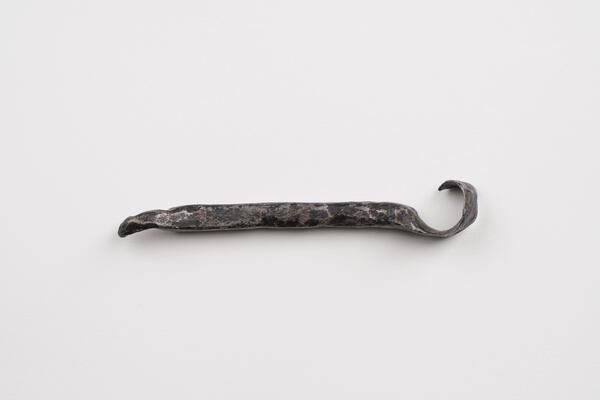
The permanent exhibition “Relics from the Battle of Kulikovo” features a piece of horse equipment. It is a half of a bit dating back to the period from the 12th to the 17th century. The bit is a tetrahedral rod that is 9.8 cm long. It is sub-rectangular in cross section measuring 0.7×0.8 cm and has rounded loops at the ends that are up to 1.3 cm wide (the inner diameter is 0.8 cm). The hinges are flat in cross section.
The object was discovered in excavations conducted by the military-historical unit of the Upper Don archaeological expedition of the State Historical Museum and the State Museum-Reserve “Kulikovo Field” in 2002. The archaeological dig was conducted on the watershed of the Verkhodub and Orzhevik ravines, to the south of the Monastyrshchino village, Kimovsky district, Tula region, on site No. 22, grid 1.
The discovered detail is a part of a bit with two movable links and two rings (type IV according to A.N. Kirpichnikov). A similar object was found in the same area in 2000.
A bit is a device for controlling a horse, an item of a bridle. According to the impact of the leverage, there are three types of bits: a snaffle bit, a curb bit and a pelham bit. A snaffle bit consists of a bit and two rings, that are used to attach the mouthpiece to the cheek straps of the bridle. Snaffle-type bits are two-piece iron bits with movable rings at the ends — they were the most common bits in Old Rus. The curb bit is a solid iron bit, which is generally more severe than the snaffle bit. The mouthpiece can be curved to act on the roof of the mouth. The greater the curvature is, the more severe the curb bit is, which also means that the control is more precise. The pelham bit is a bit with a movable mouthpiece, a kind of a curb bit, but with the mouthpiece of a snaffle bit. As far as severity is concerned, it occupies an intermediate position between the snaffle and the curb bit.
The Kulikovo cycle — chronicles describing the battle — feature Russian troops exclusively on horseback: “Very armored and mounted on horses their army is”, “Already the Russian horses have become stronger from the voice of the trumpet, and everyone will go under their banner”, “And their banners sent by a strong leader Dmitry Volynets.” In the latter case, the “banners” is the Old Russian term used to describe cavalry units. The army of Khan Mamai consisted exclusively of mounted warriors.
The object was discovered in excavations conducted by the military-historical unit of the Upper Don archaeological expedition of the State Historical Museum and the State Museum-Reserve “Kulikovo Field” in 2002. The archaeological dig was conducted on the watershed of the Verkhodub and Orzhevik ravines, to the south of the Monastyrshchino village, Kimovsky district, Tula region, on site No. 22, grid 1.
The discovered detail is a part of a bit with two movable links and two rings (type IV according to A.N. Kirpichnikov). A similar object was found in the same area in 2000.
A bit is a device for controlling a horse, an item of a bridle. According to the impact of the leverage, there are three types of bits: a snaffle bit, a curb bit and a pelham bit. A snaffle bit consists of a bit and two rings, that are used to attach the mouthpiece to the cheek straps of the bridle. Snaffle-type bits are two-piece iron bits with movable rings at the ends — they were the most common bits in Old Rus. The curb bit is a solid iron bit, which is generally more severe than the snaffle bit. The mouthpiece can be curved to act on the roof of the mouth. The greater the curvature is, the more severe the curb bit is, which also means that the control is more precise. The pelham bit is a bit with a movable mouthpiece, a kind of a curb bit, but with the mouthpiece of a snaffle bit. As far as severity is concerned, it occupies an intermediate position between the snaffle and the curb bit.
The Kulikovo cycle — chronicles describing the battle — feature Russian troops exclusively on horseback: “Very armored and mounted on horses their army is”, “Already the Russian horses have become stronger from the voice of the trumpet, and everyone will go under their banner”, “And their banners sent by a strong leader Dmitry Volynets.” In the latter case, the “banners” is the Old Russian term used to describe cavalry units. The army of Khan Mamai consisted exclusively of mounted warriors.