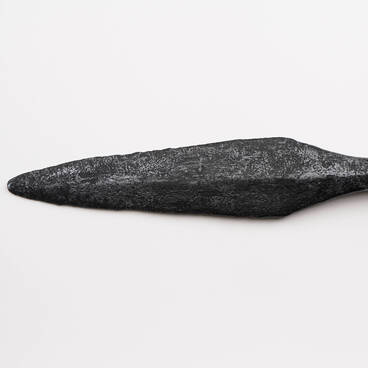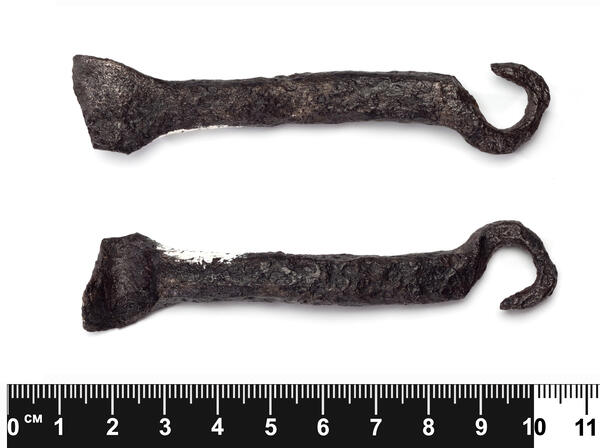
The permanent exhibition “Relics from the Battle of Kulikovo” features a piece of a horse’s tack — a half of an iron bit of the 12th–14th centuries. One end is pointed and bent into a hook, and the other has the form of a flat coil. One of the two bits, without snaffle rings, has the shape of a tetrahedral rod that is 9 cm long, sub-rectangular in cross section (0.8×0.8 cm) and with rounded loops at the ends, which are up to 2 cm wide. The loops are flat in cross section, preserved in fragments.
This was one of the most common types of bits in the territory of Old Rus, which appeared in the 9th–10th centuries. A century later, some other previously common forms went out of use. This type was common for a long time. Its popularity peaked in the 12th–13th centuries — this type made up 95% of all the found bits.
The exhibits were discovered in 2000 in excavations conducted by the State Historical Museum and the State Museum-Reserve “Kulikovo Field” in the Green Oak Grove area, to the south of the Monastyrshchino village, Kimovsky District, Tula Oblast, on site No. 22.
The bit is the main part of a bridle, a device for controlling a horse. The Slavs, as a rule, used a simple type of bit, consisting of two parts connected to each other, with rings at the ends for threading a belt. At that time, there was also a kind of bit, equipped with two fixed or movable cheek-pieces (parts of the ancient bridle set — a pair of vertical rods that were attached perpendicular to the ends of the bit). In the Nikon Chronicle, there is a description of the hand-to-hand battle:
This was one of the most common types of bits in the territory of Old Rus, which appeared in the 9th–10th centuries. A century later, some other previously common forms went out of use. This type was common for a long time. Its popularity peaked in the 12th–13th centuries — this type made up 95% of all the found bits.
The exhibits were discovered in 2000 in excavations conducted by the State Historical Museum and the State Museum-Reserve “Kulikovo Field” in the Green Oak Grove area, to the south of the Monastyrshchino village, Kimovsky District, Tula Oblast, on site No. 22.
The bit is the main part of a bridle, a device for controlling a horse. The Slavs, as a rule, used a simple type of bit, consisting of two parts connected to each other, with rings at the ends for threading a belt. At that time, there was also a kind of bit, equipped with two fixed or movable cheek-pieces (parts of the ancient bridle set — a pair of vertical rods that were attached perpendicular to the ends of the bit). In the Nikon Chronicle, there is a description of the hand-to-hand battle: