


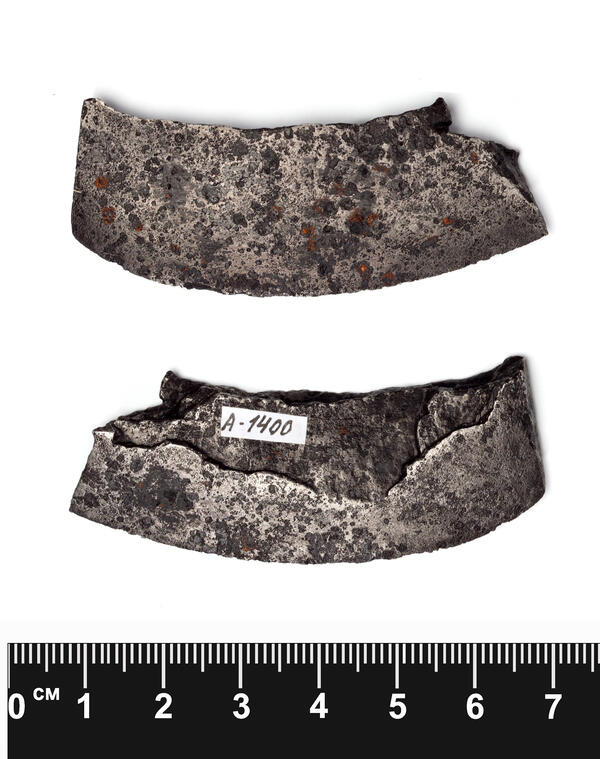
The permanent exhibition “Relics from the Battle of Kulikovo” features a fully preserved blade part of an axe. The width of the fragment is 6.2 cm, and its height is 2.4 cm. It is an elongated wedge-shaped plate with uneven edges in the place where the item was broken.
The blade was discovered in 2009 in excavations conducted by the military-historical unit of the Upper-Don archaeological expedition of the State Historical Museum and the State Museum-Reserve “Kulikovo Field”, on the watershed of the Verkhodub and Orzhevik ravines, to the south of the Monastyrshchino village, Kimovsky District, Tula Oblast, site No. 22, grid 8.
The width of the preserved fragment suggests that this blade can be attributed to the type of battle axes of the 13th–15th centuries and to group 2 according to A.N. Kirpichnikov — the so-called axes of “small forms”. They were shaped like working axes, but were more miniature in size.
The combination of a relatively low price and excellent combat characteristics, made maces, flanged maces, axes, and flails widely popular. An Old Russian warrior could use different types of edged weapons. One of the main weapons was a battle-axe. It could be used on the battlefield and during a campaign, so it was widely distributed and served for a long time. In addition, over the centuries, battle-axes constantly evolved, giving advantages over the enemy. The axe was not used by infantry alone. An equestrian warrior also used it during a long cavalry charge. Light battle-axes were inlaid with precious metals and often served as ceremonial weapons. During the battle, an axe could be held with one or both hands. So, the axe was a multi-functional companion of a warrior and served him not only in battle, but also during rest, as well as when clearing a road in the forest.
As modern trace evidence studies of weapons show, the blades of battle-axes broke quite often. This was caused by the manufacturing technique — the blade was a welded element. The axe was forged from iron or steel, depending on the blacksmith.
The blade was discovered in 2009 in excavations conducted by the military-historical unit of the Upper-Don archaeological expedition of the State Historical Museum and the State Museum-Reserve “Kulikovo Field”, on the watershed of the Verkhodub and Orzhevik ravines, to the south of the Monastyrshchino village, Kimovsky District, Tula Oblast, site No. 22, grid 8.
The width of the preserved fragment suggests that this blade can be attributed to the type of battle axes of the 13th–15th centuries and to group 2 according to A.N. Kirpichnikov — the so-called axes of “small forms”. They were shaped like working axes, but were more miniature in size.
The combination of a relatively low price and excellent combat characteristics, made maces, flanged maces, axes, and flails widely popular. An Old Russian warrior could use different types of edged weapons. One of the main weapons was a battle-axe. It could be used on the battlefield and during a campaign, so it was widely distributed and served for a long time. In addition, over the centuries, battle-axes constantly evolved, giving advantages over the enemy. The axe was not used by infantry alone. An equestrian warrior also used it during a long cavalry charge. Light battle-axes were inlaid with precious metals and often served as ceremonial weapons. During the battle, an axe could be held with one or both hands. So, the axe was a multi-functional companion of a warrior and served him not only in battle, but also during rest, as well as when clearing a road in the forest.
As modern trace evidence studies of weapons show, the blades of battle-axes broke quite often. This was caused by the manufacturing technique — the blade was a welded element. The axe was forged from iron or steel, depending on the blacksmith.


