“The Dictionary of the
Vocabulary of Traditional Trades and Economic Occupations of the Kola Sami”
says the following about fishing,


Fishing rod
Creation period
the late 19th — early 20th century
Place of сreation
the Kola Peninsula, the Russian Empire
Dimensions
57x4,5 cm
Technique
wood; carving, drilling
0
Open in app#1
#3
Lake fishing, like reindeer herding, is one of the oldest occupations of the population of the North, and it is undoubtedly older than reindeer herding.
#4
In summer and fall, the basis of the Kola Sami diet was fish, mostly lake fish: whitefish, pike, perch, burbot and others. As a rule, they sold salmon to Russian and Norwegian merchants. Coastal Sami (Iokang, Lumbov and others) sold their salmon to the Sami of the inland areas and at the same time bought lake fish from them.
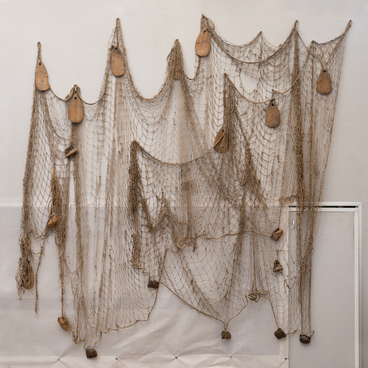
The main fishing tools were a net, including its special garva kind, as well as a seine, gaff, hook, longline, and fishing rod.
#5
Fishing in Lapland waters is far from being a pleasure even for a casual fisherman: the lakes are rough, the karbas [vessels] are very bad, the freezing water in which one has to drag the net and the clouds of mosquitoes stinging intolerably make this fishing a hard work for a Lapper, and yet it is his only means of subsistence.
#6
Fish, like meat, was used to make soup: first the Sami ate pieces of cooked fish and then drank the broth. Fish was fried on an open fire in the following way: it was gutted, washed, cut into large pieces, salted and fried which was done by poking it on special sticks that were stuck into the ground near the fire. Fish fried in this way was eaten with or without bread.
Drying fish usually took place in the open air. The Kola Sami people attached pieces of fish, intended for drying, to the outside of the dwelling.
Salting fish was apparently much less widespread among the Sami. For this purpose, it was cut, gutted, washed, salted inside and placed for storage in barrels. To store salted fish by varieties, special pits and wooden barrels were used. The fish was covered with wooden chips. A heavy stone weight was put on top so that the brine would cover the fish. Besides, northerners often ate raw salted fish.
#2
Ministry of Culture of the Russian Federation
read morehide
00:00
00:00
1x
Fishing rod
Creation period
the late 19th — early 20th century
Place of сreation
the Kola Peninsula, the Russian Empire
Dimensions
57x4,5 cm
Technique
wood; carving, drilling
0
 Point your smartphone camera to open in the app
Open in app
Share