#1
Books
#3
Textbook of homeland studies
#4
#2
Alelsandr Sedelnikov was born on August 30, 1876, in the city of Talitsa, Perm Governorate. His parents moved to Omsk to give their children a good education.
There Sedelnikov completed primary school and college and then enrolled at one of the best institutions of Siberia — the Omsk Teacher Training College. In his student years, he made several trips up the Irtysh River, near Omsk, and collected natural and historical materials.
Sedelnikov was interested in public life, studied prohibited literature, and even attended illegal political clubs. Police subsequently put him under surveillance. After graduating from college, Sedelnikov had to leave Omsk. In 1896, he became a non-matriculated student of the physics and mathematics faculty at the Yuryev University.
Sedelnikov returned to Omsk in 1900. In the same year, he became a member of the Western-Siberian department of the Imperial Russian Geographical Society. He made 17 research expeditions and published 47 scientific papers.
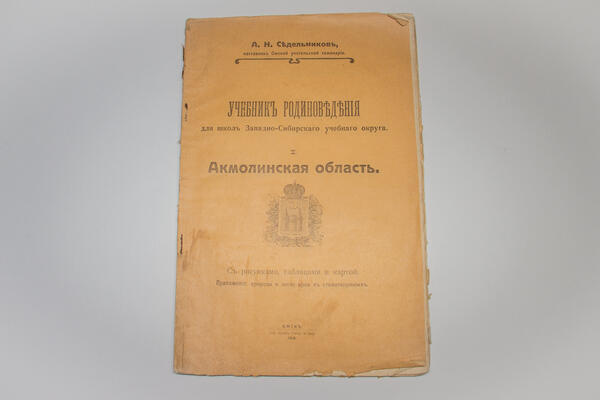
Sedelnikov devoted 19 years to pedagogy. Since 1900, he was a teacher at the Omsk College, from 1907 to 1919 worked in the Omsk TeacherTraining College. At first, he was a natural science teacher and then became its first elected director. In 1916, his “Homeland Studies Textbook for the Schools of Western-Siberian Educational District. Akmola Region” was published.
Sedelnikov hoped that in the future such textbooks will be used in schools of other regions. He wrote in the preface: “Regions and governorates of the Western-Siberian educational district are completely different in nature and population composition, and in terms of space, each of them exceeds the major states of Western Europe… Writing a textbook for one region should not seem a luxury.”
The textbook consisted of eight chapters: “Governor-Generalship of the Steppes, ” “Akmola Region: Nature, Population, Occupations, ” “Omsk Uezd, ” “Petropavlovsk Uezd, ” “Kokchetav Uezd, ” “Akmola Uezd, ” “Atbasar Uezd, ” “Appendices” (statistical tables, Homeland Studies syllabus, collection of poems, excursions program, a Homeland Studies Museum program, map of Akmola Region).
This textbook was in high demand due to its clarity, simplicity, and clear structure. It introduced students to the region through excursions, practical studies, and research.
#5
Full name: Textbook of homeland studies for the Schools of Western-Siberian Educational District. Part 1
Author: Aleksandr Nikitich Sedelnikov
Date: 1916
Technique: black and white typographic printing
Place: Omsk
Dimensions: 28.7×18.7 cm
Copyright: Omsk State Museum of History and Regional Studies
Author: Aleksandr Nikitich Sedelnikov
Date: 1916
Technique: black and white typographic printing
Place: Omsk
Dimensions: 28.7×18.7 cm
Copyright: Omsk State Museum of History and Regional Studies
#6
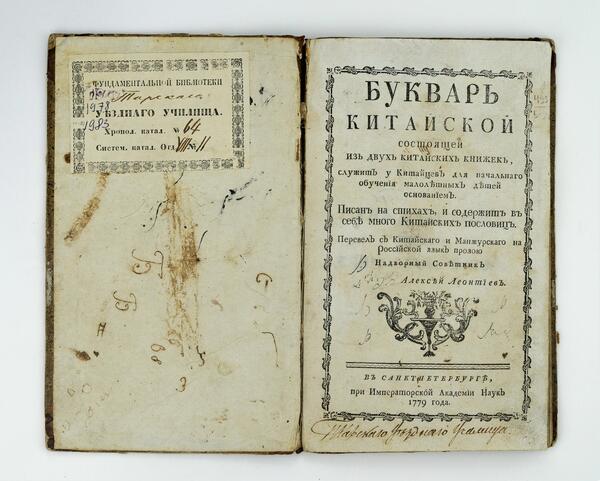
Chinese alphabet book
#7
#8
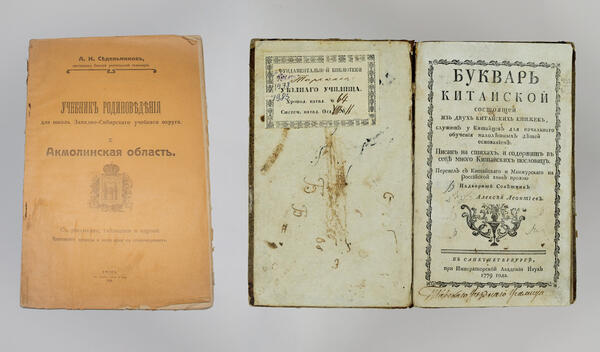
The alphabet book, which consisted of two volumes, was used in China to teach small children. It was written in verse and contained many proverbs. The book was translated from Chinese and Manchu by court councilor Aleksei Leontiev. Then it was published in Saint Petersburg in 1779. Researchers suppose that the Cossack Military School students used such books.
The Cossack Military School was founded on May 1, 1813, at the initiative of general Georg Johann von Glasenapp, the chief of the Siberian Frontier Line and commander of the independent Siberian Corps. His goal was ‘to make the young men acquainted with the duties of man, with virtue, with humility, and with the fear of God.’
Initially, it was situated at the ‘ambassador’ house, where Asian ambassadors who came to Omsk lived. The building was intended for only 20 students.
First, the education program included calligraphy, arithmetic, and Russian grammar. Then the school started to teach physics, foreign languages, war science, agriculture. The number of students increased to 300 by 1817. In 1825, the school acquired a new official name: ‘The Siberian Cossack Combat Host School.’
In 1826, the cadet school moved to a new building. In 1828, it merged with the Asian school where interpreters (tolmachi) were trained. In 1829, the school began to train topographers. Moreover, a teacher-scribe class was created, where average-ability students learned. A handyman class for underachievers also opened. Its students lived separately, wore the worst clothes, did not study in classes, did not sit at the common table.
The school also taught religion, history, geography, and statistics. Real guns and sabers were used in military classes. The students wore Cossack clothes, the best ones were awarded with a feldwebel’s or non-commissioned officer’s tie. Since 1841, they were sent to a camp for summer, where they lived in tents. In 1833, the school established its garden where the students worked.
#9
Full name: Chinese alphabet book
Date: 1779
Technique: typographic printing
Place: Russian Empire, Saint Petersburg
Dimensions: 20.7×25.4×1 cm
Copyright: Omsk State Museum of History and Regional Studies
Date: 1779
Technique: typographic printing
Place: Russian Empire, Saint Petersburg
Dimensions: 20.7×25.4×1 cm
Copyright: Omsk State Museum of History and Regional Studies
#10
Ministry of Culture of the Russian Federation
read morehide
00:00
00:00
1x
0
 Point your smartphone camera to open in the app
Open in app
Share