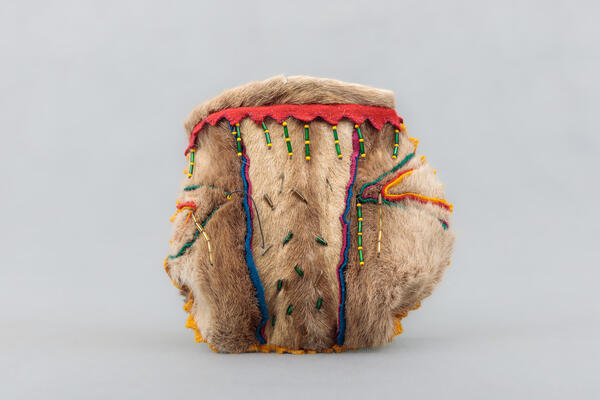
This tutchan from the collection of the Uray City Historical Museum of Khanty-Mansi Autonomous Okrug is a women’s bag. It was sewn in the second half of the 20th century. In fact, this is the main household attribute of a woman of the Khanty and Mansi peoples.
Such a bag was most often made from reindeer fur, however, the people of this region also sewed tutchans from cloth. The main elements of the bag were made oval. Along the perimeter, they were connected by a strip of fur.
Needlewomen supplied the neck of the tutchan with a cord, which was pulled to secure the bag. In addition, it was sometimes decorated with “rovduga” — red rawhide. A cloth or fur needle case with a thimble case, which was also made from deer skin, was sewn on the side. It could have been diamond-shaped. The tutchan had not only a functional purpose, but also personified the soul of its owner.
Women used tutchans to keep a variety of sewing accessories — shreds of fabric, pieces of fur, tendon threads, needles and even scissors. The design of a handicraft bag was of paramount importance. The way a tutchan looked testified to the woman’s skill and diligence. To some extent, it also hinted at the wealth of the owner. Tutchans could be decorated with pendants made of metal, wood, and beads. The pattern was made using the so-called fur mosaic technique.
In a sewing bag, next to needles and threads, a Mansi woman traditionally kept her amulets and incense items used for cleansing: scraps of beaver skin, chaga mushrooms, and pieces of deer tendons. The mother also kept her children’s umbilical cords in her tutchan. The woman always had her bag by her side throughout her life. When she died, her relatives always put her tutchan at her head.
It was believed that a woman who possessed this item could overcome all trials and obstacles. For example, in one of the Khanty legends it is said that the heroine managed to sail across the ocean in her sewing bag. This emphasized the importance and great role of this object in a woman’s life.