Sergei Prokofiev started smoking at the age of 21. He enjoyed solitude and good tobacco.


#1
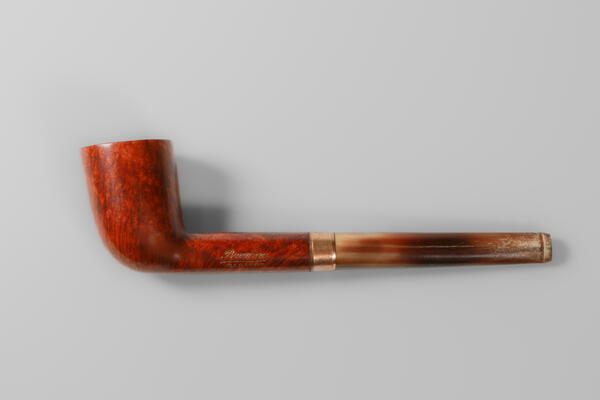
Smoking pipe of Sergei Prokofiev
#4
#5
Outside the wind blew and the rain drizzled, but inside it was roomy and warm, and there was a sufficiency of good things — hard to come by at times like these! A whole collection of differently colored boxes containing various kinds of English and Egyptian cigarettes (as many as fifteen different brands) filled one of the drawers in my commode.
Prokofiev reminisced
#6
When Prokofiev was neither composing nor rehearsing, he would often fill the intervals with smoking. On one occasion, he wrote in his diary, “The rehearsal lasted for five hours with small breaks, and the best thing of all was to be able when it was over to change my clothes, rub myself with eau de Cologne and lie down to drink tea and smoke cigarettes. When I was not engaged in composing, reading, astronomy and walking, I rested, smoked English and Egyptian cigarettes, ate chocolate and generally gave myself up to blissful indolence, and felt wonderful.”
Prokofiev was fond of English and Egyptian cigarettes. However, he also appreciated Russian products. He once wrote, “We smoked a lot of Russian cigarettes which I rather fancied after the foreign ones, although Russian connoisseurs have no time at all for modern tobacco.”
In 1930, Prokofiev visited a cigar factory in Cuba and described the trip in his diary, “We were taken to the world’s most famous cigar factory, Partagás. Machine methodology is unknown here; all cigars are made by hand just as they were fifty years ago, with wondrous dexterity. These cigars are smoked by the Kings of England and Spain, and ‘all the monarchs that are left’. Ordinary ‘Havanas’ are nothing by comparison. I sniffed them, the aroma was divine, but I had no desire to light up. The process begins with the tobacco leaves being dampened with water, and then left for a year or two to ferment. During this time, they give off such a powerful smell of ammonia that when I entered that part of the factory where they were I could hardly stop the tears flowing. Other people, I was told, are convulsed by ungovernable fits of sneezing.”
Prokofiev tried to give up smoking. In 1927, he wrote, “I really am ashamed of smoking; perhaps it is time I tried to give up?” At the end of that year, he reported, “I did not smoke, and did not seem to crave it unbearably, although from time to time it would have been nice. But the sensation of ‘see, I’ve broken the habit’ is even better.” However, in the last years of his life, Prokofiev relapsed into smoking.
Prokofiev was fond of English and Egyptian cigarettes. However, he also appreciated Russian products. He once wrote, “We smoked a lot of Russian cigarettes which I rather fancied after the foreign ones, although Russian connoisseurs have no time at all for modern tobacco.”
In 1930, Prokofiev visited a cigar factory in Cuba and described the trip in his diary, “We were taken to the world’s most famous cigar factory, Partagás. Machine methodology is unknown here; all cigars are made by hand just as they were fifty years ago, with wondrous dexterity. These cigars are smoked by the Kings of England and Spain, and ‘all the monarchs that are left’. Ordinary ‘Havanas’ are nothing by comparison. I sniffed them, the aroma was divine, but I had no desire to light up. The process begins with the tobacco leaves being dampened with water, and then left for a year or two to ferment. During this time, they give off such a powerful smell of ammonia that when I entered that part of the factory where they were I could hardly stop the tears flowing. Other people, I was told, are convulsed by ungovernable fits of sneezing.”
Prokofiev tried to give up smoking. In 1927, he wrote, “I really am ashamed of smoking; perhaps it is time I tried to give up?” At the end of that year, he reported, “I did not smoke, and did not seem to crave it unbearably, although from time to time it would have been nice. But the sensation of ‘see, I’ve broken the habit’ is even better.” However, in the last years of his life, Prokofiev relapsed into smoking.
#3
Name: Smoking pipe of Sergei Prokofiev
№: 5962112
№: 5962112
#2
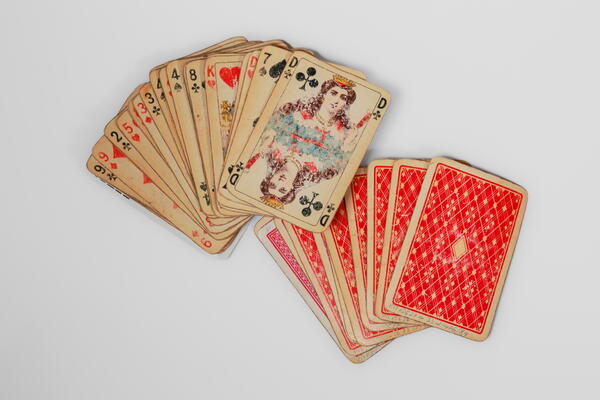
Playing cards
#9
The museum’s collection includes 101 playing cards from various decks with red and blue backs. These include three jokers which may be used to represent any other playing card.
Sergei Prokofiev was an avid card player since childhood. As a young boy, he had a special notebook where he wrote down the rules of various card games. As an adult, he played whist, Macao, baccarat, blackjack, and other games. However, his favorite card game was bridge. In the 1930s, Prokofiev and his wife Lina Ivanovna lived in Paris and often hosted bridge tournaments which sometimes lasted for days.
Prokofiev also enjoyed playing patience which he often did in between his composing sessions. The game helped him relax and take his mind off things. Sometimes, Prokofiev played patience with his friends.
For example, on one occasion, he wrote that he and his wife visited friends.
Sergei Prokofiev was an avid card player since childhood. As a young boy, he had a special notebook where he wrote down the rules of various card games. As an adult, he played whist, Macao, baccarat, blackjack, and other games. However, his favorite card game was bridge. In the 1930s, Prokofiev and his wife Lina Ivanovna lived in Paris and often hosted bridge tournaments which sometimes lasted for days.
Prokofiev also enjoyed playing patience which he often did in between his composing sessions. The game helped him relax and take his mind off things. Sometimes, Prokofiev played patience with his friends.
For example, on one occasion, he wrote that he and his wife visited friends.
#10
…and played four-hand patience. The tension was so nail-biting that we howled from excitement and cursed our partners.
Sergei Prokofiev
#11
In 1929, Prokofiev sailed to America on a transatlantic liner where he met another famous composer Sergei Rachmaninoff. “At night, when the sea was calm, we played patience — what a touching idyll!” reminisced Prokofiev.
The composer enjoyed gambling but was always able to handle the situation calmly. He admitted, “Gambling clubs represent no particular danger to me, since I am not prone to lose money in them. This is because I so much hate the thought of losing money at cards and consider it a stupid activity. For this reason, whenever I go to a club, I decide in advance how much I am prepared to lose, and make sure not to exceed that amount. If I win, I get up and leave. Not only that, but I regard playing cards as a complete and tiring waste of time. The result of my five visits to the card tables was: +300, -300, +50, -250, +1,000. The last one crowned my efforts: I won the bank with seven cards. This happened on the eve of my departure to Yessentuki and was extremely timely for my journey.”
Prokofiev often included gambling scenes in his works, describing them with exceptional vividness. These include the opera “The Gambler” based on Dostoevsky’s novel, the soundtrack to “The Queen of Spades” and the card-playing scene in the opera “Love for Three Oranges”.
The composer enjoyed gambling but was always able to handle the situation calmly. He admitted, “Gambling clubs represent no particular danger to me, since I am not prone to lose money in them. This is because I so much hate the thought of losing money at cards and consider it a stupid activity. For this reason, whenever I go to a club, I decide in advance how much I am prepared to lose, and make sure not to exceed that amount. If I win, I get up and leave. Not only that, but I regard playing cards as a complete and tiring waste of time. The result of my five visits to the card tables was: +300, -300, +50, -250, +1,000. The last one crowned my efforts: I won the bank with seven cards. This happened on the eve of my departure to Yessentuki and was extremely timely for my journey.”
Prokofiev often included gambling scenes in his works, describing them with exceptional vividness. These include the opera “The Gambler” based on Dostoevsky’s novel, the soundtrack to “The Queen of Spades” and the card-playing scene in the opera “Love for Three Oranges”.
#8
Name: Playing cards
Technique: paper, typographic printing
Dimensions: 8,8×6,2 cm
Technique: paper, typographic printing
Dimensions: 8,8×6,2 cm
#7
Ministry of Culture of the Russian Federation
read morehide
00:00
00:00
1x
Smoking pipe, Playing cards
Exhibition
0
 Point your smartphone camera to open in the app
Open in app
Share