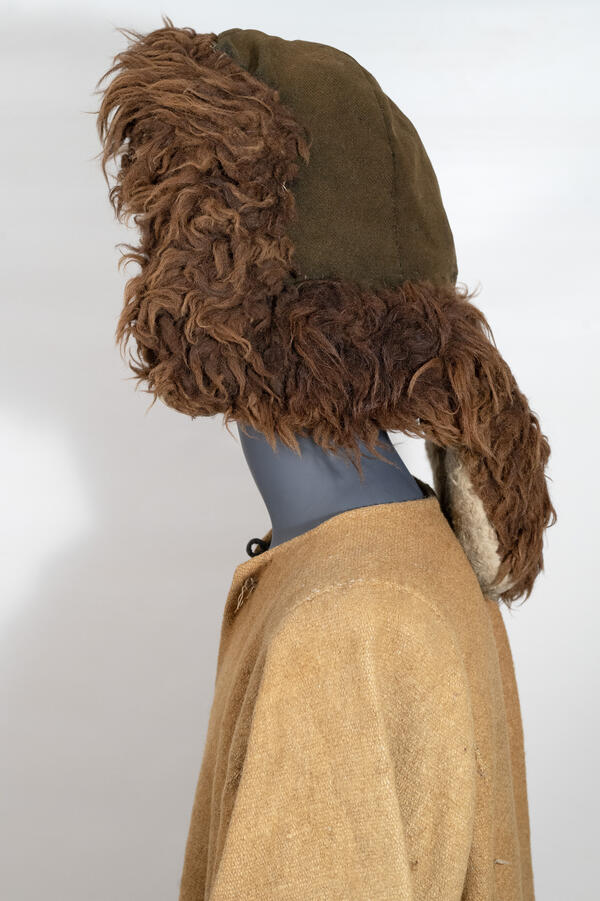
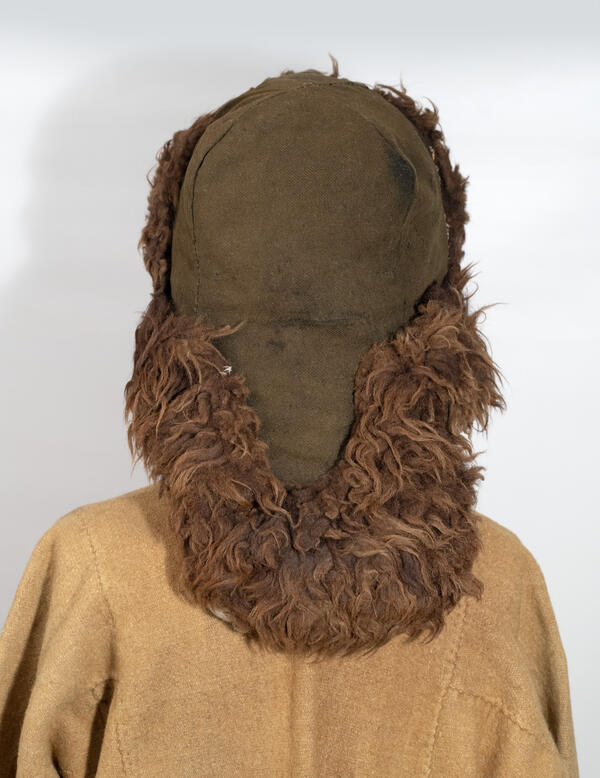
The Pomors wore the treukh headdress when ice fishing for navaga, smelt, and herring. The one from the museum collection was handmade in the early 20th century in the Vorzogory village, Onega Uyezd, Arkhangelsk Governorate. The top of the hat was covered in dark green wool fabric, while the bottom was made from sheepskin. In between these materials, the craftsman inserted pieces of fabric from old shawls.
The treukh is a type of hat, a prototype of the ushanka. Apart from the two ear flaps, it also had a backflap that protected the neck from wind. In the ushanka, the third flap was located vertically in the front.
According to one theory, the treukh may have been inspired by the Mongolian malahai, which was worn by nomads. It is also possible that the Pomors borrowed the design from the Finno-Ugric peoples. In addition to the treukh, the Pomors wore other types of hats, such as the tsibak, a fur or leather helmet with long, wide ties. According to ethnologists, this type of headdress was adopted by the Pomors from the Sami people. Opleukhi were Pomor fur hats with long earflaps that went down to the waist. Fishermen wore these in severe weather instead of a scarf when going out into the White Sea.
The treukh quickly became popular among northern peasants. This convenient hat provided protection from severe frosts and could be tied at the back when it was warmer. A treukh was usually worn with a sheepskin coat, a common everyday garment used by northern peasants. It was made from the same material as the hat.
To make such clothes, flocks of Romanov sheep were kept. These sheep were distinguished by their coarse wool of medium length. In the summer, the main food for the sheep in this region was grass. In winter, hay was used. This is why their maintenance was not too expensive. Clothes made from the skins of these sheep were widespread.
In the late 17th century, treukh hats started to become popular among women. Tsarina Natalya Kirillovna Naryshkina, the mother of Peter the Great, had three such hats in her wardrobe. Agafya Semyonovna, the first wife of Tsar Feodor Alekseyevich, had four treukh hats. Women often wore pearl jewelry which could be seen from under their hats.