#1
Tools
#2
#3
#4
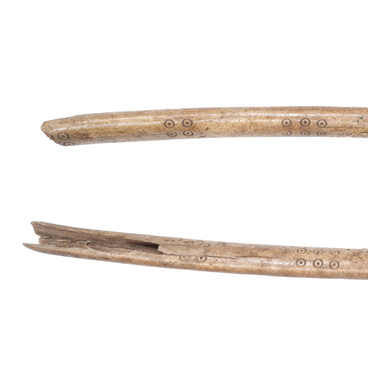
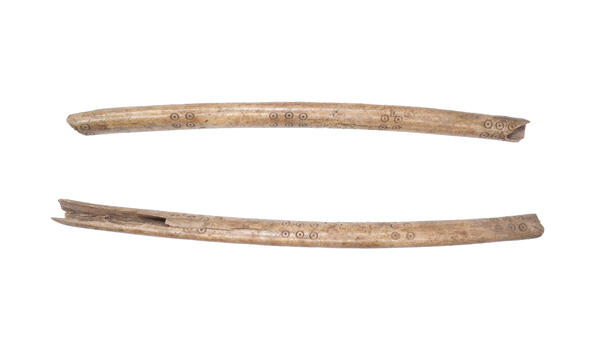
In prehistoric times, sewing needles were stored in needlecases made of tubular bones of large birds.
Bone needlecases were common not just in settlements near Lake Baikal. Scientists found similar objects at archaeological sites in different places that were dated to the Neolithic and Paleometallic eras: starting from Western Siberia, Chukotka, Primorye, Kamchatka, Sakhalin and Hokkaido and all the way to Northwestern America. Therefore, it is believed that needlecases were used in many cultures from the Stone Age to the Middle Ages. In different periods, only the material from which such objects were made changed.
During the period when people started using metals (about 3000-2000 BC), along with bone, metal needlecases appeared in about the same shapes and sizes. In the burials of the Glazkov culture, tube needlecases can be found — they are rolled up from flattened thin sheets of copper.
Needlecases of a similar shape were made by many peoples: Lapps, Tunguses, Gilyaks, Ainu. The Chukchi (small-numbered indigenous people of the extreme northeast of Asia), for example, used metal needlecases until the beginning of the 20th century. Needlecases were created according to the Eskimo model: hollow tubes, in which iron needles were stored, were placed in a piece of seal skin. A special strap with a ball at the end was passed through the case. Needles were fixed at one end, and a hook made of walrus tusk, which was clung to the belt of one’s clothes, was at the other.
Unlike the cases, needles manufacturing methods and their design did not change over time. Threads from animal tendons were used for sewing clothes and creating inventory — they were valued for their strength and durability.
The indigenous peoples of the Lower Amur — Nanais, Orochi, Negidals, Ulchi, — in addition to traditional vein threads, were also able to make threads from fish skin, swim bladder of a large fish, blood arteries of deer or moose, as well as from plant fibers. For example, from nettles: the plant was collected in the fall, and then dried and kneaded in a wooden mortar or crushed with stones. Sometimes the threads were painted with natural dyes: an infusion of berries, herbs, roots or bark.
Bone needlecases were common not just in settlements near Lake Baikal. Scientists found similar objects at archaeological sites in different places that were dated to the Neolithic and Paleometallic eras: starting from Western Siberia, Chukotka, Primorye, Kamchatka, Sakhalin and Hokkaido and all the way to Northwestern America. Therefore, it is believed that needlecases were used in many cultures from the Stone Age to the Middle Ages. In different periods, only the material from which such objects were made changed.
During the period when people started using metals (about 3000-2000 BC), along with bone, metal needlecases appeared in about the same shapes and sizes. In the burials of the Glazkov culture, tube needlecases can be found — they are rolled up from flattened thin sheets of copper.
Needlecases of a similar shape were made by many peoples: Lapps, Tunguses, Gilyaks, Ainu. The Chukchi (small-numbered indigenous people of the extreme northeast of Asia), for example, used metal needlecases until the beginning of the 20th century. Needlecases were created according to the Eskimo model: hollow tubes, in which iron needles were stored, were placed in a piece of seal skin. A special strap with a ball at the end was passed through the case. Needles were fixed at one end, and a hook made of walrus tusk, which was clung to the belt of one’s clothes, was at the other.
Unlike the cases, needles manufacturing methods and their design did not change over time. Threads from animal tendons were used for sewing clothes and creating inventory — they were valued for their strength and durability.
The indigenous peoples of the Lower Amur — Nanais, Orochi, Negidals, Ulchi, — in addition to traditional vein threads, were also able to make threads from fish skin, swim bladder of a large fish, blood arteries of deer or moose, as well as from plant fibers. For example, from nettles: the plant was collected in the fall, and then dried and kneaded in a wooden mortar or crushed with stones. Sometimes the threads were painted with natural dyes: an infusion of berries, herbs, roots or bark.
#5
Full name: Needlecase
Date: 7500–4600 years ago
Place: The “Lokomotiv” Early Neolithic Cemetery, Irkutsk
Copyright: Irkutsk Regional Museum of Local History
Dimensions: 20×1,4×1,1 cm
Date: 7500–4600 years ago
Place: The “Lokomotiv” Early Neolithic Cemetery, Irkutsk
Copyright: Irkutsk Regional Museum of Local History
Dimensions: 20×1,4×1,1 cm
#6
Arrowheads
#7
#8
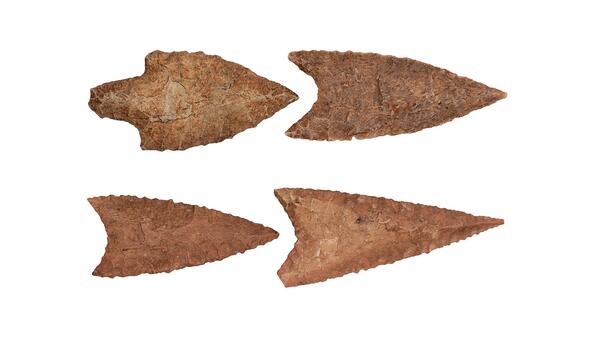
The arrowheads were donated to the Irkutsk Museum of Local History funds by Soviet archaeologist and historian Alexey Okladnikov. They were found during an expedition near the Isakovo village in the Bratsky district of the Irkutsk region.
The arrowheads were made of flint and argillite — hard clay rocks. They were attached to a thin rod and used in animal hunting. Researchers attribute the tools to the Neolithic period and assume that they were created 7500-4600 years ago.
The Neolithic era is a special epoch in the history of mankind, during which the way of life for prehistoric people changed. Archaeological sites show this change. People began to use new fabricating materials and create new types of inventories in the Neolithic era. For example, bone harpoons, composite fish hooks, ceramic dishes and a variety of stone arrowheads: leaf-shaped, rhomboidal, triangular, with spikes, with petioles, and without them.
Larger spearheads and bone daggers with flint detailing appeared in the northern regions — they were used to hunt moose or deer. In addition, new techniques for processing of materials emerged: ancient people learned to saw, drill and grind. This helped to improve hunting bow and arrows.
Hunting was the main occupation for ancient humans. In the Neolithic era people began to domesticate animals, including horses and dogs, to hunt and collect food further from home and to transport the prey. In Siberia this happened later than in other regions.
Hunters were also the protagonists of cave paintings — they were depicted with axes, spears and bows in their hands, pursuing wild animals. Often some fictional creatures — patrons of the hunters — were painted nearby.
In the Neolithic era, the things that people used during their lifetime were placed with them when they were buried in a grave. The hunters had axes and adzes made of green jade, bone harpoons, composite fish hooks, scrapers, knives and stone arrowheads. Moreover, archaeologists found stone adzes and axes, jewelry and various miniature figurines in the graves.
The arrowheads were made of flint and argillite — hard clay rocks. They were attached to a thin rod and used in animal hunting. Researchers attribute the tools to the Neolithic period and assume that they were created 7500-4600 years ago.
The Neolithic era is a special epoch in the history of mankind, during which the way of life for prehistoric people changed. Archaeological sites show this change. People began to use new fabricating materials and create new types of inventories in the Neolithic era. For example, bone harpoons, composite fish hooks, ceramic dishes and a variety of stone arrowheads: leaf-shaped, rhomboidal, triangular, with spikes, with petioles, and without them.
Larger spearheads and bone daggers with flint detailing appeared in the northern regions — they were used to hunt moose or deer. In addition, new techniques for processing of materials emerged: ancient people learned to saw, drill and grind. This helped to improve hunting bow and arrows.
Hunting was the main occupation for ancient humans. In the Neolithic era people began to domesticate animals, including horses and dogs, to hunt and collect food further from home and to transport the prey. In Siberia this happened later than in other regions.
Hunters were also the protagonists of cave paintings — they were depicted with axes, spears and bows in their hands, pursuing wild animals. Often some fictional creatures — patrons of the hunters — were painted nearby.
In the Neolithic era, the things that people used during their lifetime were placed with them when they were buried in a grave. The hunters had axes and adzes made of green jade, bone harpoons, composite fish hooks, scrapers, knives and stone arrowheads. Moreover, archaeologists found stone adzes and axes, jewelry and various miniature figurines in the graves.
#9
Full name: Arrowheads
Date: about 5500-2400 years BC
Date: about 5500-2400 years BC
Technique: flint, argillite
Place: Irkutsk region, Bratsky district, the Isakovo burial ground
Copyright: Irkutsk Regional Museum of Local History
Dimensions: 4,2×1,6×0,3 cm; 4×1,5×0,3 cm; 3,7×1,8×0,5 cm; 3,5×1,5×0,3 cm
Place: Irkutsk region, Bratsky district, the Isakovo burial ground
Copyright: Irkutsk Regional Museum of Local History
Dimensions: 4,2×1,6×0,3 cm; 4×1,5×0,3 cm; 3,7×1,8×0,5 cm; 3,5×1,5×0,3 cm
#10
Composite Dagger
#11
#12
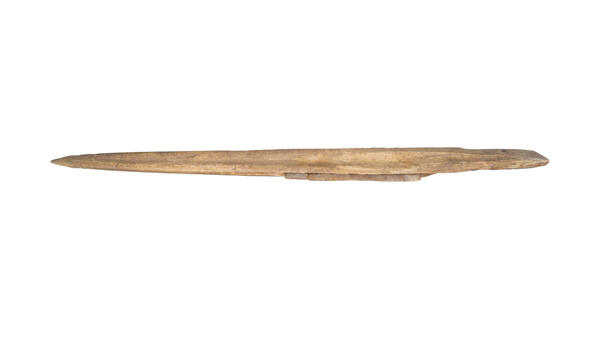
A composite dagger from the Late Neolithic era, which was created 4.6-5.2 thousand years ago, was found at the excavations of the Isakovo burial ground on the bank of the Angara River in the Bratsk district of the Irkutsk region. There, archaeologists discovered a solitary burial covered by masonry. Underneath it, were human remains, as well as jewelry, tools, arrowheads, and also a dagger from the museum’s collection.
Similar implements have been found at many archaeological sites in Siberia. On both sides of the pointed bone part there were grooves for inserts and plates inserted into them. The knives were placed in the burials in a certain way: either near the head with the point upwards, or in the area of the pelvic and femoral bones.
The Isakovsky burial, where the dagger was found, was explored from the 1930s to the 1950s during the rescue work on the Angara river. Before the construction of the Irkutsk and Bratsk hydroelectric power plants, archaeologists were invited to the flooded area to study the ancient objects found there. The excavations were led by the Irkutsk scientist Aleksey Okladnikov. He discovered the Isakovo burial ground and, on the basis of his findings, proposed to identify a separate stage of the Siberian Neolithic — the Isakovo stage.
Okladnikov concluded that there were certain traditions in the Angara Region (Priangarie), which he also described as the Isakovo culture. They covered different areas of life. Following these traditions, the locals made pottery, used certain tools, buried their dead and placed special objects in the grave. As the archaeologist wrote about the findings, “The excavations on the Angara were connected with another big dream — of Angarstroi. Archaeologists in the 30s, having only the most meager material resources at their disposal, equipped mainly with enthusiasm, sought to “clear the zone” of this construction with their excavations, they wanted to preserve for science the wealth of ancient culture of Siberia, which was to go under the waters of the artificial seas of the future. And their diligence was rewarded’.
At present, the scheme of ancient Siberian cultures proposed by Okladnikov has undergone a significant adjustment: the Isakovo culture is not singled out as a separate stage of the Siberian Neolithic, but is closely associated with the neighboring Serovo culture. However, the scientist’s research and findings have not lost their significance: he saved many archaeological sites from destruction and discovered what life looked like on the banks of the Angara River thousands of years ago.
Similar implements have been found at many archaeological sites in Siberia. On both sides of the pointed bone part there were grooves for inserts and plates inserted into them. The knives were placed in the burials in a certain way: either near the head with the point upwards, or in the area of the pelvic and femoral bones.
The Isakovsky burial, where the dagger was found, was explored from the 1930s to the 1950s during the rescue work on the Angara river. Before the construction of the Irkutsk and Bratsk hydroelectric power plants, archaeologists were invited to the flooded area to study the ancient objects found there. The excavations were led by the Irkutsk scientist Aleksey Okladnikov. He discovered the Isakovo burial ground and, on the basis of his findings, proposed to identify a separate stage of the Siberian Neolithic — the Isakovo stage.
Okladnikov concluded that there were certain traditions in the Angara Region (Priangarie), which he also described as the Isakovo culture. They covered different areas of life. Following these traditions, the locals made pottery, used certain tools, buried their dead and placed special objects in the grave. As the archaeologist wrote about the findings, “The excavations on the Angara were connected with another big dream — of Angarstroi. Archaeologists in the 30s, having only the most meager material resources at their disposal, equipped mainly with enthusiasm, sought to “clear the zone” of this construction with their excavations, they wanted to preserve for science the wealth of ancient culture of Siberia, which was to go under the waters of the artificial seas of the future. And their diligence was rewarded’.
At present, the scheme of ancient Siberian cultures proposed by Okladnikov has undergone a significant adjustment: the Isakovo culture is not singled out as a separate stage of the Siberian Neolithic, but is closely associated with the neighboring Serovo culture. However, the scientist’s research and findings have not lost their significance: he saved many archaeological sites from destruction and discovered what life looked like on the banks of the Angara River thousands of years ago.
#13
Full name: Composite Dagger
Date: 3.2-2.6 millennia BC
Technique: bone, flint
Place: Area of the modern Bratsk district, Irkutsk region
Copyright: Irkutsk Regional Museum of Local History
Dimensions: 29,2×2,9×1,2 cm
Date: 3.2-2.6 millennia BC
Technique: bone, flint
Place: Area of the modern Bratsk district, Irkutsk region
Copyright: Irkutsk Regional Museum of Local History
Dimensions: 29,2×2,9×1,2 cm
#14
Fragment of a mouth of a ceramic pot
#15
#16
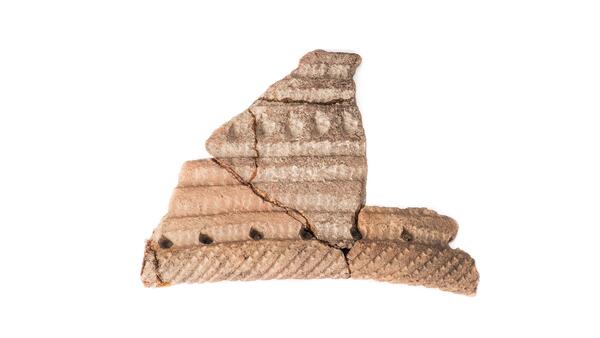
The fragment of a mouth (the so-called upper edge of the neck) of a ceramic pot is housed in the collection of the Regional Museum of Local History. The fragment was discovered in 1960 during an archaeological expedition led by archaeologist Herman Medvedev at the Ust-Belaya site. The find was dated to the Neolithic period: the jar was created about 4.6-7.5 thousand years ago.
Ceramic pots appeared simultaneously in many regions. Scientists factored this in when they determined the periodization of the Early Neolithic era, since in the previous epoch (Mesolithic), such finds are rare. With the Neolithic era, a large number of various pots appeared, along with other changes in human life. When ceramics appeared, people began to invent new ways of cooking and trying those products that could only be eaten boiled or baked.
Some scientists have suggested that ceramics was the first way for people to change the structure of the fabricating material. People learned how to make a solid and moisture-proof object from a dry, loose and free-flowing substance.
Initially, ceramics were made by hand, from local clay. Impurities that kept the products from cracking during thermal heating were added to it: talc, asbestos, sand, crushed shell, gravel (coarse sand) and even plants; the exact ingredients depended on the region. Later, people invented the potter’s wheel, and this greatly simplified the process of pottery making. Household utensils were also made out of ceramics: spinning wheels, sinkers and small figurines.
Neolithic jars of various shapes were found in Siberia: round-bottomed and pointed-bottom pottery. Most likely, this was due to cooking over a fire: it was more convenient to put pots with a pointed bottom between stones or into small pits around which a fire was built.
It is not known what the shape of the jar from the Museum’s collection was; only a fragment of the neck has been preserved. However, on the outer surface of the pot, one can see stamped impressions in the form of a mesh or a thin thread-like cord — this was an early method of ornamental design. The researchers believe that the prints on the jars were not simply decorative, but were also used for rites and rituals.
Ceramic pots appeared simultaneously in many regions. Scientists factored this in when they determined the periodization of the Early Neolithic era, since in the previous epoch (Mesolithic), such finds are rare. With the Neolithic era, a large number of various pots appeared, along with other changes in human life. When ceramics appeared, people began to invent new ways of cooking and trying those products that could only be eaten boiled or baked.
Some scientists have suggested that ceramics was the first way for people to change the structure of the fabricating material. People learned how to make a solid and moisture-proof object from a dry, loose and free-flowing substance.
Initially, ceramics were made by hand, from local clay. Impurities that kept the products from cracking during thermal heating were added to it: talc, asbestos, sand, crushed shell, gravel (coarse sand) and even plants; the exact ingredients depended on the region. Later, people invented the potter’s wheel, and this greatly simplified the process of pottery making. Household utensils were also made out of ceramics: spinning wheels, sinkers and small figurines.
Neolithic jars of various shapes were found in Siberia: round-bottomed and pointed-bottom pottery. Most likely, this was due to cooking over a fire: it was more convenient to put pots with a pointed bottom between stones or into small pits around which a fire was built.
It is not known what the shape of the jar from the Museum’s collection was; only a fragment of the neck has been preserved. However, on the outer surface of the pot, one can see stamped impressions in the form of a mesh or a thin thread-like cord — this was an early method of ornamental design. The researchers believe that the prints on the jars were not simply decorative, but were also used for rites and rituals.
#17
Full name: Fragment of a mouth of a ceramic pot
Date: about 5.5-2.6 millennia BC
Technique: modeling, clay
Place: Ust-Belaya village
Copyright: Irkutsk Regional Museum of Local History
Dimensions: 10×7,7×0,8 cm
Date: about 5.5-2.6 millennia BC
Technique: modeling, clay
Place: Ust-Belaya village
Copyright: Irkutsk Regional Museum of Local History
Dimensions: 10×7,7×0,8 cm
#18
Rod of a compound fishhook
#19
#20
People have been catching fish since ancient times, as evidenced by archaeological findings. The earliest evidence is found at the Late Paleolithic site of Malta, which is 24-26 millennia old. There, scientists found large fish bones and beads made from taimen vertebrae. However, it is impossible to establish exactly when fishing appeared in Siberia.
Most likely, the ancient inhabitants of Siberia originally caught fish with their hands, and later learned to create gear and devices for fishing. Archaeologists found all sorts of equipment: harpoons, baits, hooks and nets.
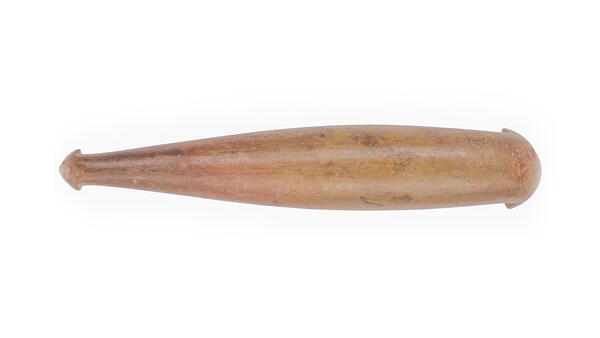
The rod in the collection of the Museum of Regional Studies is part of an ancient composite fishhook. Similar products were used in Eastern Siberia in the Neolithic period (4-7 thousand years ago), especially in the period of the Kitoi culture (about 5.8-7 thousand years ago). The rods were made of stone. Sharp bone stingers were attached to them on one side, and a cord was tied to them on the other.
Archaeologists did not immediately understand how the object was used: the first finds, made in the 19th century, were mistaken by scientists for fish sculptures and symbolic signs. Later it became clear that these products were used to catch fish, but it was not known exactly how the tackle was constructed. It was not until 1928 that researcher Mikhail Gerasimov discovered the assembled hook, which lay in the burial ground in the form in which it had been used. Thanks to this find, scientists have established exactly how the bone pincer was attached and thus what the early fishing gear looked like in Siberia.
Such fishing hook rods are the item most commonly found in the burials of the Kitoi culture. For example, more than 150 similar rods of different sizes, from 0.9 to 15 centimeters, were found at the excavation of the Lokomotiv archaeological site. Among the finds was an object that is now stored in the Regional Museum of Local History — it was donated to the museum by archaeologist Pavel Khoroshikh. In addition to rods, bait fish, an ancient version of the modern spinner, were often found at the excavations of the Lokomotiv burial ground.
Most likely, the ancient inhabitants of Siberia originally caught fish with their hands, and later learned to create gear and devices for fishing. Archaeologists found all sorts of equipment: harpoons, baits, hooks and nets.
The rod in the collection of the Museum of Regional Studies is part of an ancient composite fishhook. Similar products were used in Eastern Siberia in the Neolithic period (4-7 thousand years ago), especially in the period of the Kitoi culture (about 5.8-7 thousand years ago). The rods were made of stone. Sharp bone stingers were attached to them on one side, and a cord was tied to them on the other.
Archaeologists did not immediately understand how the object was used: the first finds, made in the 19th century, were mistaken by scientists for fish sculptures and symbolic signs. Later it became clear that these products were used to catch fish, but it was not known exactly how the tackle was constructed. It was not until 1928 that researcher Mikhail Gerasimov discovered the assembled hook, which lay in the burial ground in the form in which it had been used. Thanks to this find, scientists have established exactly how the bone pincer was attached and thus what the early fishing gear looked like in Siberia.
Such fishing hook rods are the item most commonly found in the burials of the Kitoi culture. For example, more than 150 similar rods of different sizes, from 0.9 to 15 centimeters, were found at the excavation of the Lokomotiv archaeological site. Among the finds was an object that is now stored in the Regional Museum of Local History — it was donated to the museum by archaeologist Pavel Khoroshikh. In addition to rods, bait fish, an ancient version of the modern spinner, were often found at the excavations of the Lokomotiv burial ground.
#21
Full name: Rod of a compound fishhook
Date: about 5-2.8 thousand years BC
Technique: splitting, drilling, grinding
Place: Present-day territory of Irkutsk
Copyright: Irkutsk Regional Museum of Local History
Dimensions: 13,4×2,3×2 cm
Date: about 5-2.8 thousand years BC
Technique: splitting, drilling, grinding
Place: Present-day territory of Irkutsk
Copyright: Irkutsk Regional Museum of Local History
Dimensions: 13,4×2,3×2 cm
#22
Stone knives
#23
#24
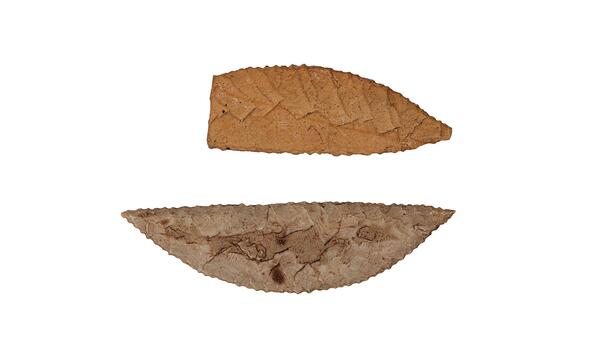
Каменные ножи из коллекции краеведческого музея нашли в 1950 году во время раскопок Глазковского некрополя — самого крупного древнего кладбища эпохи неолита в Северной Азии. Его обнаружили в Свердловском районе города Иркутска. Большая часть Глазковского некрополя — могильник Локомотив, названный так из-за того, что древние захоронения обнаружили под стадионом.
В работах на территории археологического памятника принимали участие многие иркутские археологи разных поколений: Николай Витковский, Михаил Овчинников, Павел Хороших, Михаил Герасимов, Владимир Базалийский и другие. Ученые исследовали некрополь на протяжении более 130 лет и раскопали 87 неолитических могил со скелетами 140 погребенных, а также множество бытовых и ритуальных предметов. Среди них — и каменные ножи, которые передал в музей Павел Хороших.
Предметы, которые археологи обнаружили в могилах, — это полезный инвентарь, который по древней традиции обязательно клали в могилы. Так погребенных снаряжали в путь на тот свет. Внешний вид предметов, их размеры и материалы, из которого они были изготовлены, отличались в зависимости от региона и традиций.
В Сибири в захоронения часто клали предметы искусства, орудия охоты и рыбной ловли, а также ножи. В эпоху неолита люди использовали кремневые ножи — край тщательно обрабатывали, и по остроте они не уступали стальным. Рукоятки у орудий, которые обнаружили археологи, не сохранились, а лезвия имели множество вариантов. Поэтому ученые называли термином “нож” все каменные находки, которые имели вытянутую форму и острый заточенный край.
Древний могильник Локомотив, где были обнаружены артефакты, находился прямо в центре города Иркутска. Из-за строительства железной дороги в конце XIX — начале XX века большая часть древних предметов была уничтожена. А все раскопки, которые проходили на Локомотиве в последующие годы, становились экстренными спасательными работами перед тем, как здесь начинали строить новые здания или прокладывать городские коммуникации. Сейчас за территорией памятника следит Служба по охране объектов культурного наследия Иркутской области. Здесь, на месте Глазковского некрополя, планируют создать музей.
В работах на территории археологического памятника принимали участие многие иркутские археологи разных поколений: Николай Витковский, Михаил Овчинников, Павел Хороших, Михаил Герасимов, Владимир Базалийский и другие. Ученые исследовали некрополь на протяжении более 130 лет и раскопали 87 неолитических могил со скелетами 140 погребенных, а также множество бытовых и ритуальных предметов. Среди них — и каменные ножи, которые передал в музей Павел Хороших.
Предметы, которые археологи обнаружили в могилах, — это полезный инвентарь, который по древней традиции обязательно клали в могилы. Так погребенных снаряжали в путь на тот свет. Внешний вид предметов, их размеры и материалы, из которого они были изготовлены, отличались в зависимости от региона и традиций.
В Сибири в захоронения часто клали предметы искусства, орудия охоты и рыбной ловли, а также ножи. В эпоху неолита люди использовали кремневые ножи — край тщательно обрабатывали, и по остроте они не уступали стальным. Рукоятки у орудий, которые обнаружили археологи, не сохранились, а лезвия имели множество вариантов. Поэтому ученые называли термином “нож” все каменные находки, которые имели вытянутую форму и острый заточенный край.
Древний могильник Локомотив, где были обнаружены артефакты, находился прямо в центре города Иркутска. Из-за строительства железной дороги в конце XIX — начале XX века большая часть древних предметов была уничтожена. А все раскопки, которые проходили на Локомотиве в последующие годы, становились экстренными спасательными работами перед тем, как здесь начинали строить новые здания или прокладывать городские коммуникации. Сейчас за территорией памятника следит Служба по охране объектов культурного наследия Иркутской области. Здесь, на месте Глазковского некрополя, планируют создать музей.
#25
Full name: Stone knives
Date: the Neolithic era
Technique: flint
Place: The “Lokomotiv” Early Neolithic Cemetery, present-day Irkutsk
Copyright: Irkutsk Regional Museum of Local History
Dimensions: 1,7×6,5×0,3 см; 1,7×4,7×0,3 cm
Date: the Neolithic era
Technique: flint
Place: The “Lokomotiv” Early Neolithic Cemetery, present-day Irkutsk
Copyright: Irkutsk Regional Museum of Local History
Dimensions: 1,7×6,5×0,3 см; 1,7×4,7×0,3 cm
#27
Axe with earlike protrusions
#28
#29
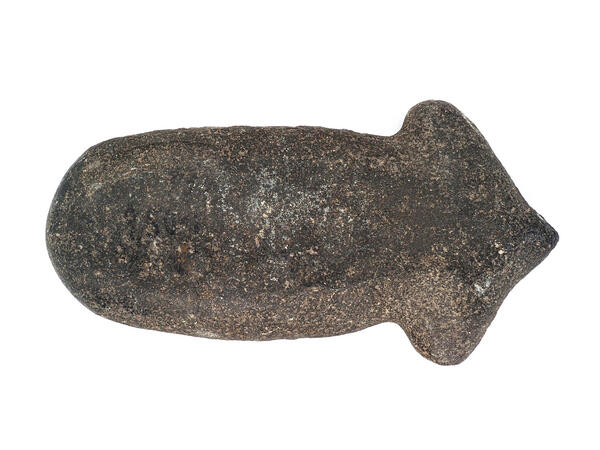
An axe with earlike protrusions is an ancient stone tool with a sharpened blade and symmetrical protrusions on both sides. They were probably used to attach the axe to the handle. In archaeological literature, the handles were called trunnions, and the implements of this shape were described as trunnion. This type of axe was first discovered in Eastern Siberia by archaeologist Nikolai Vitkovsky in 1882, during excavations on the left bank of the Chadobets River.
The earliest trunnion axes found in North Asia were created 8-9 millennia ago. However, archaeologists assume that the tools were used even earlier, which means that it will be possible to find more ancient stone axes. The finds varied in shape — there were pointed, rectangular, round — and size: their height was from 10 centimeters to half a meter. The handles could also be both symmetrical and asymmetrical.
Stone axes have raised many questions and speculations since the first specimens were found and described. Among different peoples of Eurasia Many ancient stone tools, including axes, were considered ‘thunder arrows’ — a weapon of the gods or the result of lightning striking the ground. There have also been widely differing interpretations among scholars as to the purpose of this object.
Irkutsk archaeologists German Medvedev, Ekaterina Lipnina and Dmitry Lohov told what hypotheses were put forward by scientists about axes with handles: ‘They were often not taken as tools of some ancient labor, but believed to be sculptural images of animals and fish. Trunnions are the paws, flippers, fins of a swimming creature, sharp-angled heads of stone products, apparently, were supposed to serve as heads — muzzles’.
Scientists have also speculated that such axes could have been used to drill and cut through ice, work wood, chisel out boats, loosen the earth and create ritual sculptures.
According to another version, the trunnion axes were used in battle. For example, they were used as a weapon like the Tomahawk, the battle axe of the North American Indians.
Such axes were often found inside ancient graves. Irkutsk researchers have suggested that the tool could denote the power and authority possessed by the deceased: ‘There is also a vision of many similar axes with trunnions as symbols of dignity and many others. It’s probably too early today to look for and find a solution to the basic function of such products.’
The earliest trunnion axes found in North Asia were created 8-9 millennia ago. However, archaeologists assume that the tools were used even earlier, which means that it will be possible to find more ancient stone axes. The finds varied in shape — there were pointed, rectangular, round — and size: their height was from 10 centimeters to half a meter. The handles could also be both symmetrical and asymmetrical.
Stone axes have raised many questions and speculations since the first specimens were found and described. Among different peoples of Eurasia Many ancient stone tools, including axes, were considered ‘thunder arrows’ — a weapon of the gods or the result of lightning striking the ground. There have also been widely differing interpretations among scholars as to the purpose of this object.
Irkutsk archaeologists German Medvedev, Ekaterina Lipnina and Dmitry Lohov told what hypotheses were put forward by scientists about axes with handles: ‘They were often not taken as tools of some ancient labor, but believed to be sculptural images of animals and fish. Trunnions are the paws, flippers, fins of a swimming creature, sharp-angled heads of stone products, apparently, were supposed to serve as heads — muzzles’.
Scientists have also speculated that such axes could have been used to drill and cut through ice, work wood, chisel out boats, loosen the earth and create ritual sculptures.
According to another version, the trunnion axes were used in battle. For example, they were used as a weapon like the Tomahawk, the battle axe of the North American Indians.
Such axes were often found inside ancient graves. Irkutsk researchers have suggested that the tool could denote the power and authority possessed by the deceased: ‘There is also a vision of many similar axes with trunnions as symbols of dignity and many others. It’s probably too early today to look for and find a solution to the basic function of such products.’
#30
Full name: Axe with earlike protrusions
Date: about 6000-2600 years BC
Technique: splitting, grinding, picketing, melanocratic granite
Place: Present-day territory of the village of Vimsk
Copyright: Irkutsk Regional Museum of Local History
Dimensions: 28,7×17×4,1 cm
Date: about 6000-2600 years BC
Technique: splitting, grinding, picketing, melanocratic granite
Place: Present-day territory of the village of Vimsk
Copyright: Irkutsk Regional Museum of Local History
Dimensions: 28,7×17×4,1 cm
#26
Ministry of Culture of the Russian Federation
read morehide
00:00
00:00
1x
Tools
Collection
0
 Point your smartphone camera to open in the app
Open in app
Share