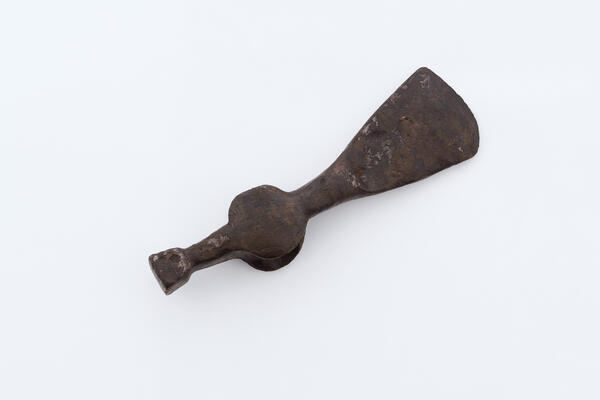
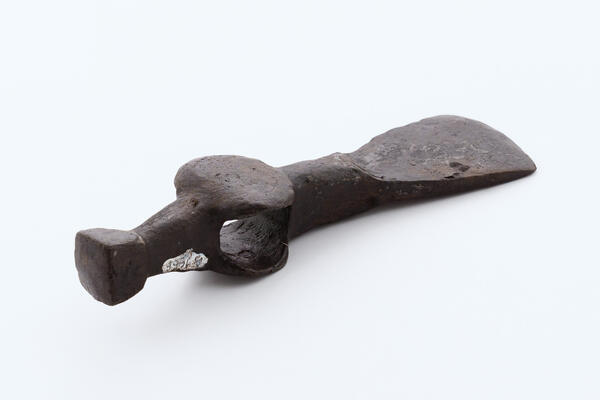
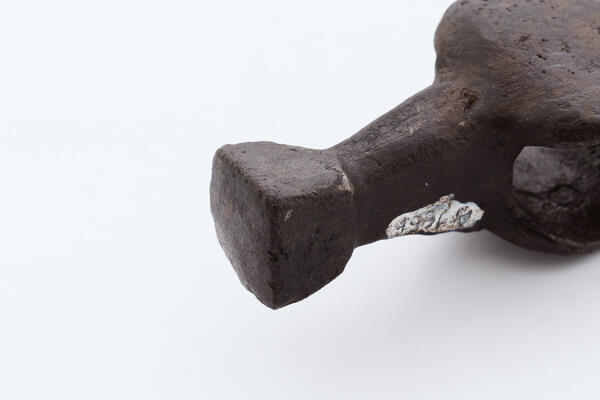
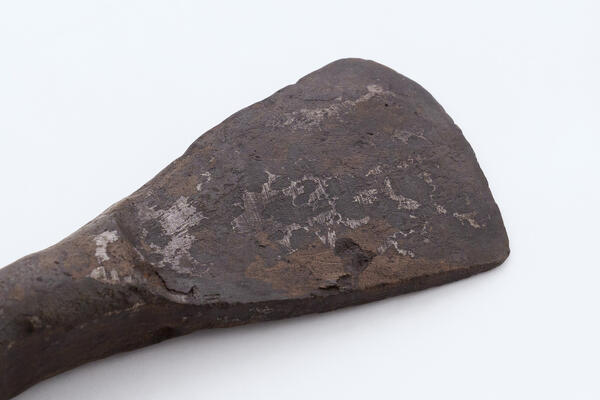
The exhibition at the State Museum-Reserve “Kulikovo Field” features a battle ax displayed in its main hall “Rus and Horde: 14th Century Warfare”. This is an example of offensive weapons used by warriors in the 12th–14th centuries. The base of the ax is forged from an iron blank bent in half. Its lower portion is shaped like a narrow blade and the upper one forms a square head on a narrow handle. After forging, the ax was tempered.
Battle axes were used exclusively for military purposes. They became widespread in the military culture of Ancient Rus and were common until the 12th century, after which they were replaced by pole axes.
Battle axes were smaller and lighter than working axes. Archaeologists often use diminutives to refer to them. A heavy ax that requires two hands to wield is better suited for a lumberjack than for a warrior. After all, a battle ax needed to be carried over long distances. Furthermore, a small battle ax is more maneuverable and convenient as a weapon.
In the era of the Battle of Kulikovo, battle axes were weapons used exclusively by professional warriors against armored opponents. The narrow blade could easily break through armor, while the head could stun an enemy. The ax served warriors not only in combat but also during rest and while clearing paths through dense forests. Battle axes were almost unknown in the Golden Horde during the time of the Battle of Kulikovo. Thus, this is almost certainly a piece of ancient Russian weaponry.
Several fragments of ax blades have been discovered at the site of the Battle of Kulikovo. Battle axes were relatively rare.
The specimen displayed in the museum exhibition pertains to battle axes. They were most popular in Ancient Rus during the 10th and 11th centuries. Still, they remained present in Russian lands until the first half of the 15th century. It is likely that this exhibit was produced during this later period.