#1
V.G. Tonkoshkurov, Leaflet
#2
#3
#4
In mid-July 1941, the headquarters of the 22nd Army arrived in VelIkiye LUki. The defense of the city from the Nazi invaders was entrusted to the 29th Rifle Corps, which operated together with the people’s volunteer corps of the city.
On July 18, under the onslaught of the enemy, after two days of stubborn fighting, the Red Army abandoned Velikiye Luki, but already on July 22, after a regrouping of forces, the city was liberated. Velikiye Luki was the third city in Russia to be liberated from the Nazi occupiers at the initial stage of the war on the Eastern front.
Further repeated attempts of the Nazis to seize Velikiye Luki again were unsuccessful. For more than a month, despite a significant superiority in forces, the enemy could not prevail over the Red Army and the volunteer corps defending the city. The soldiers of the 48th Tank Division and of the 179th Rifle Division and the people’s volunteer corps did not retreat. On some days the city’s defenders fought off up to seven attacks a day. Since July 30, the 48th Tank Division mainly operated as infantry, since only 11 out of 85 tanks were left.
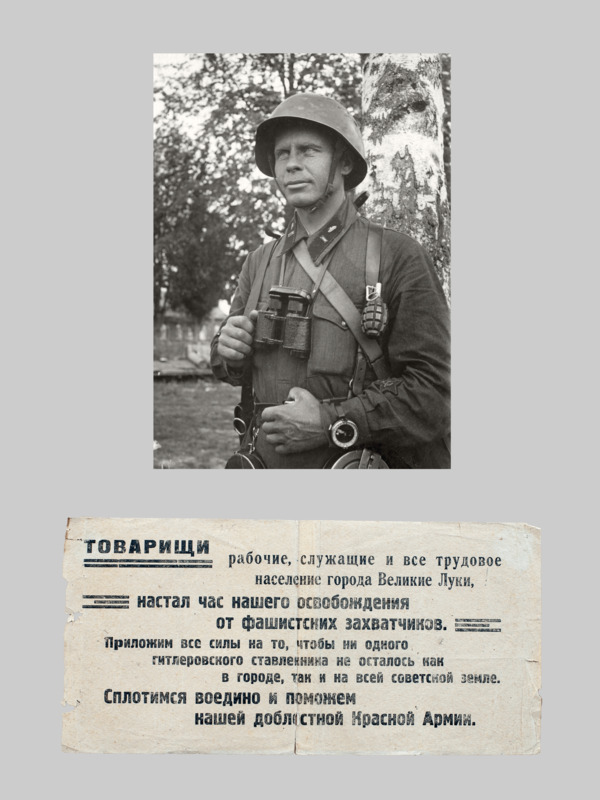
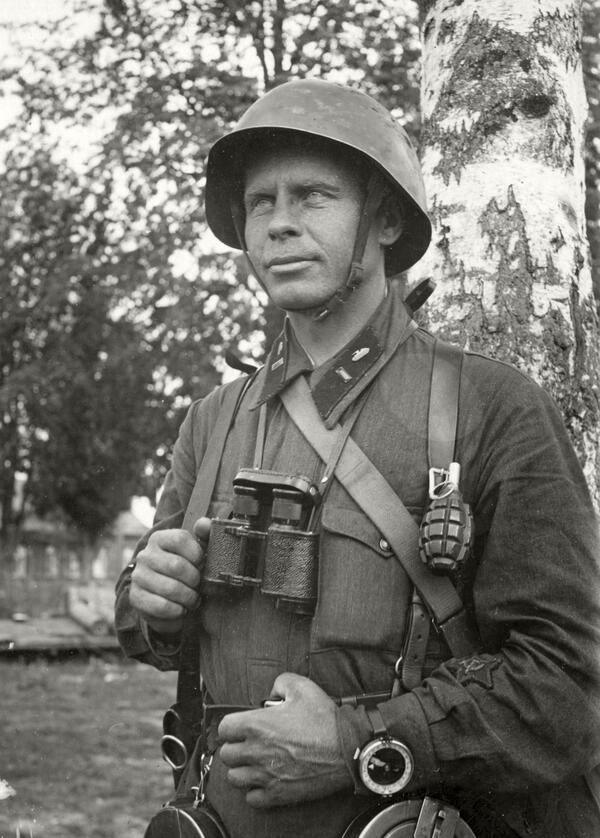
In August 1941, the positions of the 48th Tank Division were visited by the front-line photojournalist for the newspaper of the Western Military District Krasnoarmeyskaya Pravda Mikhail Savin, who had been at the forefront since the first days of the war. One of the people captured by Savin’s camera in the Velikiye Luki district was Viktor Tonkoshkurov, commissar of the 48th Detached Battalion of the 48th Tank Division.
On the back of the photograph, taken on August 7 or 8, 1941, there is a writing on several lines.
Presumably, its author was Tonkoshkurov himself, who tried to convey the mood of the Red Army soldiers: ‘V. Luki. The Birch Grove is a re[al] artillery duel, the Germans are throwing lots of mines and shells at [us], a sea of metal is boiling around… the earth is shaking… and we are fearle[s[sly preparing for a counterattack’.
At the end of August, Viktor Tonkoshkurov was able to leave the encirclement, and in October he was seriously wounded and concussed. Later Tonkoshkurov served as deputy head for political affairs of the 3rd Saratov Tank School. During the defense of Velikiye Luki, he received letters from the city of Kuybyshev from his wife, son and neighbors. In 1979, Viktor Tonkoshkurov donated a collection of letters to the Velikiye Luki Museum of History and Local Lore.
#10
Full name: Photograph Viktor Grigorievich Tonkoshkurov
Author: Mikhail Ivanovich Savin
Date: august 7, 1941
Technique: black and white photography
Date: august 7, 1941
Technique: black and white photography
Place: Velikiye Luki
Dimentions: 11.5×8.7 cm
Collection: Velikiye Luki Museum of History and Local Lore
Copyright: Public State-Funded Cultural Institution Pskov-Izborsk United Museum Preserve
Dimentions: 11.5×8.7 cm
Collection: Velikiye Luki Museum of History and Local Lore
Copyright: Public State-Funded Cultural Institution Pskov-Izborsk United Museum Preserve
#5
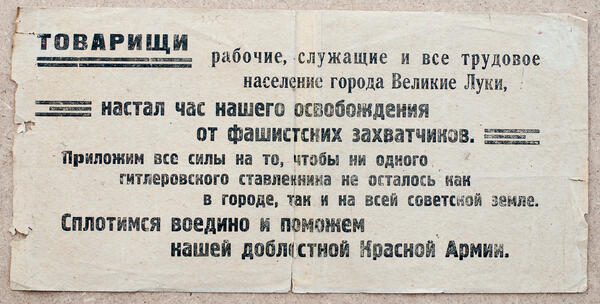
Leaflet printed by underground printers
#6
#7
On August 25, 1941, German troops occupied VelIkiye LUki. The Nazis created a system of camps and prisons and carried out a mass extermination of the civilian population. Many residents of Velikiye Luki were driven into German slavery.
Under the ‘new order’, active resistance to the enemy began. Underground groups were formed in the city, and among them were anti-fascist organizations in a printing house, a steam locomotive repair plant, a locomotive depot and a power plant.
The underground members committed many acts of sabotage. At the power plant, they disabled the AC generator and the pumping station. At the steam locomotive and car repair plant, the shops and the ammunition depot were set on fire, and leaflets were printed and distributed.
The underground group in the city printing house was headed by its director VasIly TsvetkOv. The organization included RodiOn BogdAnov, AntonIna GusEva, EgOr KolpakOv, NadEzhda NechAyeva, and the old watchman BonifAtiy Kork. To print anti-Nazi leaflets, the members of the underground organization used fonts hidden before the enemy attack. The leaflets said: ‘Let’s join our forces and help our valiant Red Army.’
The head of the underground organization of the steam locomotive and car repair plant Fokin established contact with Tsvetkov to coordinate the anti-Nazi activities of both underground organizations. At the same time, they agreed that Tsvetkov would write and print the leaflets, and the members of the other organizations would distribute them.
Even the children helped the underground organizations: they secretly transported leaflets hidden between rugs.
These events are recounted in the memoirs of the city resident:
#8
’ I have to go to the printing house as Tsvetkov’s daughter, bring him lunch. An armed German stood at the entrance. He checked the food and let me in. One of the women hastily wrapped a shawl with leaflets around my waist, pulled on coat… then I gave the leaflets to the underground members. They started posting them up’
M.G. Ivanova
#9
The underground patriots were executed at the Kolomenskoye cemetery on the morning of March 19, 1942. They are buried in a mass grave. This leaflet was issued in the same year, when the Soviet soldiers defeated the Nazis near Moscow and drove them to the west. On March 19, 1997, a memorial sign was erected at the place of the execution in Velikiye Luki.
#11
Full name: Leaflet printed by underground printers
Author: Vasily Illarionovich Tsvetkov
Date: 1942
Technique: printing
Author: Vasily Illarionovich Tsvetkov
Date: 1942
Technique: printing
Place: Velikiye Luki
Dimentions: 18×37 cm
Collection: Velikiye Luki Museum of History and Local Lore
Copyright: Public State-Funded Cultural Institution Pskov-Izborsk United Museum Preserve
Dimentions: 18×37 cm
Collection: Velikiye Luki Museum of History and Local Lore
Copyright: Public State-Funded Cultural Institution Pskov-Izborsk United Museum Preserve
read morehide
00:00
00:00
1x
V.G. Tonkoshkurov, Leaflet
Collection
Exhibition
0
 Point your smartphone camera to open in the app
Open in app
Share