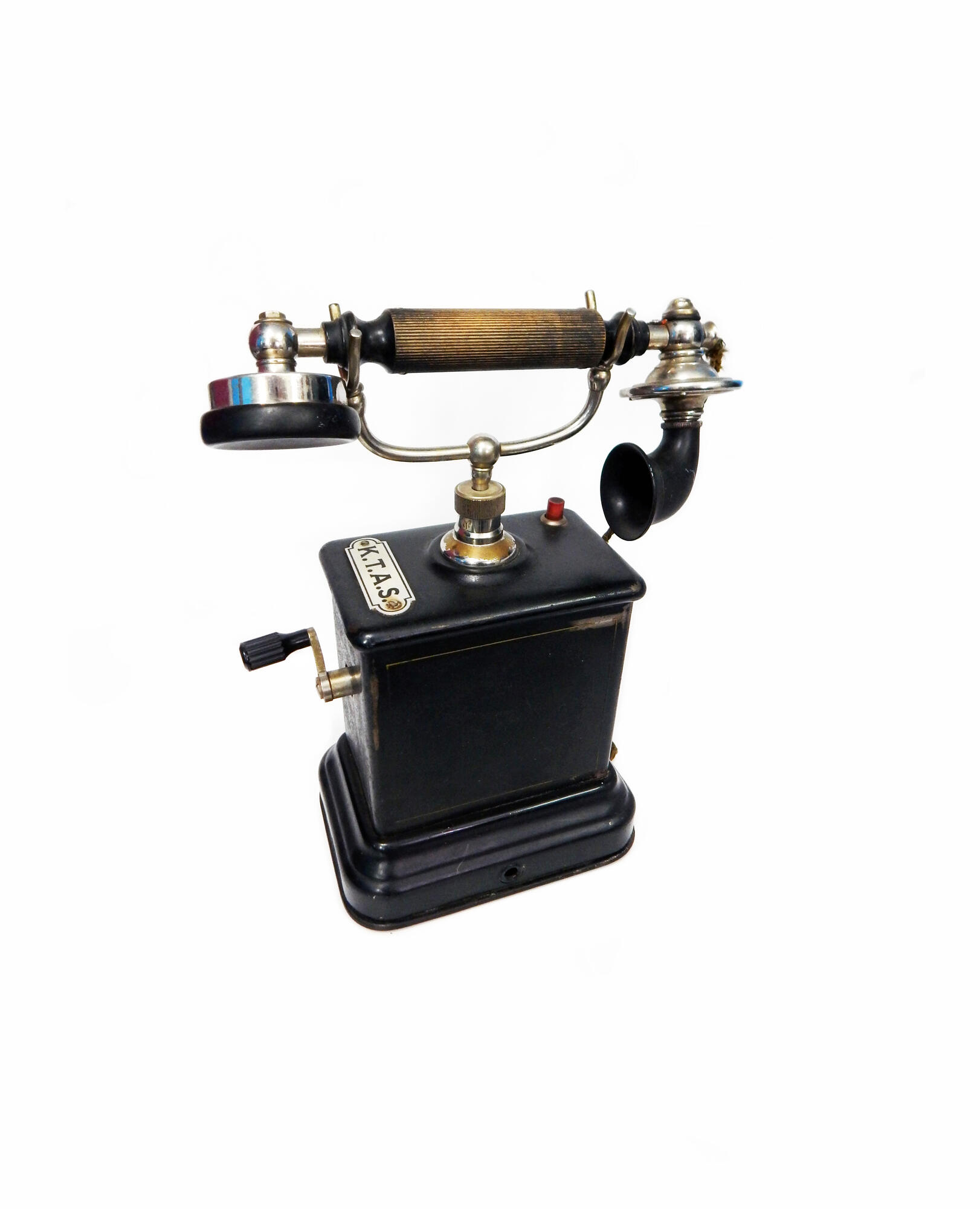


A telephone is a device designed to convert electrical signals into sound and transmit sounds at a distance, sample 1914, Denmark patent of Lars Magnus Erickson, switchboard. The phone case is rectangular in shape, high, black in color. A metal handle with a brown plastic tip is screwed onto the narrow side on the right side with a screw. In the upper part, on the fork spring holder, there is a tube, on one side of which there is a carbon microphone with a bell, on the other side of the tube there is a hearing aid. A plate with the brand “K.T.A.S.” is screwed on the upper part on the right. There is a red button on the left. An insulated wire is inserted from the microphone side with a bell, the second part of which is inserted into the lower part of the phone case. On the bottom of the phone there are four round legs in the corners, round holes and the brand “KLQBTNHAVNS TELEVON AKTIESELSAB”.
At the origins of Russian telephony in the late XIX — early XX century was the largest telecommunications Swedish company “Erikson”. In 1876, Lars Magnus Erikson founded electromechanical workshops in Stockholm. Soon the company took a leading place in the Swedish industrial market. Erikson’s first foreign experience was a factory in St. Petersburg. He even considered a plan to move his entire business here, but the competitive situation has changed, and the need to move to the east has disappeared. Since 1897, Erickson’s workshops have been located in rented premises on Vasilievsky Island and in four years have produced more than one thousand telephones and switchboards. Production was expanding, more space was needed. The factory was opened in the new building in December 1900. In honor of this event, each worker was given a monetary reward in the amount of 25 kopecks.
In 1905, the Russian Joint Stock Company L.M. Erikson and Co. was registered. During the seventeen years of his reign, Sandberg turned the plant into a large, well-equipped enterprise. It supplied switchboards and telephones to the postal administration, telegraph and other civil and military departments. The client of the company was the Emperor Nicholas II himself. The demand for the company’s products especially increased after the outbreak of the First World War. The production was expanded and modernized.
In the early years of the revolution, the factory manufactured telephones for Kremlin offices. However, due to the lack of fuel, electricity, and lack of labor, production was rapidly declining. In 1919 it was nationalized. The plant received a new name “Red Dawn”. Its territory expanded over time, neighboring plots were attached to it, on which new workshops were erected.