Font
Color
Graphics
Изображение точки

To see AR mode in action:

1. Install ARTEFACT app for iOS or Android;

2. Find the exhibition «Ancient Cultures of the Trans-Ural Steppe»

3. Push the «Augmented reality» button and point your phone's camera at the exhibit;

Скрыть точки интересаПоказать точки интереса
Показать в высоком качестве

Mirror, Beads, Pobeda vessel, Spoon

0
Open in app
#2

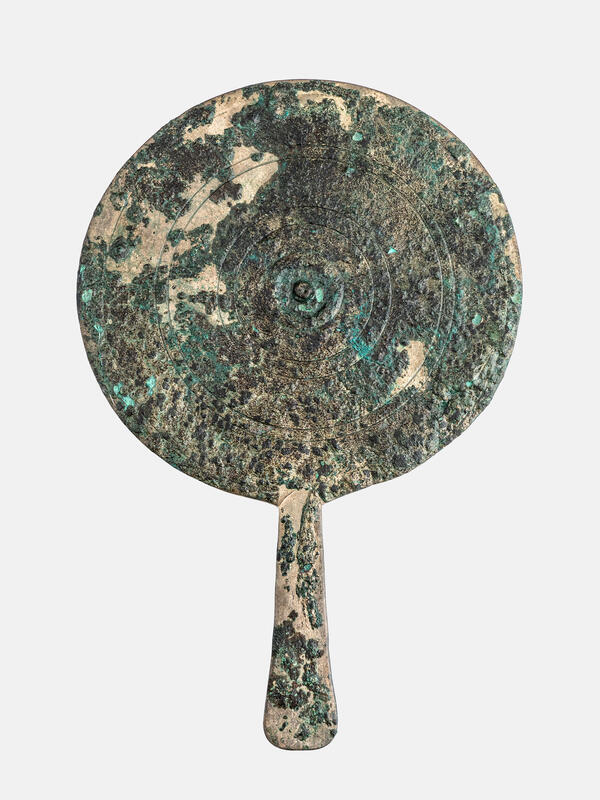
Bronze mirror

#7

The museum exhibition includes a bronze mirror from mound 3 of the Pobeda burial ground (Kizilsky district, Chelyabinsk region). The burial mound was studied in 1999–2000 by the archaeological expedition of the Arkaim Museum-Reserve and Chelyabinsk State University led by Alexander Tairov and Ilya Lyubchansky.

The Pobeda burial ground is located six kilometers northeast of the village of Zingeysky on a flattened hilltop and consists of three mounds with earthy, well turfed fill. Mound 3 was 20 meters in diameter and 0.8 meters high. Five grave pits were found under the mound. Among the finds were ceramic vessels, iron knives, a quiver with arrows (one bone arrowhead and twenty-three bronze ones), and the remains of an incomplete ram carcass. Grave pit 3 is embedded in the southwestern flank of the mound. The entrance to the burial chamber was closed with poles and blocks. A skeleton of a woman was excavated at the bottom of the burial chamber (1.1 meters deep). The buried woman was laid on her back, with her arms stretched along her body. There was a bronze torc around her neck and a silver ring on the ring finger of her right hand. At her right shoulder was a leather bag, inside which there was a bronze mirror with a long side handle, a bronze wheel amulet and an iron knife. At the right knee was a ceramic vessel, at the feet was a piece of chalk, two bone spoons, a shell, a ceramic spindle whorl and a round pebble.

The bronze mirror is very well preserved. On the reverse side of the mirror in the center there is an umbo (diameter — 0.9 centimeters, height — 0.4 centimeters), around which there is a roller (diameter — 3.3 centimeters, width — 0.6 centimeters). Further to the periphery are concentric circles drawn twice in pairs, and another single circle at the edge. The handle smoothly expands to the rounded end. It is slightly thickened at the base. The disk at the junction with the handle on the reverse side has an arched pattern, the ends of which pass into the lateral edges of the handle.
#6
Name: Bronze mirror
Date of creation: Early Iron Age
Technique: bronze; casting, forging
Dimensions: disk diameter — 18–18.3 cm, thickness — 0.2 cm; handle length — 10 cm, width — 3.1 cm
#3

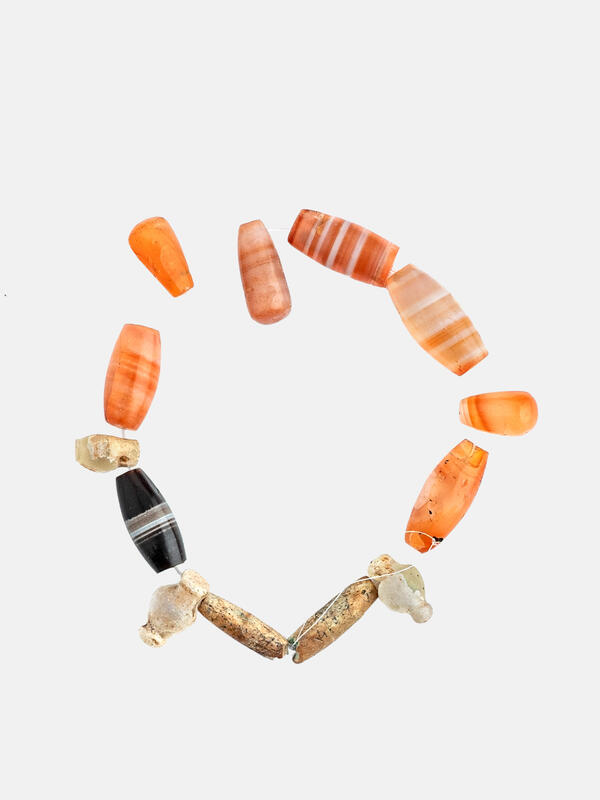
String of beads

#9

The museum exhibition includes a string of beads from mound 3 of the Pobeda burial ground (Kizilsky district, Chelyabinsk region). The burial mound was studied in 1999–2000 by the archaeological expedition of the Arkaim Museum-Reserve and Chelyabinsk State University led by Alexander Tairov and Ilya Lyubchansky. The Pobeda burial ground is located six kilometers northeast of the village of Zingeysky on a flattened hilltop and consists of three mounds with earthy, well turfed fill. Mound 3 was 20 meters in diameter and 0.8 meters high. Five grave pits were found under the mound.

Grave pit 4 was located almost in the center of the mound. In order to dig it, part of the original fill was removed down to the level of the firm land. After the burial, the soil was returned to its place. The pit had a buttress along the long side wall. The remains of a wooden burial structure in the form of a frame made of poles of 5–7 centimeters in diameter were found at the bottom. The buried woman was laid on her back with her arms stretched out along her body. On the wrists of both hands there were bracelets made of stone and glass beads. At the left hand of the buried woman a string of glass, stone and paste beads totaling 13 pieces was found. The beads are different in shape (amphora-shaped, keg-shaped, truncated-drop-shaped and elongated-cylindrical), varied in color (beige with natural flecks of red and white stripes, black with stripes of gray shades, silver, gold and grayish yellow) and made of different materials (glass, stone, paste).

Also, a bronze mirror with a long side handle was placed behind the head of the buried woman; a leather quiver on a wooden base, which was attached to the belt with an iron hook, was found at her feet. Inside the quiver there were 135 bronze-tipped arrows and one iron-tipped arrow. Next to the quiver, a leather bag was placed at the bottom of the pit, containing a round pebble, a stone whetstone, a piece of chalk, a shell, seven fragments of rock crystal, a bone pipe, and pieces of minerals for producing red, yellow and brown paint. An iron knife was found at the shin of the left leg.

Mound 3 was erected in the 5th century BC. Its materials demonstrate the emergence of the tradition of centric-circular layout of burials under the mound fill. The tradition was later developed in the Southern Urals and Lower Volga region.

#8
Name: String of beads
Date of creation: Early Iron Age
Technique: glass, stone, paste; smelting, drilling, polishing
Dimensions: 1.5×1.0 cm; 1.6×0.9 cm; 1.2×0.9 cm; 1.5×0.9 cm; 2.0×0.9 cm; 1.5×1.9 cm
#4

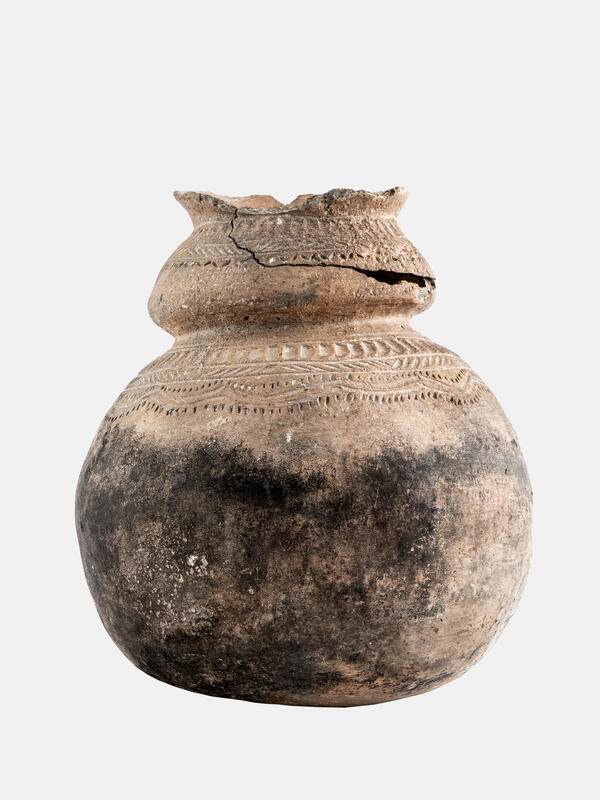
Ceramic vessel. Pobeda burial ground

#11

The museum exhibition includes a ceramic vessel from mound 3 of the Pobeda burial ground in Kizilsky district of Chelyabinsk region. The burial mound was studied in 1999–2000 by the archaeological expedition of the Arkaim Museum-Reserve and Chelyabinsk State University led by Alexander Tairov and Ilya Lyubchansky. The Pobeda burial ground is located six kilometers northeast of the village of Zingeysky on a flattened hilltop and consists of three mounds with earthy, well turfed fill. Mound 3 was 20 meters in diameter and 0.8 meters high. Five grave pits were found under the mound. Among the finds were ceramic vessels, iron knives, a quiver with arrows (one bone arrowhead and twenty-three bronze ones), and the remains of an incomplete ram carcass.

Grave pit 3 is embedded in the southwestern flank of the mound. The entrance to the burial chamber was closed with poles and blocks. A skeleton of a woman was excavated at the bottom of the 1.1-meter-deep burial chamber. The buried woman was laid on her back, with her arms stretched along her body. There was a bronze torc around her neck and a silver ring on the ring finger of her right hand. At her right shoulder was a leather bag, inside which there was a bronze mirror with a long side handle, a bronze wheel amulet and an iron knife. At the right knee was a ceramic vessel, at the feet was a piece of chalk, two bone spoons, a shell, a ceramic spindle whorl and a round pebble.

The ceramic vessel was found at the feet of the woman’s skeleton. It has a flat bottom and consists of two parts. The body of its lower part is spherical, the upper part is flattened-conical, the high corolla is significantly bent. The surface of the vessel is carefully smoothed. The lower part of the vessel is decorated with two dashed wavy lines bounded by rows of small indentations, above them are three lines, between which are slanting indentations in different directions and large vertical ones. In the upper part there is a horizontal zigzag, above that there are inclined indentations in groups, which both above and below are limited by lines. Still higher are large vertical indentations and a horizontal line.

The materials of mound 3 demonstrate the emergence of the tradition of centric-circular layout of burials under the mound fill. The tradition was later developed in the Southern Urals and Lower Volga region.

#10
Name: Ceramic vessel. Pobeda burial ground
Date of creation: Early Iron Age
Technique: clay; hand modeling, firing, clay; ornamentation
Dimensions: 21,6×18,6×18,4 cm
#5

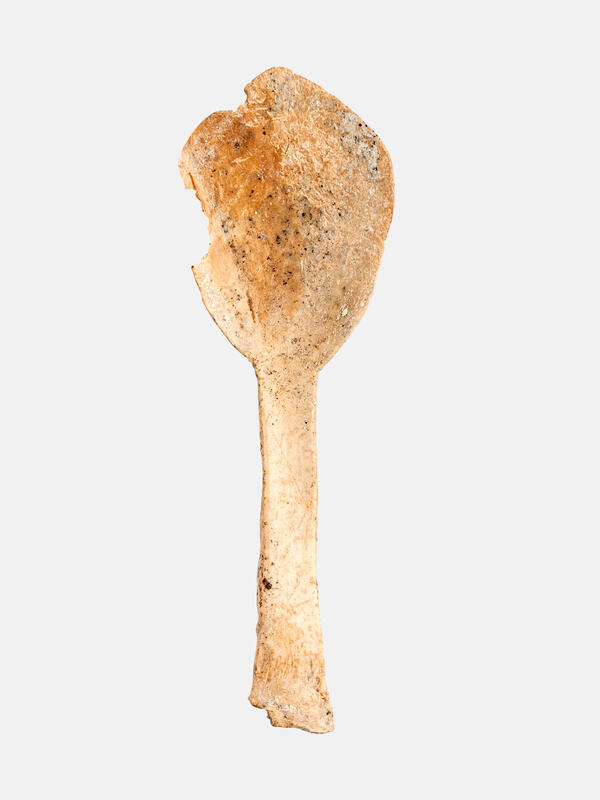
Bone spoon

#12

The museum exhibition presents finds from the Pobeda burial ground in Kizilsky district, Chelyabinsk region. The burial mound was studied in 1999–2000 by the expedition of the Arkaim Museum-Reserve and Chelyabinsk State University led by the archeologists Alexander Tairov and Ilya Lyubchansky.

The Pobeda burial ground is located six kilometers northeast of the village of Zingeysky on a flattened hilltop and consists of three mounds with earthy, well turfed fill. Mound 3 was 20 meters in diameter and 0.8 meters high. Five grave pits were found under the mound. Among the finds were ceramic vessels, iron knives, a quiver with arrows (one bone arrowhead and twenty-three bronze ones), and the remains of an incomplete ram carcass.

The grave pit is embedded in the southwestern flank of the mound. The entrance to the burial chamber was closed with poles and blocks. A skeleton of a woman was excavated at the bottom of the burial chamber (1.1 meters deep). The buried woman was laid on her back, with her arms stretched along her body. There was a bronze torc around her neck and a silver ring on the ring finger of her right hand. At her right shoulder was a leather bag, inside which there was a bronze mirror with a long side handle, a bronze wheel amulet and an iron knife. At the right knee was a ceramic vessel, at the feet was a piece of chalk, two bone spoons, a shell, a ceramic spindle whorl and a round pebble.

The exhibition includes one of the found bone spoons. The piece is smoothly curved, has a flat handle subrectangular in cross-section, which widens towards the end. The bowl is ovoid in shape and shallow. The spoon was found near a pebble with traces of use in the form of clogs and abrasions. One flat surface of the pebble had a stain of burgundy-colored substance with white and beige spots, as well as a mollusk shell with a red stain. To all appearances, this spoon can be attributed to female household items associated with cosmetics and grinding of coloring substances.

The mound was erected in the 5th century BC. Its materials demonstrate the emergence of the tradition of centric-circular layout of burials under the mound fill, which was later developed in the Southern Urals and Lower Volga region.

#1
Name: Bone spoon
Date of creation: Early Iron Age; late 5th — early 4th centuries BC
Technique: bone; carving

Dimensions: 10,3×3,4×0,4 cm

#13
read morehide

Mirror, Beads, Pobeda vessel, Spoon

0
Point your smartphone camera to open in the app
Share
VkontakteOdnoklassnikiTelegram
Share on my website
Copy linkCopied
Copy
Open in app
To see AR mode in action:
  1. Install ARTEFACT app for 
  2. iOS or Android;
  3. Find and download the «Paintings in Details» exhibition
  4. Push the «Augmented reality» button and point your phone's camera at the painting;
  5. Watch what happens on your phone screen whilst you flip through the pictures.
 
We use Cookies
Cookies on the Artefact Website. We use cookies to ensure that we give you the best experience on our website. If you continue without changing your settings, we'll assume that you are happy to receive all cookies on the Artefact website. However, if you would like to, you can change your cookie settings at any time.
Learn more about useHide
Content is available only in Russian

X

Нашли опечатку?...

%title%%type%