#5
Tobacco pipe, Needlework kit
#6
#7
#8
The first clay tobacco pipes appeared in England back in 1575. But at that time smoking was frowned upon at the royal court, and most English pipe makers moved to Gouda, in Holland. Back then, pipes were made with small bowls, as tobacco was an expensive luxury. Slowly, as more suppliers of tobacco appeared, both in America and in other countries, pipes were made with larger bowls.
The clay used to make the Dutch pipes came from Germany. In the 17th Century the city of Gouda was home to more than 500 master pipe makers. A little later on, manufacturers set up business in Germany, Poland and Russia. In the Ottoman Empire pipes were generally made with clay bowls and the expensive mouthpieces were made of amber. Every royal court had a chibouk keeper - a special official who was responsible for looking after the pipes and tobacco. In Asia and the Pacific Ocean region, bamboo pipes were very popular. A small bamboo cylinder, or partially dried gourd was inserted at right angles into a long bamboo tube. The large reservoir of air had the effect of cooling the smoke.
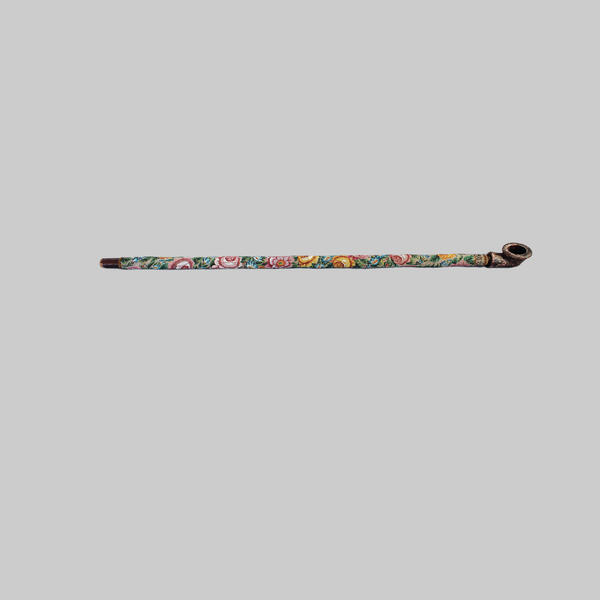
The tobacco pipe displayed in the Decembrists in Yalutorovsk exhibition, in the Matvey Muravyov-Apostol Memorial House, was made in 1840. It was presented to the Museum by Nikolai Vasilevich Zubarev, Director of the Yalutorovsk Regional Decembrist Memorial Museum. He was given the pipe on one of his study trips, back in 1984. The tobacco pipe belonged to a Moscow resident, Klavdiya Sergeyeva. The State Historical Museum recommended her to donate the pipe to the collection in Yalutorovsk. It can now be seen in the Decembrists in Yalutorovsk exhibition.
The mouthpiece, bowl and stem are made of different materials. The long stem is made of cherry wood, covered with a fine beadwork design of red and yellow roses, small blue flowers, leaves and the letters VS, and the date 1840. The bowl of the pipe and the mouthpiece are made of ceramic and reddish-brown wood. The bowl is conical in shape and is decorated with a recessed line around the edge and a stripe made of small circles.
The clay used to make the Dutch pipes came from Germany. In the 17th Century the city of Gouda was home to more than 500 master pipe makers. A little later on, manufacturers set up business in Germany, Poland and Russia. In the Ottoman Empire pipes were generally made with clay bowls and the expensive mouthpieces were made of amber. Every royal court had a chibouk keeper - a special official who was responsible for looking after the pipes and tobacco. In Asia and the Pacific Ocean region, bamboo pipes were very popular. A small bamboo cylinder, or partially dried gourd was inserted at right angles into a long bamboo tube. The large reservoir of air had the effect of cooling the smoke.
The tobacco pipe displayed in the Decembrists in Yalutorovsk exhibition, in the Matvey Muravyov-Apostol Memorial House, was made in 1840. It was presented to the Museum by Nikolai Vasilevich Zubarev, Director of the Yalutorovsk Regional Decembrist Memorial Museum. He was given the pipe on one of his study trips, back in 1984. The tobacco pipe belonged to a Moscow resident, Klavdiya Sergeyeva. The State Historical Museum recommended her to donate the pipe to the collection in Yalutorovsk. It can now be seen in the Decembrists in Yalutorovsk exhibition.
The mouthpiece, bowl and stem are made of different materials. The long stem is made of cherry wood, covered with a fine beadwork design of red and yellow roses, small blue flowers, leaves and the letters VS, and the date 1840. The bowl of the pipe and the mouthpiece are made of ceramic and reddish-brown wood. The bowl is conical in shape and is decorated with a recessed line around the edge and a stripe made of small circles.
#9
Date: 1840
Place: Russian Empire
Technique: cast metal, hand embroidery, beadwork
Dimensions: Pipe stem: 66×1 cm; bowl and mouthpiece: 7×3.5×4.5 cm
Collection: Wood/Household items
Copyright: Tyumen Province State Autonomous Cultural Institution ‘Tyumen Museum and Educational Association’
Place: Russian Empire
Technique: cast metal, hand embroidery, beadwork
Dimensions: Pipe stem: 66×1 cm; bowl and mouthpiece: 7×3.5×4.5 cm
Collection: Wood/Household items
Copyright: Tyumen Province State Autonomous Cultural Institution ‘Tyumen Museum and Educational Association’
#10
Needlework kit
#11
#12
In the family of the Decembrist MatvEy MuravyOv-ApOstol, the pupils were taught needlework. Avgusta Sozonovich, one of the foster children of the Decembrist, for some time was in charge of the needlework class at the girls’ school, opened by the Decembrist Ivan Yakushkin in YalUtorovsk. Craftswomen improved their craft: some used special aids with patterns and ideas, sometimes composed embroidery plots themselves, and occasionally made copies of painting reproductions and turned them into embroidery. Handcrafts were often made of beads. In Russia, beadwork was mainly done by those of noble families. Hand embroidery made of beads could be so skillfully executed that such work was often presented to the Empress as a present.
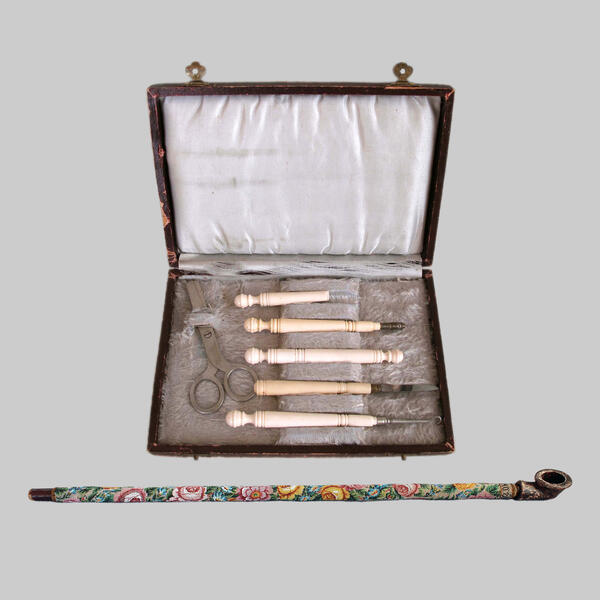
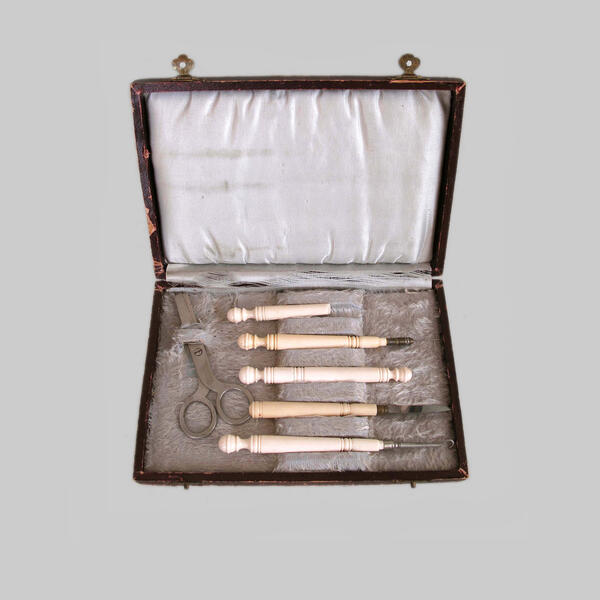
The item depicted is the most widespread needlework set in the 19th century. It was made in Russia in the 19th century. The set for needlework consists of a case, a hook for lifting loops, a crochet hook, a case for needles, a knife and scissors. These devices allowed the girls to do any kind of handicraft: embroidery, crocheting, beading, and others. The cover of the case was folded back and closed with two fasteners. The body of the case is made of wood, the outside is pasted over with brown paper, the inside is sheathed with satin and light blue plush. The included hook for lifting the hinges consists of a rod and a handle. The rod is made of light gray metal, straight, with a sharp end. The handle of the hook was cut out of white bone, turned and decorated with carved belts and a spherical tip. The crochet hook was decorated in the same way. The needle case was made of a white, cylindrical bone, tapering slightly on one side. It consists of two parts connected by a screw thread.
It was also decorated with carved ball-shaped points. The knife is cut out of light gray metal, and its handle is made of white bone. Like other handicraft knives, the blade in this set is short, straight, and pointed. The kit was added to the museum collection in 1993. The museum staff bought it in an antique store in Moscow specifically for a new exhibit in the memorial house of M.I. Muravyov-Apostol. The house-museum was opened after restoration in 1994.
The item depicted is the most widespread needlework set in the 19th century. It was made in Russia in the 19th century. The set for needlework consists of a case, a hook for lifting loops, a crochet hook, a case for needles, a knife and scissors. These devices allowed the girls to do any kind of handicraft: embroidery, crocheting, beading, and others. The cover of the case was folded back and closed with two fasteners. The body of the case is made of wood, the outside is pasted over with brown paper, the inside is sheathed with satin and light blue plush. The included hook for lifting the hinges consists of a rod and a handle. The rod is made of light gray metal, straight, with a sharp end. The handle of the hook was cut out of white bone, turned and decorated with carved belts and a spherical tip. The crochet hook was decorated in the same way. The needle case was made of a white, cylindrical bone, tapering slightly on one side. It consists of two parts connected by a screw thread.
It was also decorated with carved ball-shaped points. The knife is cut out of light gray metal, and its handle is made of white bone. Like other handicraft knives, the blade in this set is short, straight, and pointed. The kit was added to the museum collection in 1993. The museum staff bought it in an antique store in Moscow specifically for a new exhibit in the memorial house of M.I. Muravyov-Apostol. The house-museum was opened after restoration in 1994.
#13
Date: 19th century
Place: Russia
Technique: turning, forging
Dimensions: 2,5×18,5×12,5 cm
Collection: Metal
Copyright: Tyumen Museum and Educational Association
Goskatalog Number: 10178361
Place: Russia
Technique: turning, forging
Dimensions: 2,5×18,5×12,5 cm
Collection: Metal
Copyright: Tyumen Museum and Educational Association
Goskatalog Number: 10178361
read morehide
00:00
00:00
1x
Tobacco pipe, Needlework kit
Collection
Exhibition
0
 Point your smartphone camera to open in the app
Open in app
Share