#5
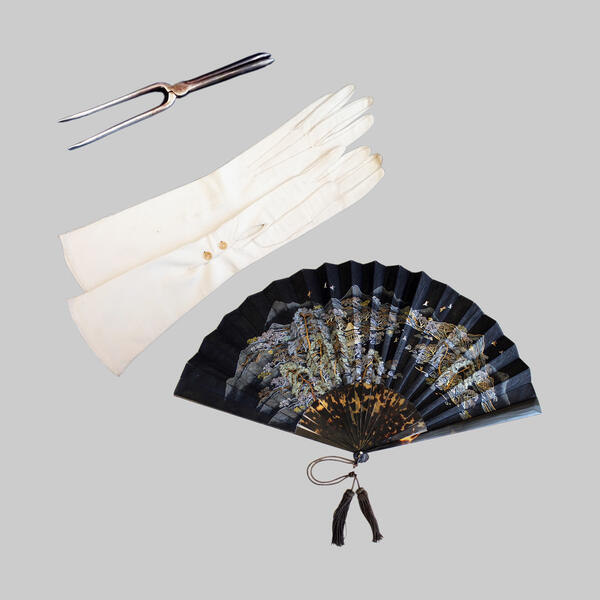
Щипцы для завивки, перчатки, веер
#6
#7
#8
The hair curling iron presented in the Decembrists in Yalutorovsk exhibit was donated to the museum by the Russian Cultural Foundation.
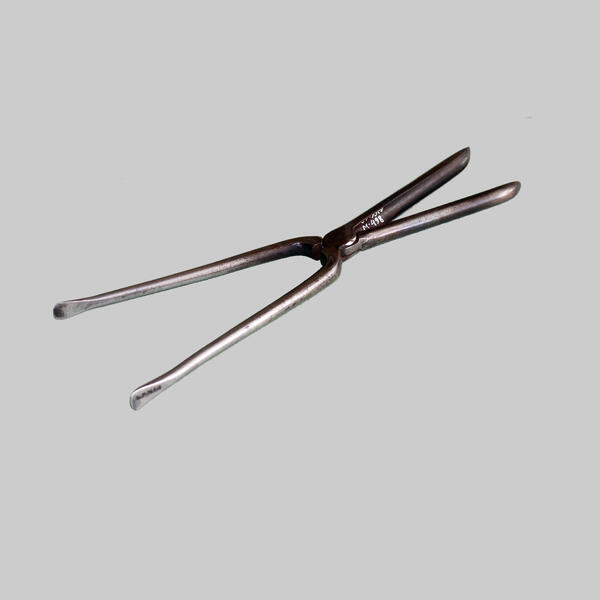
The iron was designed with a scissor-like look, straight rod handles and flat ends. The working part is made up of a grooved plate and a rod with a sharp end. Marcel Grato is considered to be the inventor of this device. His invention was born in 1880. Marcel Grato connected two iron rods, very similar to the way scissors are made. The mechanism was very simple. They were heated over the fire, and then used to press locks of hair in between their rods. Marcel Grato used the iron in a special way; if you clamp a strand of hair with the tongs with a notch down, you get an inward curve, and if up, then an outward one. Hair curled with this method resembled a series of waves. In 1882 Marcel Grato opened his own hair salon in downtown Paris. For the longest time, the inventor kept taking care that his methods remain a secret. The new and fashionable wavy hairstyle was not cheap, and only ladies of status could afford them.
The process in itself was far from safe, and required extreme caution of the hairdresser. If the iron got overheated, the hair being treated could easily burn. After heating the iron on the fire, they pressed it against a sheet of paper to test the temperature. If the paper was at all charred, the iron could not be used immediately, as a light darkening was the desired effect. Many women began applying this technique on their own, heating their irons on the fire and reaching the desired effect without the help of a professional. The tool is completely made of metal, which meant that not only the working area heated up, but the handle as well. To avoid burns, women would use special padded mittens, much like those used in the kitchen. Other variations of the iron existed as well. Later versions had wooden handles, which allowed the hairdresser work without the help of protective mittens.
The Yalutorovsk museum complex hair curling iron finds it’s origins in France. It’s handle bears the engraving: L.Р. PARIS, MARCEL, AGIEA. In the family of the Decembrist Matvey Muravyov-Apostol, his spouse and pupils also used curling irons. As seen in this presented exhibit, you can tell what devices Maria Konstantinovna, Anna Borovskaya and Avgusta Sozonovich used when they created hairstyles with curls that were fashionable in those years.
The iron was designed with a scissor-like look, straight rod handles and flat ends. The working part is made up of a grooved plate and a rod with a sharp end. Marcel Grato is considered to be the inventor of this device. His invention was born in 1880. Marcel Grato connected two iron rods, very similar to the way scissors are made. The mechanism was very simple. They were heated over the fire, and then used to press locks of hair in between their rods. Marcel Grato used the iron in a special way; if you clamp a strand of hair with the tongs with a notch down, you get an inward curve, and if up, then an outward one. Hair curled with this method resembled a series of waves. In 1882 Marcel Grato opened his own hair salon in downtown Paris. For the longest time, the inventor kept taking care that his methods remain a secret. The new and fashionable wavy hairstyle was not cheap, and only ladies of status could afford them.
The process in itself was far from safe, and required extreme caution of the hairdresser. If the iron got overheated, the hair being treated could easily burn. After heating the iron on the fire, they pressed it against a sheet of paper to test the temperature. If the paper was at all charred, the iron could not be used immediately, as a light darkening was the desired effect. Many women began applying this technique on their own, heating their irons on the fire and reaching the desired effect without the help of a professional. The tool is completely made of metal, which meant that not only the working area heated up, but the handle as well. To avoid burns, women would use special padded mittens, much like those used in the kitchen. Other variations of the iron existed as well. Later versions had wooden handles, which allowed the hairdresser work without the help of protective mittens.
The Yalutorovsk museum complex hair curling iron finds it’s origins in France. It’s handle bears the engraving: L.Р. PARIS, MARCEL, AGIEA. In the family of the Decembrist Matvey Muravyov-Apostol, his spouse and pupils also used curling irons. As seen in this presented exhibit, you can tell what devices Maria Konstantinovna, Anna Borovskaya and Avgusta Sozonovich used when they created hairstyles with curls that were fashionable in those years.
#9
Date: 19th century
Place: France
Technique: forging
Dimensions: 26,5 cm
Copyright: Tyumen Museum and Educational Association
Collection: Metal
Goskatalog Number: 8338109
Place: France
Technique: forging
Dimensions: 26,5 cm
Copyright: Tyumen Museum and Educational Association
Collection: Metal
Goskatalog Number: 8338109
#10
Lady’s gloves
#11
#12
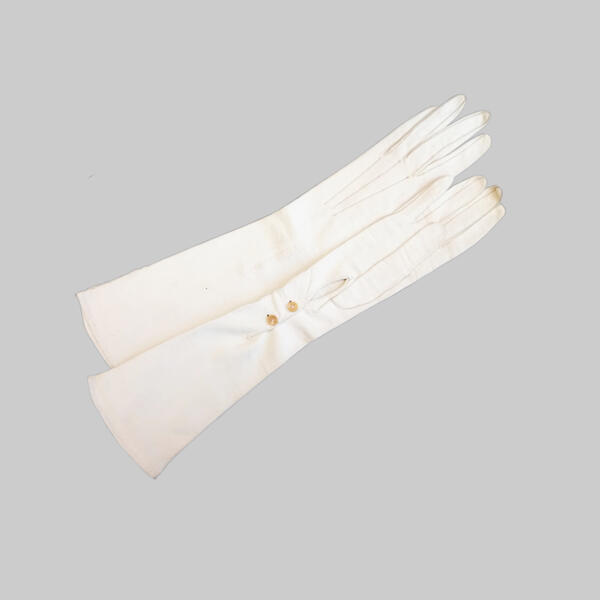
These lady’s gloves, exhibited in the Decembrists in Yalutorovsk, joined the museum’s collection in 1994. They were acquired by museum staff during a business trip to St. Petersburg specifically for the exhibit in the memorial house of M.I. Muravyov-Apostol. These gloves are a good example of what accessories were worn in those years by those brought up in noble families.
Two girls were brought up in the family of Matvey and Maria Muravyov-Apostol: Avgusta Sozonovich and Anna Borodinskaya. They were taught not only literacy, but also the rules of good manners, as was customary in high society. In 1851, the pupils of Matvey Muravyov-Apostol spent some time in Tobolsk, where they accompanied the sick Ivan Yakushkin for treatment. A ball was organized for the auditor who came to Tobolsk. Alexander and Josephine Muravyov, with whom the girls stayed in Tobolsk, took Avgusta Sozonovich with them to the balls. An obligatory part of the ballroom costume were snow-white kidskin gloves, such as those presented in the exhibition.
In Russia in the 19th century, gloves were an integral part of a lady’s wardrobe. They were sewn from kidskin, a very thin leather. They were made very slim so that they perfectly follow the shape of the hand. There was a special way of checking glove quality: the glove was pulled through ladies’ rings. If they stretched easily, it meant that the gloves were of very high quality.
Ladies chose gloves to match their outfit color or specifically, pure white. Sometimes gloves were decorated with pearls, embroidery, and precious stones. Gloves made of kidskin were not only elastic and easily retained their shape, but also had a noble soft soft luster. From the mid-19th century, evening and ballroom gloves were wrist-length with a button cover. According to the rules of etiquette, gloves could not be removed throughout the ball. Arriving at a ball with naked hands was considered bad form. The presented ladies’ gloves of the second half of the 19th century are also made of white kidskin leather. The seams are finished with decorative stitching. The outer side of the glove is decorated with three lines arranged in the form of rays. On the inner middle side, there is a figured cutout with a fastener on two plastic buttons of light brown color.
Two girls were brought up in the family of Matvey and Maria Muravyov-Apostol: Avgusta Sozonovich and Anna Borodinskaya. They were taught not only literacy, but also the rules of good manners, as was customary in high society. In 1851, the pupils of Matvey Muravyov-Apostol spent some time in Tobolsk, where they accompanied the sick Ivan Yakushkin for treatment. A ball was organized for the auditor who came to Tobolsk. Alexander and Josephine Muravyov, with whom the girls stayed in Tobolsk, took Avgusta Sozonovich with them to the balls. An obligatory part of the ballroom costume were snow-white kidskin gloves, such as those presented in the exhibition.
In Russia in the 19th century, gloves were an integral part of a lady’s wardrobe. They were sewn from kidskin, a very thin leather. They were made very slim so that they perfectly follow the shape of the hand. There was a special way of checking glove quality: the glove was pulled through ladies’ rings. If they stretched easily, it meant that the gloves were of very high quality.
Ladies chose gloves to match their outfit color or specifically, pure white. Sometimes gloves were decorated with pearls, embroidery, and precious stones. Gloves made of kidskin were not only elastic and easily retained their shape, but also had a noble soft soft luster. From the mid-19th century, evening and ballroom gloves were wrist-length with a button cover. According to the rules of etiquette, gloves could not be removed throughout the ball. Arriving at a ball with naked hands was considered bad form. The presented ladies’ gloves of the second half of the 19th century are also made of white kidskin leather. The seams are finished with decorative stitching. The outer side of the glove is decorated with three lines arranged in the form of rays. On the inner middle side, there is a figured cutout with a fastener on two plastic buttons of light brown color.
#13
Date: second half of the 19th century
Place: Russia
Technique: Machine sewing
Dimensions: 41,1×6,5 cm
Collection: Leather
Copyright: Tyumen Museum and Educational Association
Goskatalog Number: 8338109
Place: Russia
Technique: Machine sewing
Dimensions: 41,1×6,5 cm
Collection: Leather
Copyright: Tyumen Museum and Educational Association
Goskatalog Number: 8338109
#14
Hand fan
#15
#16
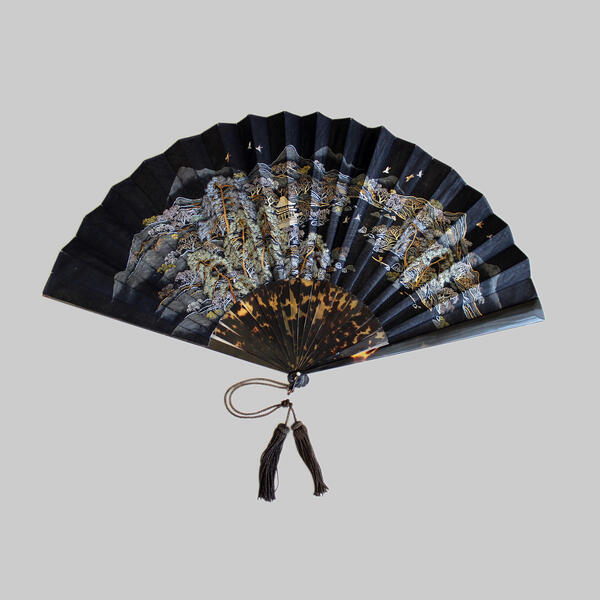
The hand fan presented in this exhibition was made in 19th century Japan. It was purchased from the antique dealer Stepan Petrenko, especially for the exhibition in the house of the Decembrist Matvey Ivanovich Muravyov-Apostol. The fan consists of tortoiseshell plates with black parchment paper stretched between them. The composition is made complete by the contrast of the black and white elements. On one side there is a blossoming tree with white flowers, green leaves and birds. The other side is embroidered with silk threads, the basis of the plot ornament is a pagoda, trees, and birds. The end of the handle is decorated with a tassel half ring. The fan before you is considered a ‘plie’ type, which speaks to it’s folds. Fans of this type are created based on their frame, representing the lower part of the fan, with the upper part being the screen, which is made of paper, parchment, fabric, lace.
The history of the fan reaches back several thousand years. Traditionally, it’s roots trace back to China and Japan, as it was these countries that gave it the broad acknowledgment it has today. This accessory arrived in Europe in the 16th century, and was initially only available to the most notable people. The fan was considered a symbol of status, due to the fact that it required expensive materials and precious gems. European masters quickly picked up the Eastern trend, while it infiltrated all of high society as an exquisite accessory.
In Russia, the women’s fan saw widespread use at the beginning of the 18th century. Experts believe fans to be peers of St. Petersburg, since they entered secular life at the time of Peter’s secular dress reforms. At that time fans started to be created in Russia, and they were in no way inferior to Eastern and European products in terms of the quality of materials and their artistic merit. Fans were made by a variety of craftsmen: jewelers, engravers, painters, wood and bone carvers. As they grew in popularity, fans began to turn into real works of art. Gold, jade, ivory, turtle shell frames, animal horns, sandalwood and bamboo were used as material for frames of the fans. In the 19th century, such fans claimed a special role. The fan became a channel to express desires or flirt, relay to the other person your feelings or intentions.
The history of the fan reaches back several thousand years. Traditionally, it’s roots trace back to China and Japan, as it was these countries that gave it the broad acknowledgment it has today. This accessory arrived in Europe in the 16th century, and was initially only available to the most notable people. The fan was considered a symbol of status, due to the fact that it required expensive materials and precious gems. European masters quickly picked up the Eastern trend, while it infiltrated all of high society as an exquisite accessory.
In Russia, the women’s fan saw widespread use at the beginning of the 18th century. Experts believe fans to be peers of St. Petersburg, since they entered secular life at the time of Peter’s secular dress reforms. At that time fans started to be created in Russia, and they were in no way inferior to Eastern and European products in terms of the quality of materials and their artistic merit. Fans were made by a variety of craftsmen: jewelers, engravers, painters, wood and bone carvers. As they grew in popularity, fans began to turn into real works of art. Gold, jade, ivory, turtle shell frames, animal horns, sandalwood and bamboo were used as material for frames of the fans. In the 19th century, such fans claimed a special role. The fan became a channel to express desires or flirt, relay to the other person your feelings or intentions.
#17
Date: First quarter of the 19th century
Technique: painting, flat stitch embroidery
Place: Japan
Dimensions: 32×60,5 cm
Collection: Other materials
Copyright: Tyumen Museum and Educational Association
Goskatalog Number: 7252315
Technique: painting, flat stitch embroidery
Place: Japan
Dimensions: 32×60,5 cm
Collection: Other materials
Copyright: Tyumen Museum and Educational Association
Goskatalog Number: 7252315
read morehide
00:00
00:00
1x
Hair curling iron, Lady’s gloves, Hand fan
Collection
Exhibition
0
 Point your smartphone camera to open in the app
Open in app
Share