#6
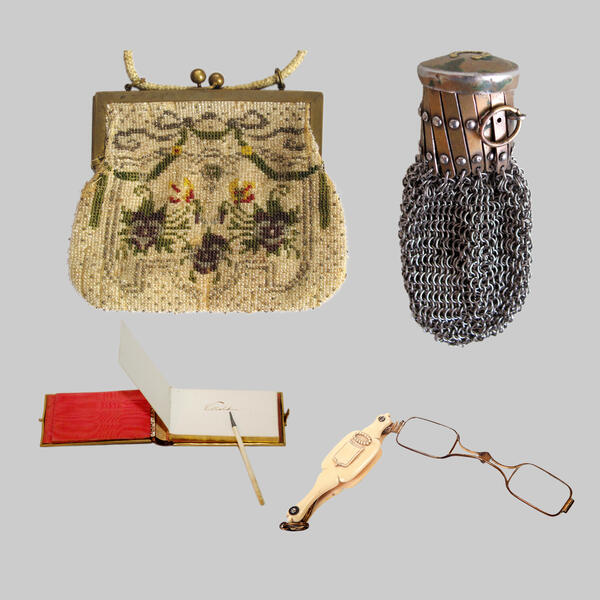
Beaded purse, Chainmail wallet, Folding lorgnettе, Dance card book
#7
#8
#9
The first women’s purse appeared in the mid 18th century. Before that, women carried their things in their pockets, hidden in the folds of broad skirts. One of the first women’s handbags, the pompadour, as it was called, was intended mainly for handmade things. A similar handbag, called a reticule, came to be a classic for many years. The handbags carried letters, photographs, jewelry, perfume, a powder box, a mirror, cosmetics and much more. The smaller the bag, the more prosperous the woman was considered, since it was believed that next to her was a man or a servant who carried the rest of her things. Over time, women’s purses grew in size, and apart from odds and ends, they were able to carry books and other things.
Various purses were passed on from mother to daughter, through generations. Purses were both purchased and sewn at home. Craftswomen used different materials: silk and satin, cotton and tapestry, leather and straw, wood and iron. Wealthy ladies adorned bags with beads made of Venetian or Bohemian glass, semi-precious stones and gems, bronze figures, embroidery, applique and cameos. Beaded purses came into style 200 years ago. Keeping their color is a unique quality that the masters used when sewing various designs.
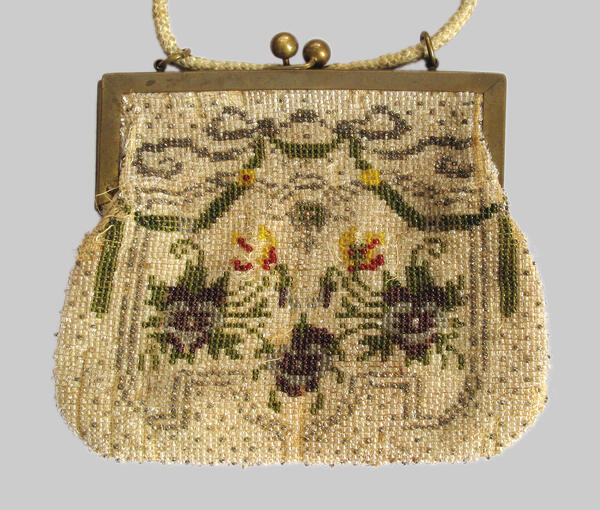
The women’s purse exhibited in the Decembrists in YalUtorovsk, joined the museum’s collection in 2010. It was donated to the museum by a resident of the city of YalUtorovsk, Margarita Chizh, along with several other items. This small beaded bag belonged to her grandmother, ZinaIda Pervushina. ZinaIda Pervushina was born in SemipalAtinsk in 1868. From her young age, she was a skilled craftswoman. Its creator decorated a rectangular purse with colored beads the same pattern was applied to both sides. In the center you can see two yellow-red flowers with stems facing in different directions, lower down there are three blue-lilac flowers with leaves. The lining of the bag is made of a soft beige fabric. The bag snaps shut using a metal ball clasp.
Various purses were passed on from mother to daughter, through generations. Purses were both purchased and sewn at home. Craftswomen used different materials: silk and satin, cotton and tapestry, leather and straw, wood and iron. Wealthy ladies adorned bags with beads made of Venetian or Bohemian glass, semi-precious stones and gems, bronze figures, embroidery, applique and cameos. Beaded purses came into style 200 years ago. Keeping their color is a unique quality that the masters used when sewing various designs.
The women’s purse exhibited in the Decembrists in YalUtorovsk, joined the museum’s collection in 2010. It was donated to the museum by a resident of the city of YalUtorovsk, Margarita Chizh, along with several other items. This small beaded bag belonged to her grandmother, ZinaIda Pervushina. ZinaIda Pervushina was born in SemipalAtinsk in 1868. From her young age, she was a skilled craftswoman. Its creator decorated a rectangular purse with colored beads the same pattern was applied to both sides. In the center you can see two yellow-red flowers with stems facing in different directions, lower down there are three blue-lilac flowers with leaves. The lining of the bag is made of a soft beige fabric. The bag snaps shut using a metal ball clasp.
#11
Date: The end of the 19th and beginning of the 20th centuries
Technique: beading, hand sewing, machine sewing, forging
Place: The Russian Empire
Dimensions: 14,5×16 cm
Collection: Fabrics / Household items
Copyright: Tyumen Museum and Educational Association
Technique: beading, hand sewing, machine sewing, forging
Place: The Russian Empire
Dimensions: 14,5×16 cm
Collection: Fabrics / Household items
Copyright: Tyumen Museum and Educational Association
#10
Chainmail wallet
#12
#13
The pupils of Matvey Muravyov-Apostle, Avgust Sozonovich and Anna Borodinskaya followed fashion, despite the fact that they were far from cultural centers. In this exhibit you can see fashion accessories that they used in everyday life, as well as similar ones.
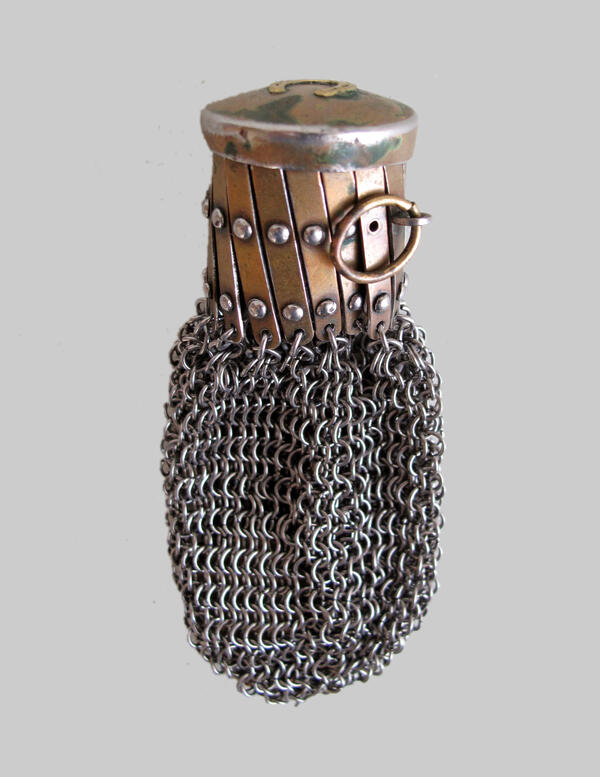
The displayed item is a chainmail wallet, an elegant but inexpensive ladies’ accessory. The history of this miniature handbag goes back about three centuries. In the Middle Ages, the handbag was replaced by an unpretentious pouch, which was worn on the belt by both women and men alike. This little bag was called a bundle at times. The contents of these bags varied from coins, keys, toilet items to a myriad of other little things. They carried everything that might come in handy outside the house and be useful at any given moment.
At the end of the 18th century, fashionable women, when arriving at a ball, a palace, a reception or theater, always attached a small handbag to the belt of an elegant dress with a special crochet hook. This type of handbag went with the ball gown outfit due to it’s necessity. One of the most popular models, a reticule, was soft, it was sewn from fabrics like velvet, satin, decorated with embroidery, lace, beads.
In the second half of the 19th century, reticules made of silver, gold or gilded chain mail became especially fashionable. Chains served as handles, and frame locks were finished with chasing and even precious stones or their imitation. At that time, chainmail bags were highly common, and were woven from rings or from tiny metal plates connected by rings. Most often they had a natural, metallic color - light sterling silver or gold, if the silver was gilded. Steel products were also made, including those from blued and blackened metal. The handbags made of small plates were sometimes covered with enamel, one-color or several colors - in the latter case, a mosaic effect was achieved.
The displayed wallet was donated to the museum collection from the Russian Cultural Fund. The wallet is made in the form of a flask with a soft case woven from small round rings. The throat is assembled from narrow sliding plates, with a hinged lid, decorated with a relief image of a horseshoe. A hook is attached to one of the plates for hanging the chain mail on the belt.
The displayed item is a chainmail wallet, an elegant but inexpensive ladies’ accessory. The history of this miniature handbag goes back about three centuries. In the Middle Ages, the handbag was replaced by an unpretentious pouch, which was worn on the belt by both women and men alike. This little bag was called a bundle at times. The contents of these bags varied from coins, keys, toilet items to a myriad of other little things. They carried everything that might come in handy outside the house and be useful at any given moment.
At the end of the 18th century, fashionable women, when arriving at a ball, a palace, a reception or theater, always attached a small handbag to the belt of an elegant dress with a special crochet hook. This type of handbag went with the ball gown outfit due to it’s necessity. One of the most popular models, a reticule, was soft, it was sewn from fabrics like velvet, satin, decorated with embroidery, lace, beads.
In the second half of the 19th century, reticules made of silver, gold or gilded chain mail became especially fashionable. Chains served as handles, and frame locks were finished with chasing and even precious stones or their imitation. At that time, chainmail bags were highly common, and were woven from rings or from tiny metal plates connected by rings. Most often they had a natural, metallic color - light sterling silver or gold, if the silver was gilded. Steel products were also made, including those from blued and blackened metal. The handbags made of small plates were sometimes covered with enamel, one-color or several colors - in the latter case, a mosaic effect was achieved.
The displayed wallet was donated to the museum collection from the Russian Cultural Fund. The wallet is made in the form of a flask with a soft case woven from small round rings. The throat is assembled from narrow sliding plates, with a hinged lid, decorated with a relief image of a horseshoe. A hook is attached to one of the plates for hanging the chain mail on the belt.
#14
Date: 19th century
Technique: Forging
Place: Russia
Dimensions: 10×5,5×3,5 cm
Collection: Metal
Copyright: Tyumen Museum and Educational Association
Goskatalog Number: 10179592
Technique: Forging
Place: Russia
Dimensions: 10×5,5×3,5 cm
Collection: Metal
Copyright: Tyumen Museum and Educational Association
Goskatalog Number: 10179592
#15
Folding lorgnette
#16
#17
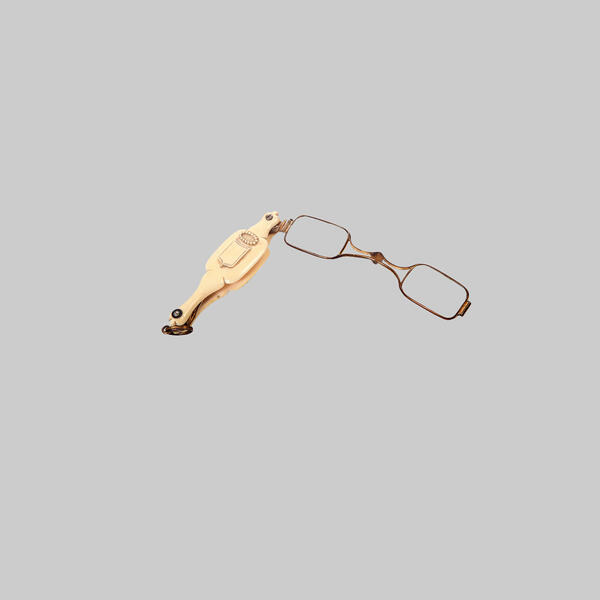
The ladies’ folding double lorgnette, displayed in the Decembrists in Yalutorovsk, was made at the end of the 19th century. It was given to the museum by a resident of Yalutorovsk, named Irina Frolova. The lorgnette belonged to her great-grandmother - Elena Tizengauzen, the great-grand-niece of the Decembrist Vasily Tizengauzen.
Lorgnette is a type of glasses that look like pince-nez, but differ in that they are held by the handle, and not a nose clamp. This fashionable accessory appeared in the late 18th and early 19th centuries. They were used like theater binoculars, from time to time bringing it to our eyes.
The inventor of the lorgnette is considered to be English optician, inventor of mathematical instruments and globes, George Adams. He focused on the upper echelon of British society and wanted to make luxurious glasses for aristocrats, which would differ from the usual “plebeian” non-standard design. This is how an elegant lorgnette with a thin frame and a long handle came about. It originally had only one glass and looked like a modern magnifying glass. A similar device was actively used by the Russian Emperor Alexander I, who had poor vision in his left eye since early childhood. By the middle of the 19th century, lorgnettes were considered an almost obligatory attribute of a respectable lady. There were no pockets then in women’s clothing, so this accessory was worn on neck chains, belts, on special chains chatelaines or wrist chains. Men fastened lorgnettes to their vests. In women’s hands, lorgnettes, along with fans, became a must for virtuoso coquetry. Ladies with his help showed their beautiful wrists, thin fingers, expressed attention to gentleman, they showed their favor or complete disregard. For the so-called “emancipants”, the new fashion became a real challenge. Trying to convince the society that external attractiveness is absolutely not important for them, they deliberately “disfigured” themselves with blue lensed glasses.
The design of the optical device is simple: two lenses in a brass frame are attached with a movable hinge to an enameled handle. Closer to the 20th century, the men’s lorgnette was replaced by a more practical pince-nez. For secular ladies, this accessory remained almost mandatory when going in public until early 20th century.
Lorgnette is a type of glasses that look like pince-nez, but differ in that they are held by the handle, and not a nose clamp. This fashionable accessory appeared in the late 18th and early 19th centuries. They were used like theater binoculars, from time to time bringing it to our eyes.
The inventor of the lorgnette is considered to be English optician, inventor of mathematical instruments and globes, George Adams. He focused on the upper echelon of British society and wanted to make luxurious glasses for aristocrats, which would differ from the usual “plebeian” non-standard design. This is how an elegant lorgnette with a thin frame and a long handle came about. It originally had only one glass and looked like a modern magnifying glass. A similar device was actively used by the Russian Emperor Alexander I, who had poor vision in his left eye since early childhood. By the middle of the 19th century, lorgnettes were considered an almost obligatory attribute of a respectable lady. There were no pockets then in women’s clothing, so this accessory was worn on neck chains, belts, on special chains chatelaines or wrist chains. Men fastened lorgnettes to their vests. In women’s hands, lorgnettes, along with fans, became a must for virtuoso coquetry. Ladies with his help showed their beautiful wrists, thin fingers, expressed attention to gentleman, they showed their favor or complete disregard. For the so-called “emancipants”, the new fashion became a real challenge. Trying to convince the society that external attractiveness is absolutely not important for them, they deliberately “disfigured” themselves with blue lensed glasses.
The design of the optical device is simple: two lenses in a brass frame are attached with a movable hinge to an enameled handle. Closer to the 20th century, the men’s lorgnette was replaced by a more practical pince-nez. For secular ladies, this accessory remained almost mandatory when going in public until early 20th century.
#18
Date: 19th century
Technique: glass, brass, bone
Place: Russia
Dimensions: 7,8 cm; lenses: 2×2,8 cm
Collection: Glass
Copyright: Tyumen Museum and Educational Association
Restorers: L.M. Parfyonov
Goskatalog Number: 7730761
Technique: glass, brass, bone
Place: Russia
Dimensions: 7,8 cm; lenses: 2×2,8 cm
Collection: Glass
Copyright: Tyumen Museum and Educational Association
Restorers: L.M. Parfyonov
Goskatalog Number: 7730761
#19
Dance card book
#20
#21
The main attraction of respectable balls was the dance program, which was accompanied by a special ballroom ceremony. The ball required all participants to follow the rules of etiquette, emotional restraint and physical endurance. Accepting invitations from two gentlemen at once to the same dance was considered a huge and embarrassing mistake. This was considered bad form, and could even lead to a duel.
The most significant dances, such as the polonaise, cotillion, and square dance, required an invitation long before the event itself. Invitations were made to small and intermediate dances at the ball itself. But for some of the more successful women, it was almost impossible to get to the front of the line for even a small dance, let alone a waltz or a mazurka, as everything was decided in advance.
To avoid misunderstandings, each lady had her own special dance card book to take to the ball. It was a miniature accessory that allowed the young lady to write the name of each admirer across from the dance she had him down for. These small booklets came with a pencil, which was fastened with a special clip to the lady’s waist. A list of dances, completely “filled” with gentlemen, indicated the popularity and success of a lady, however, bragging about it was frowned upon.
After a while, these booklets evolved into real works of art. They were decorated with precious stones, enamel, used gold, silver, mother of pearl. Books with mother-of-pearl or bone pages were especially appreciated, since they could be used several times. Old inscriptions in such books could be erased and new ones made in their place.
There were no balls in Yalutorovsk. However, the pupil of Matvey and Maria Muravyov-Apostol, Avgusta Sozonovich attended a ball in Tobolsk. Whenever she was in town she would stay with the Muravyov couple.
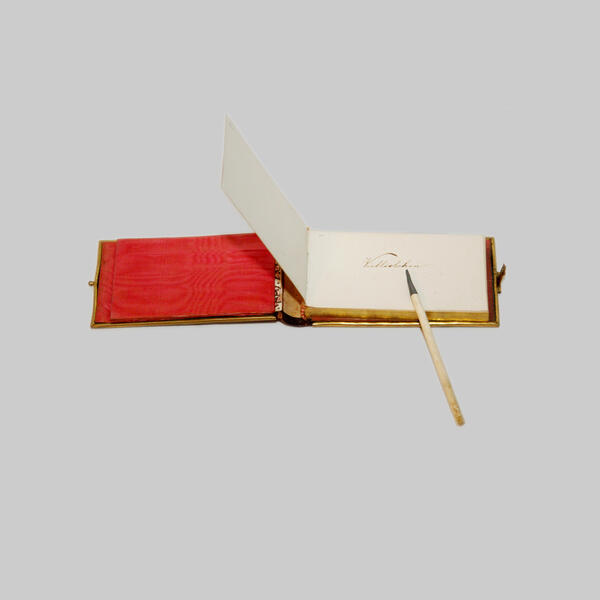
The dance card book displayed in the Decembrists in Yalutorovsk exhibit was acquired from an antique shop by employee of the State Historical Museum, Alexander Sidorov. Along with other Historical Museum exhibits, the book ended up in the Yalutorovsk Museum Complex.
A miniature palm-sized book made of paper and leather. The cover was decorated with a metal frame. In the center you may notice a mountain range depicted in an oval frame. The inside of the cover is overlain with pink fabric and two pockets: one large and one narrow. A bone pencil with a lead tip was kept in the narrow pocket. It is now displayed in the exhibit as well.
The most significant dances, such as the polonaise, cotillion, and square dance, required an invitation long before the event itself. Invitations were made to small and intermediate dances at the ball itself. But for some of the more successful women, it was almost impossible to get to the front of the line for even a small dance, let alone a waltz or a mazurka, as everything was decided in advance.
To avoid misunderstandings, each lady had her own special dance card book to take to the ball. It was a miniature accessory that allowed the young lady to write the name of each admirer across from the dance she had him down for. These small booklets came with a pencil, which was fastened with a special clip to the lady’s waist. A list of dances, completely “filled” with gentlemen, indicated the popularity and success of a lady, however, bragging about it was frowned upon.
After a while, these booklets evolved into real works of art. They were decorated with precious stones, enamel, used gold, silver, mother of pearl. Books with mother-of-pearl or bone pages were especially appreciated, since they could be used several times. Old inscriptions in such books could be erased and new ones made in their place.
There were no balls in Yalutorovsk. However, the pupil of Matvey and Maria Muravyov-Apostol, Avgusta Sozonovich attended a ball in Tobolsk. Whenever she was in town she would stay with the Muravyov couple.
The dance card book displayed in the Decembrists in Yalutorovsk exhibit was acquired from an antique shop by employee of the State Historical Museum, Alexander Sidorov. Along with other Historical Museum exhibits, the book ended up in the Yalutorovsk Museum Complex.
A miniature palm-sized book made of paper and leather. The cover was decorated with a metal frame. In the center you may notice a mountain range depicted in an oval frame. The inside of the cover is overlain with pink fabric and two pockets: one large and one narrow. A bone pencil with a lead tip was kept in the narrow pocket. It is now displayed in the exhibit as well.
#22
Date: Mid 19th century
Place: Russia
Technique: paper, leather, metal, fabric
Dimensions: 6,5×10,2×1,5 cm
Copyright: Tyumen Museum and Educational Association
Collection: Other materials
Goskatalog Number: 4703088
Place: Russia
Technique: paper, leather, metal, fabric
Dimensions: 6,5×10,2×1,5 cm
Copyright: Tyumen Museum and Educational Association
Collection: Other materials
Goskatalog Number: 4703088
read morehide
00:00
00:00
1x
Purse, wallet, lorgnettе, Dance card book
Collection
Exhibition
0
 Point your smartphone camera to open in the app
Open in app
Share