#6
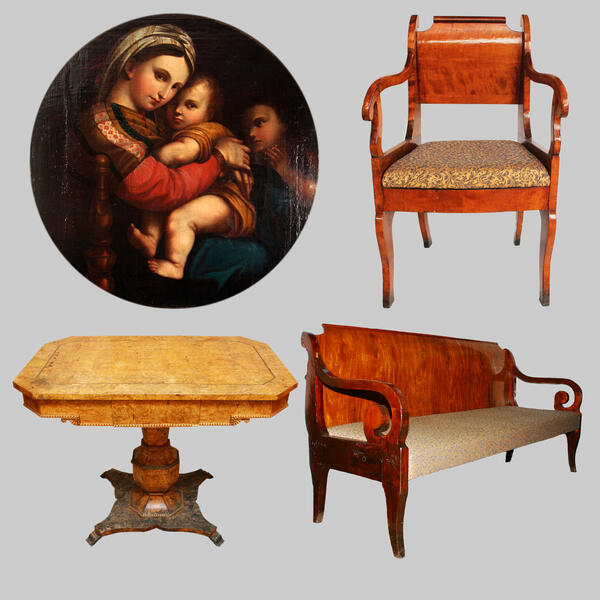
Madonna in a Chair, Chair, Side table, Sofa
#7
#8
#9
Decembrist Matvey Ivanovich Muravyov-Appostol was in Yalutorovsk from 1836 to 1856. According to the recollections of his contemporaries, he lived in an elite part of the city, in a very well furnished house. The house was built much earlier, in 1795, and modern furniture was imported, which was created in the first half of the 19th century.
Today, the basis of the museum funds are collections of ancient copper casting, icons, numismatics, rare books, glassware. The museum also displays a collection of furniture from the 19th-20th centuries, a collection of paintings, sculptures, ceramics, metal and wood.
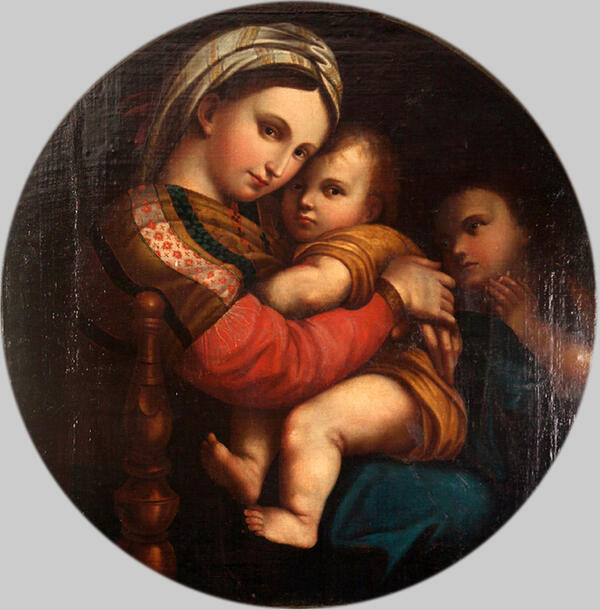
In the living room of the house of MatvEy Muravyov-Apostol there is a copy of Raphael SantI’s painting Madonna on a Chair, painted by an unknown artist in the first quarter of the 19th century. The painting was transferred to the museum in 1991 by the All-Russian Art Scientific and Restoration Center named after Academician I.E. Grabar.
Rafael SantI is a Renaissance painter. In 1513-1514, while living in Rome, Raphael painted one of his Madonnas, called Madonna Della Sedia or translated from Italian Madonna on a Chair. For many years this painting was exhibited at the Palazzo Patti in Florence. The master depicted in the painting the Virgin Mary embracing the infant Christ and in awe of the mission of the young John the Baptist. The image of the woman in the Madonna on a Chair is significantly different from the artist’s previous works. A feature of this picture is the novelty of the image so beloved by RaphaEl: the image of the Madonna is endowed with a certain vitality and earthly fascination. She is depicted as a loving, caring mother who quit her job as soon as she heard her first baby cry.
The unknown artist managed to subtly convey the atmosphere of Raphael’s painting. Bright, saturated clothing colors afford the image of Madonna some sophistication and at the same time help to create a down-to-earth look. It is known that Raphael was posed for by his beloved FornarIna, the daughter of Francesco Luti, a baker from Siena who worked in Rome. According to one version, her real name is MargarIta Luti. Raphael used the appearance of Margarita for many images of women on his canvases. Only in select ones of them strangers posed for him.
Today, the basis of the museum funds are collections of ancient copper casting, icons, numismatics, rare books, glassware. The museum also displays a collection of furniture from the 19th-20th centuries, a collection of paintings, sculptures, ceramics, metal and wood.
In the living room of the house of MatvEy Muravyov-Apostol there is a copy of Raphael SantI’s painting Madonna on a Chair, painted by an unknown artist in the first quarter of the 19th century. The painting was transferred to the museum in 1991 by the All-Russian Art Scientific and Restoration Center named after Academician I.E. Grabar.
Rafael SantI is a Renaissance painter. In 1513-1514, while living in Rome, Raphael painted one of his Madonnas, called Madonna Della Sedia or translated from Italian Madonna on a Chair. For many years this painting was exhibited at the Palazzo Patti in Florence. The master depicted in the painting the Virgin Mary embracing the infant Christ and in awe of the mission of the young John the Baptist. The image of the woman in the Madonna on a Chair is significantly different from the artist’s previous works. A feature of this picture is the novelty of the image so beloved by RaphaEl: the image of the Madonna is endowed with a certain vitality and earthly fascination. She is depicted as a loving, caring mother who quit her job as soon as she heard her first baby cry.
The unknown artist managed to subtly convey the atmosphere of Raphael’s painting. Bright, saturated clothing colors afford the image of Madonna some sophistication and at the same time help to create a down-to-earth look. It is known that Raphael was posed for by his beloved FornarIna, the daughter of Francesco Luti, a baker from Siena who worked in Rome. According to one version, her real name is MargarIta Luti. Raphael used the appearance of Margarita for many images of women on his canvases. Only in select ones of them strangers posed for him.
#10
Author: unknown
Date: First quarter of the 19th century
Place: Russia
Technique: oil
Dimensions: 77×77 cm
Collection: Painting
Copyright: Tyumen Museum and Educational Association
Goskatalog: Number 7781389
Date: First quarter of the 19th century
Place: Russia
Technique: oil
Dimensions: 77×77 cm
Collection: Painting
Copyright: Tyumen Museum and Educational Association
Goskatalog: Number 7781389
#11
Chair
#12
#13
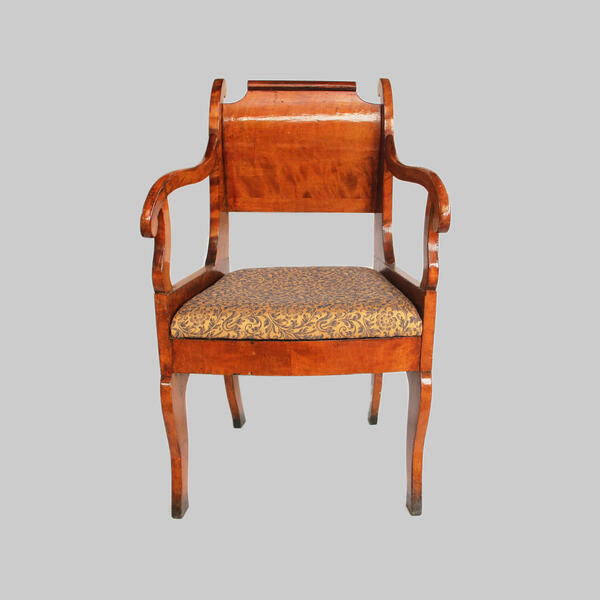
The armchair on display was made in the first quarter of the 19th century. In this object you can trace the features characteristic of furniture of the era of classicism. This is the time when laconic and strict forms, restraint and nobility penetrate first into architecture and arts and crafts, and then into furniture production.
For the manufacture of furniture, many domestic types of wood were used: walnut, birch, poplar, aspen, ash and others. But despite this, the products were almost always painted in mahogany - the most popular at that time. The special individuality of the decor of Russian classicism furniture is its restraint, which helped demonstrate the natural decorative properties of the wood species: texture and natural lines.
Carving of various types, used only in small quantities, only emphasized the calm smooth surface of the furniture surfaces. Significant changes have also been made to carving techniques. The carved ornament was mainly located at the joints of the parts. Object shapes were simplified, the lines were straightened, mainly, it touched the legs and surfaces.
Chairs and armchairs in those years were upholstered with fabrics with floral patterns. We find the features inherent in classicism in the elements of the presented chair. Dark brown lacquered armchair. Seat upholstery in colored fabric with a floral pattern: dark gray curls and stylized flowers on a beige background. The chair design was ergonomic: with a soft seat in the shape of a trapezoid, a wide back with a curvature, recesses and a bolster-headrest. The armrests were made in the form of a curved bar with a curl at the front ends. The seat was supported by graceful legs, slightly curved and tapering downward.
The chair was purchased in 1961 by the director of the museum, Ivan Stepanovich Terentyev, from a resident of the city of Yalutorovsk, K. Myasnikova for an exhibition in the memorial house of M.I. Muravyov-Apostol. Legend dictates that after the departure of the Decembrist Matvey Muravyov-Apostol from the city of Yalutorovsk, some pieces of furniture from his house ended up with the merchant Myasnikov, then they were inherited. Some of them have been preserved by K. Myasnikova.
For the manufacture of furniture, many domestic types of wood were used: walnut, birch, poplar, aspen, ash and others. But despite this, the products were almost always painted in mahogany - the most popular at that time. The special individuality of the decor of Russian classicism furniture is its restraint, which helped demonstrate the natural decorative properties of the wood species: texture and natural lines.
Carving of various types, used only in small quantities, only emphasized the calm smooth surface of the furniture surfaces. Significant changes have also been made to carving techniques. The carved ornament was mainly located at the joints of the parts. Object shapes were simplified, the lines were straightened, mainly, it touched the legs and surfaces.
Chairs and armchairs in those years were upholstered with fabrics with floral patterns. We find the features inherent in classicism in the elements of the presented chair. Dark brown lacquered armchair. Seat upholstery in colored fabric with a floral pattern: dark gray curls and stylized flowers on a beige background. The chair design was ergonomic: with a soft seat in the shape of a trapezoid, a wide back with a curvature, recesses and a bolster-headrest. The armrests were made in the form of a curved bar with a curl at the front ends. The seat was supported by graceful legs, slightly curved and tapering downward.
The chair was purchased in 1961 by the director of the museum, Ivan Stepanovich Terentyev, from a resident of the city of Yalutorovsk, K. Myasnikova for an exhibition in the memorial house of M.I. Muravyov-Apostol. Legend dictates that after the departure of the Decembrist Matvey Muravyov-Apostol from the city of Yalutorovsk, some pieces of furniture from his house ended up with the merchant Myasnikov, then they were inherited. Some of them have been preserved by K. Myasnikova.
#15
Date: First quarter of the 19th century
Technique: sawing, veneering, varnishing
Place: Russia
Dimensions: 90,5×54×48 cm
Copyright: Tyumen Museum and Educational Association
Collection: Wood/Furniture
Goskatalog Number: 8966503
Technique: sawing, veneering, varnishing
Place: Russia
Dimensions: 90,5×54×48 cm
Copyright: Tyumen Museum and Educational Association
Collection: Wood/Furniture
Goskatalog Number: 8966503
#16
Side table
#17
#18
Legend has it that this table from the Decembrists in Yalutorovsk belonged to the Decembrist Matvey Muravyov-Apostol. After he left YalUtorovsk, much of his furniture ended up in the hands of merchant MYAsnikov, a friend of Muravyov-Apostol. According to the memoirs of his contemporaries, MatvEy Muravyov-Apostol lived in a well-furnished, cozy and comfortable home. It was impossible to buy comfortable furniture in YalUtorovsk, nevertheless, the atmosphere in the house was quite aristocratic. Almost all the furniture for her brother was selected and sent to Siberia from St. Petersburg by his sister EkateIna BIbikova. Leaving YalUtorovsk, Matvey Muravyov-Apostol distributed all the furniture among local residents.
Side tables were shaped differently, but most often they were designed with one support leg. Since they were mostly in the ceremonial rooms and had more decorative value, the forms and decoration of these tables were rich and complex. In addition to wood, craftsmen also used marble, bronze and other materials to make these tables.
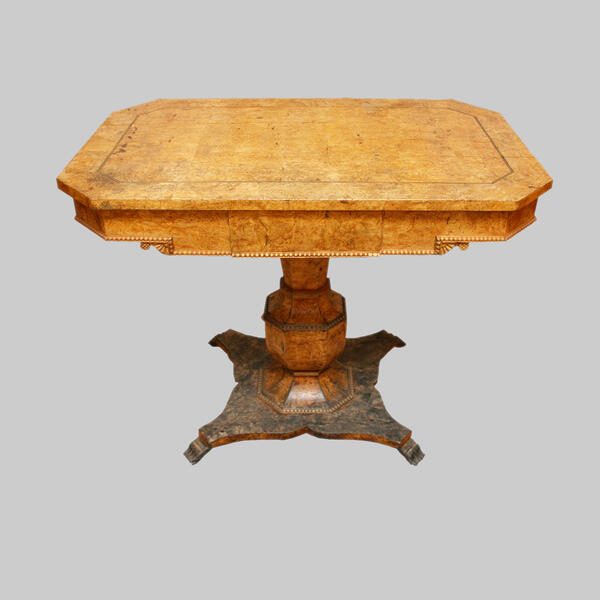
The table displayed in the Decembrist Memorial House is made of KarElian birch, which was first used in furniture production at the end of the 18th century. The surface is covered with veneer - thin slices of wood. The technique, when solid wood was pasted over with veneer, was called veneering. The table was tinted under light rocks. The supporting leg was designed in the form of a vase on four supports. The tabletop was made rectangular, but all four corners were cut off, and a thin frame was inlaid on the top surface, which imitates the shape of the tabletop. A small drawer for small things was mounted in the underframe. The knob of this drawer was concealed, making it almost invisible. The edge of the underframe and the middle part of the leg were decorated with narrow stripes with three-dimensional carvings and bead-like ornaments.
The table was restored at the E.E. Grabar All-Russia Art Research and Restoration Centre. After restoration in the period of May–August 2002, the table was shown at the exhibition of the best restored items in various Trienale-2002 restoration centers. Then it was held at the Smolny Cathedral in St. Petersburg.
Side tables were shaped differently, but most often they were designed with one support leg. Since they were mostly in the ceremonial rooms and had more decorative value, the forms and decoration of these tables were rich and complex. In addition to wood, craftsmen also used marble, bronze and other materials to make these tables.
The table displayed in the Decembrist Memorial House is made of KarElian birch, which was first used in furniture production at the end of the 18th century. The surface is covered with veneer - thin slices of wood. The technique, when solid wood was pasted over with veneer, was called veneering. The table was tinted under light rocks. The supporting leg was designed in the form of a vase on four supports. The tabletop was made rectangular, but all four corners were cut off, and a thin frame was inlaid on the top surface, which imitates the shape of the tabletop. A small drawer for small things was mounted in the underframe. The knob of this drawer was concealed, making it almost invisible. The edge of the underframe and the middle part of the leg were decorated with narrow stripes with three-dimensional carvings and bead-like ornaments.
The table was restored at the E.E. Grabar All-Russia Art Research and Restoration Centre. After restoration in the period of May–August 2002, the table was shown at the exhibition of the best restored items in various Trienale-2002 restoration centers. Then it was held at the Smolny Cathedral in St. Petersburg.
#19
Date: Early 19th century
Place: Russia, St. Petersburg
Technique: carving, veneering
Dimensions: 79×101×62 cm
Copyright: Tyumen Museum and Educational Association
Collection: Wood/Furniture
Restorers: R.S. Studennikov
Goskatalog Number: 8966496
Place: Russia, St. Petersburg
Technique: carving, veneering
Dimensions: 79×101×62 cm
Copyright: Tyumen Museum and Educational Association
Collection: Wood/Furniture
Restorers: R.S. Studennikov
Goskatalog Number: 8966496
#20
Sofa
#21
#22
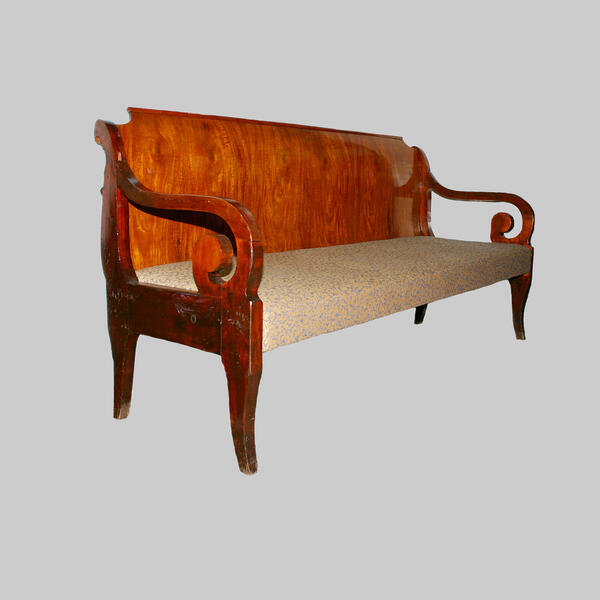
In the 19th century, the sofa was not only a necessary piece of furniture for relaxation, but also spoke to the wealth and luxury of its owner. During its history, it has undergone important changes: from luxurious, flowing lines to a typical household item of the 20th century.
This sofa was added to the collection of the memorial house in 1961. Then it was acquired by the director of the museum, Ivan Terentyev, from the heirs of the merchant Myasnikov. It was to his friend, the merchant Myasnikov, that Matvey Muravyov-Apostol handed over part of his furniture when he left Yalutorovsk for St. Petersburg.
According to the recollections of his contemporaries, he lived in an elite part of the city, in a very well furnished house. Mikhail Znamensky, who grew up among the Decembrists, recalled: ‘The whole house had only 4 rooms and a hallway. At the entrance there was a door to the left leading to the study and directly to the hall. The large hall had a fireplace and door onto the terrace. The living room, in which there was a piano, the only one in the whole city at that time, with shelves of books, portraits of relatives on the walls, a large portrait of Napoleon, guns with hunting accessories. Voltaire chair with a music stand and a washstand attached to it. Finally, the small room of Maria Konstantinovna, where Gutenka and Annushka were accommodated. Fill these rooms with fresh clean air, erase and destroy every speck of dust, and you will have an idea of Matvey Ivanovich’s house.’
Three rooms in the house today are memorial: the hall, the study and the living room. The living room is decorated with a 19th century piano, an antique front table, a sofa and an armchair.
This sofa was added to the collection of the memorial house in 1961. Then it was acquired by the director of the museum, Ivan Terentyev, from the heirs of the merchant Myasnikov. It was to his friend, the merchant Myasnikov, that Matvey Muravyov-Apostol handed over part of his furniture when he left Yalutorovsk for St. Petersburg.
According to the recollections of his contemporaries, he lived in an elite part of the city, in a very well furnished house. Mikhail Znamensky, who grew up among the Decembrists, recalled: ‘The whole house had only 4 rooms and a hallway. At the entrance there was a door to the left leading to the study and directly to the hall. The large hall had a fireplace and door onto the terrace. The living room, in which there was a piano, the only one in the whole city at that time, with shelves of books, portraits of relatives on the walls, a large portrait of Napoleon, guns with hunting accessories. Voltaire chair with a music stand and a washstand attached to it. Finally, the small room of Maria Konstantinovna, where Gutenka and Annushka were accommodated. Fill these rooms with fresh clean air, erase and destroy every speck of dust, and you will have an idea of Matvey Ivanovich’s house.’
Three rooms in the house today are memorial: the hall, the study and the living room. The living room is decorated with a 19th century piano, an antique front table, a sofa and an armchair.
At the Muravyov’s house, the whole circle of the Yalutorovsk Decembrists gathered often, and on Sundays it was actually obligatory. Here they had dinner and remained for the entire evening, playing cards, reading and listening to music. Mikhail Znamensky.
The sofa displayed in the exhibit was made of solid wood, covered with thin cuts of wood, then veneer and glossy varnish. On the soft seat, you can see the upholstery fashionable for that time period: colored fabric with floral patterns. The back of the sofa is ergonomically shaped: with a bend and a thin bolster-headrest. Carved curly armrests echo the color of the upholstery.
#23
Date: First quarter of the 19th century
Technique: sawing, veneering, varnishing
Place: Russia
Dimensions: 98×186×62 cm
Collection: Wood/Furniture
Copyright: Tyumen Museum and Educational Association
Goskatalog Number: 8966535
Technique: sawing, veneering, varnishing
Place: Russia
Dimensions: 98×186×62 cm
Collection: Wood/Furniture
Copyright: Tyumen Museum and Educational Association
Goskatalog Number: 8966535
read morehide
00:00
00:00
1x
Madonna in a Chair, Chair, Side table, Sofa
Collection
Exhibition
0
 Point your smartphone camera to open in the app
Open in app
Share