#1
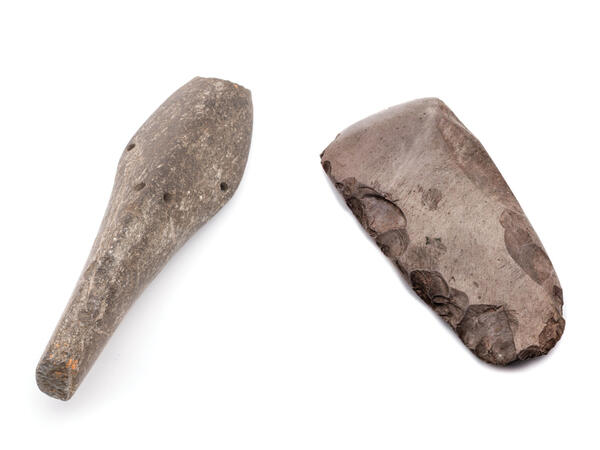
Adze, Bait fish
#2
#4
#3
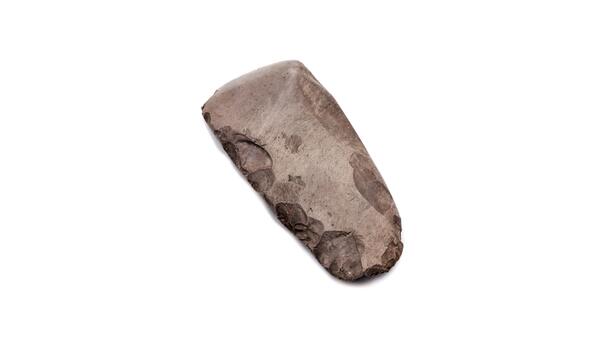
The adze is a stone or metal tool used to woodworking. It resembled an axe, but the main difference was that the axe had the cutting edge parallel to the handle, while the adze’s edge was mounted perpendicularly.
In Siberia the adze appeared during the Neolithic and Bronze Age, 7500-4600 years ago. Scientists have assumed that at this time people began to master waterways and travel along rivers. They could make boats and rafts with the help of an adze. In addition, the tool was also used in ritual rites: along with axes, they were placed in the graves of the deceased. This tradition was especially widespread in Southeast Asian cultures.
The adze from the collection of the Regional Museum of Local History was found at the excavation of the “Lokomotiv” Early Neolithic Cemetery in Irkutsk. This ancient burial ground was discovered in 1928, during the construction of a playground next to the stadium “Cyclodrom” (now — “Lokomotiv”). When workers began to dig a hole to install a swing, they saw a recess where the walls were painted red. Irkutsk archaeologists Mikhail Gerasimov and Bernhard Petri were called to the site and determined that before them was a burial ground of the Neolithic era, which was about 4600-7500 years old.
Inside the burial ground, archaeologists found skeletons and funerary artifacts — the items that were thought to be needed in the afterlife, for example, jewelry, weapons, and tools, including the adzes. Based on the funerary objects it could be determined to which culture the deceased belonged and how old they were. Scholars have even tried to understand what status they might have had within the tribe.
There were no burial grounds in the Paleolithic era (40000-12000 years ago) were, and probably the first burials were made directly within the settlements. Separate cemeteries outside inhabited territories emerged during the Mesolithic period, about 8-10 thousand years ago. Scientists are now studying the burial grounds to get an idea of how the material culture, the everyday life, the production and economic systems of that era looked like. And also — how family and social relations were built by the indigenous population of Siberia.
In Siberia the adze appeared during the Neolithic and Bronze Age, 7500-4600 years ago. Scientists have assumed that at this time people began to master waterways and travel along rivers. They could make boats and rafts with the help of an adze. In addition, the tool was also used in ritual rites: along with axes, they were placed in the graves of the deceased. This tradition was especially widespread in Southeast Asian cultures.
The adze from the collection of the Regional Museum of Local History was found at the excavation of the “Lokomotiv” Early Neolithic Cemetery in Irkutsk. This ancient burial ground was discovered in 1928, during the construction of a playground next to the stadium “Cyclodrom” (now — “Lokomotiv”). When workers began to dig a hole to install a swing, they saw a recess where the walls were painted red. Irkutsk archaeologists Mikhail Gerasimov and Bernhard Petri were called to the site and determined that before them was a burial ground of the Neolithic era, which was about 4600-7500 years old.
Inside the burial ground, archaeologists found skeletons and funerary artifacts — the items that were thought to be needed in the afterlife, for example, jewelry, weapons, and tools, including the adzes. Based on the funerary objects it could be determined to which culture the deceased belonged and how old they were. Scholars have even tried to understand what status they might have had within the tribe.
There were no burial grounds in the Paleolithic era (40000-12000 years ago) were, and probably the first burials were made directly within the settlements. Separate cemeteries outside inhabited territories emerged during the Mesolithic period, about 8-10 thousand years ago. Scientists are now studying the burial grounds to get an idea of how the material culture, the everyday life, the production and economic systems of that era looked like. And also — how family and social relations were built by the indigenous population of Siberia.
#5
Full name: Adze from a burial ground
Date: about 5500-2600 years BC
Technique: splitting, grinding, flint
Place: Present-day Irkutsk
Copyright: Irkutsk Regional Museum of Local History
Dimensions: 8,2×3,6×1,2 cm
Date: about 5500-2600 years BC
Technique: splitting, grinding, flint
Place: Present-day Irkutsk
Copyright: Irkutsk Regional Museum of Local History
Dimensions: 8,2×3,6×1,2 cm
#6
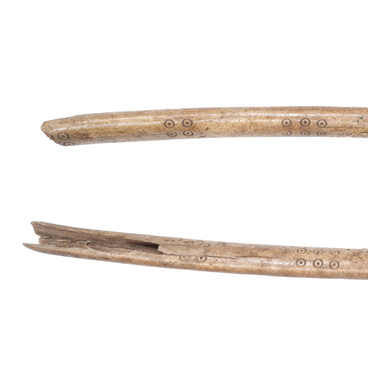
Bait fish
#7
#8
For the inhabitants of Siberia, fishing was one of the main means of subsistence. At the early human sites researchers unearthed hooks, harpoons, sinkers, baits and fish skeletons from different eras. Such archaeological finds indicated that the local population fished a lot on the Angara River. In Siberia, the development of fishery coincided with the birth of the industry all throughout Eurasia.
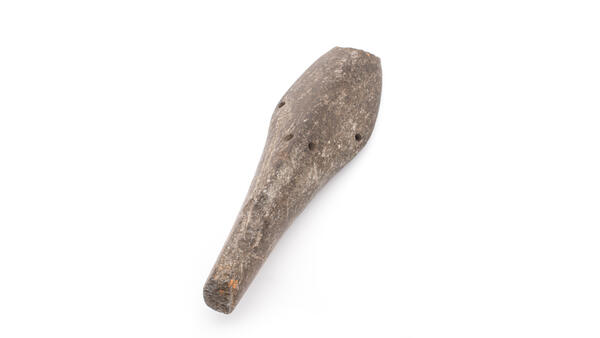
A bait fish is a fish figurine made out of stone or bone that was used in fishing. Such figurines had been made for thousands of years from the late Mesolithic period (seven to eight thousand years ago) and up to the spread of metals (three thousand years ago). The fish was depicted schematically, with its eyes and mouth scratched into the upper part of the figurine. Sometimes there were versions of bait fish with a head in place of the tail. The fish bait was used at any time of the year, during ice fishing as well, which is evidenced by the tools that were found next to the fish figurines. Sometimes cloths were tied to the lower part of the fish torso, as they were supposed to resemble fins.
Researchers have noted that there were two types of sculptural images of fish: those that had religious purposes, and those that were used solely for fishing. The bait fish from the collection of the Regional Museum of Local History most likely belonged to the second category and was used on a daily basis. It was made during the Neolithic period, 7500-4600 years ago, and was considered the precursor of modern fishing lures.
Fish became part of the early human diet in the second half of the Late Paleolithic era, 12-40 thousand years ago. Since that time, many fishing tools appeared: nets, baskets and improved harpoon heads.
The earliest evidence that early humans began to eat fish were discovered in Siberia at an early human burial site in the village of Malta in the Irkutsk region. Malta was discovered in 1928. Archaeologists found 15 dwellings, which have preserved many household items. Among them were bones of large fish, as well as a bead necklace made about 20-25 thousand years ago out of taimen vertebrae.
A bait fish is a fish figurine made out of stone or bone that was used in fishing. Such figurines had been made for thousands of years from the late Mesolithic period (seven to eight thousand years ago) and up to the spread of metals (three thousand years ago). The fish was depicted schematically, with its eyes and mouth scratched into the upper part of the figurine. Sometimes there were versions of bait fish with a head in place of the tail. The fish bait was used at any time of the year, during ice fishing as well, which is evidenced by the tools that were found next to the fish figurines. Sometimes cloths were tied to the lower part of the fish torso, as they were supposed to resemble fins.
Researchers have noted that there were two types of sculptural images of fish: those that had religious purposes, and those that were used solely for fishing. The bait fish from the collection of the Regional Museum of Local History most likely belonged to the second category and was used on a daily basis. It was made during the Neolithic period, 7500-4600 years ago, and was considered the precursor of modern fishing lures.
Fish became part of the early human diet in the second half of the Late Paleolithic era, 12-40 thousand years ago. Since that time, many fishing tools appeared: nets, baskets and improved harpoon heads.
The earliest evidence that early humans began to eat fish were discovered in Siberia at an early human burial site in the village of Malta in the Irkutsk region. Malta was discovered in 1928. Archaeologists found 15 dwellings, which have preserved many household items. Among them were bones of large fish, as well as a bead necklace made about 20-25 thousand years ago out of taimen vertebrae.
#9
Full name: Bait fish
Date: about 5500-2600 years BC
Technique: splitting, drilling, grinding
Place: The mouth of the Angara River
Copyright: Irkutsk Regional Museum of Local History
Dimensions: 17×5,5×3,3 cm
Date: about 5500-2600 years BC
Technique: splitting, drilling, grinding
Place: The mouth of the Angara River
Copyright: Irkutsk Regional Museum of Local History
Dimensions: 17×5,5×3,3 cm
#10
Ministry of Culture of the Russian Federation
read morehide
00:00
00:00
1x
Adze, Bait fish
Collection
0
 Point your smartphone camera to open in the app
Open in app
Share