#1
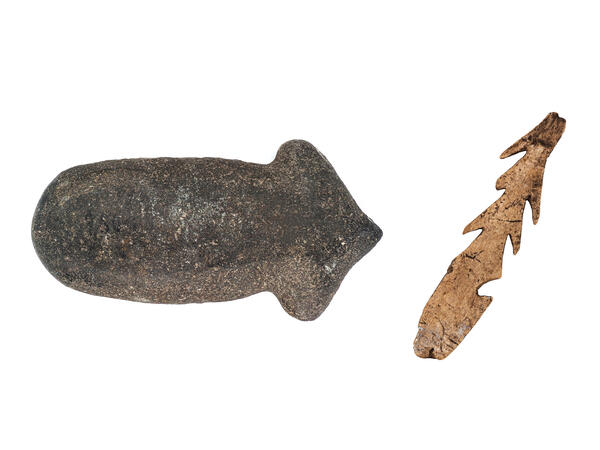
Lithic core (nucleus), Harpoon
#2
#3
#4
A lithic core was a piece of stone from which fragments were chipped or split off in the process of toolmaking. Sometimes, after treatment it was also made into a tool, for example, into choppers and axes. The object name comes from the Latin word ‘nucleus’ — ‘the core’. Despite the variety of rocks, shapes and sizes, all such stones had several specially marked places, from where flakes and lamellae were knapped off.
The nucleus from the Local History Museum collection was discovered at the multilayer Ust-Belaya site and burial ground excavations. The excavations were headed by Herman Medvedev, an Irkutsk archaeologist and ethnographer. The find was dated to the Mesolithic period: the researchers assumed that the nucleus was made 7-12 thousand years ago.
The most common types of lithic cores at that time were prismatic blades, from which laminae of different sizes were removed. This technique of toolmaking was called ‘lamellar splitting’ — it was especially widespread during the Mesolithic and Neolithic era in Siberia, and even older lamellar flakes were found in Africa and in the Middle East.
According to scientists, the lamellar flake manufacturing technology appeared in East Africa hundreds of thousands of years ago. The first lamellar flake tools were found in Kenya at the early human settlement sites of the Kapturin archaeological complex and dated to more than 500 thousand years BC.
The process of chipping off plates and flakes from the nucleus was constantly modified and bettered. The striking techniques changed: first, the early humans used stones, and then they began to use a ‘soft’ drummer made out of horn or wood. In the late Paleolithic era, masters switched from striking to pressing techniques: they pressure treated the stones using special tools.
Approximately at the same time, people mastered microplates manufacturing to make composite tools. They were made out of a bone plate and insertion plates. In the subsequent era, the Neolithic period, composite stone knives were widespread, the blade was made from a nucleus and sharpened using the retouching technique.
The nucleus from the Local History Museum collection was discovered at the multilayer Ust-Belaya site and burial ground excavations. The excavations were headed by Herman Medvedev, an Irkutsk archaeologist and ethnographer. The find was dated to the Mesolithic period: the researchers assumed that the nucleus was made 7-12 thousand years ago.
The most common types of lithic cores at that time were prismatic blades, from which laminae of different sizes were removed. This technique of toolmaking was called ‘lamellar splitting’ — it was especially widespread during the Mesolithic and Neolithic era in Siberia, and even older lamellar flakes were found in Africa and in the Middle East.
According to scientists, the lamellar flake manufacturing technology appeared in East Africa hundreds of thousands of years ago. The first lamellar flake tools were found in Kenya at the early human settlement sites of the Kapturin archaeological complex and dated to more than 500 thousand years BC.
The process of chipping off plates and flakes from the nucleus was constantly modified and bettered. The striking techniques changed: first, the early humans used stones, and then they began to use a ‘soft’ drummer made out of horn or wood. In the late Paleolithic era, masters switched from striking to pressing techniques: they pressure treated the stones using special tools.
Approximately at the same time, people mastered microplates manufacturing to make composite tools. They were made out of a bone plate and insertion plates. In the subsequent era, the Neolithic period, composite stone knives were widespread, the blade was made from a nucleus and sharpened using the retouching technique.
#5
Full name: A Mesolithic lithic core (nucleus)
Date: about 10-5 thousand years BC
Technique: lithic reduction, flint
Place: Ust-Belaya village
Copyright: Irkutsk Regional Museum of Local History
Dimensions: 2,8×1,7×1,5 cm
Date: about 10-5 thousand years BC
Technique: lithic reduction, flint
Place: Ust-Belaya village
Copyright: Irkutsk Regional Museum of Local History
Dimensions: 2,8×1,7×1,5 cm
#6
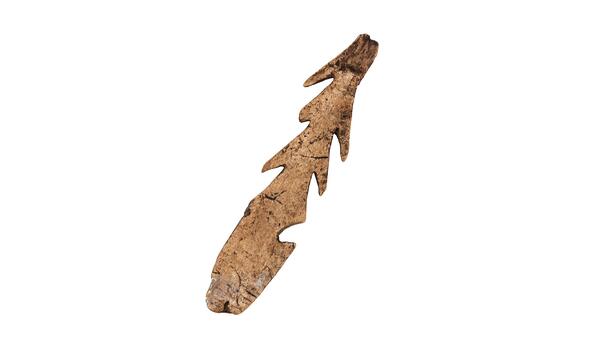
Harpoon
#7
#8
A harpoon is a tool used to extract fish or animals that live in the water. It was used all year round: both in winter and in summer. Usually, such objects were made out of bones or horns.
A bone harpoon with barbs from the collection of the Museum of Local History was found on Verkholenskaya Mountain during excavations led by Swiss-born archaeologist and ethnographer Bernhard Petri. In 1918, he moved to Irkutsk to teach at the university and explore the culture of the early Neolithic inhabitants of Eastern Siberia.
Of all the fishing equipment that has survived to this day, bone harpoon heads are the oldest finds. They appeared in the Mesolithic period, 12-7 thousand years ago, although archaeologists attribute some of the objects to an earlier time. Harpoons continued to be used, along with a later invention — hooks to catch fish. People mastered new materials and techniques, but the shape of the tool changed insignificantly.
The peoples of the coastal regions of Northern Siberia hunted the sea beast with the help of simple rotary bone harpoons. This tool had a sharp, jagged end and a soft leash in the form of a cord or rope. When hunting, the harpoon got stuck in the animal’s body, and the leash kept it afloat. Ancient hunters probably threw others weapons and jabbed the fish with them at a short distance, without letting the shaft out of their hands.
Researchers express different points of view as to how harpoons were made and used. According to one version, a flat, jagged head was first made, then it was inserted into the shaft, and a hole was made in the base of the shaft to secure the leash. A head of a simpler shape would often pop out of the body of the prey, and ancient people learned to make side barbs, like the one from the museum collection’s exhibit.
Later, larger harpoons were used to catch whales, sharks and dolphins. The Aleuts, Eskimos and Chukchi made spears from bronze, iron, silicon and native copper. And the peoples of Alaska sometimes used solid wooden harpoons. In the caves of Europe, scientists have found bone tips from complex harpoons, with which ancient people probably caught large fish and hunted forest animals.
A bone harpoon with barbs from the collection of the Museum of Local History was found on Verkholenskaya Mountain during excavations led by Swiss-born archaeologist and ethnographer Bernhard Petri. In 1918, he moved to Irkutsk to teach at the university and explore the culture of the early Neolithic inhabitants of Eastern Siberia.
Of all the fishing equipment that has survived to this day, bone harpoon heads are the oldest finds. They appeared in the Mesolithic period, 12-7 thousand years ago, although archaeologists attribute some of the objects to an earlier time. Harpoons continued to be used, along with a later invention — hooks to catch fish. People mastered new materials and techniques, but the shape of the tool changed insignificantly.
The peoples of the coastal regions of Northern Siberia hunted the sea beast with the help of simple rotary bone harpoons. This tool had a sharp, jagged end and a soft leash in the form of a cord or rope. When hunting, the harpoon got stuck in the animal’s body, and the leash kept it afloat. Ancient hunters probably threw others weapons and jabbed the fish with them at a short distance, without letting the shaft out of their hands.
Researchers express different points of view as to how harpoons were made and used. According to one version, a flat, jagged head was first made, then it was inserted into the shaft, and a hole was made in the base of the shaft to secure the leash. A head of a simpler shape would often pop out of the body of the prey, and ancient people learned to make side barbs, like the one from the museum collection’s exhibit.
Later, larger harpoons were used to catch whales, sharks and dolphins. The Aleuts, Eskimos and Chukchi made spears from bronze, iron, silicon and native copper. And the peoples of Alaska sometimes used solid wooden harpoons. In the caves of Europe, scientists have found bone tips from complex harpoons, with which ancient people probably caught large fish and hunted forest animals.
#9
Full name: Harpoon
Date: 10000–5000 BC
Technique: sawing, grinding, bone
Place: The archaeological site of Verkholenskaya Mountain, Irkutsk
Copyright: Irkutsk Regional Museum of Local History
Dimensions: 8,1×1,6×0,5 cm
Date: 10000–5000 BC
Technique: sawing, grinding, bone
Place: The archaeological site of Verkholenskaya Mountain, Irkutsk
Copyright: Irkutsk Regional Museum of Local History
Dimensions: 8,1×1,6×0,5 cm
#10
Ministry of Culture of the Russian Federation
read morehide
00:00
00:00
1x
Lithic core (nucleus), Harpoon
Collection
0
 Point your smartphone camera to open in the app
Open in app
Share