#1
Sculptures, Beads, Tusks, Ochre
#2
#3
#4
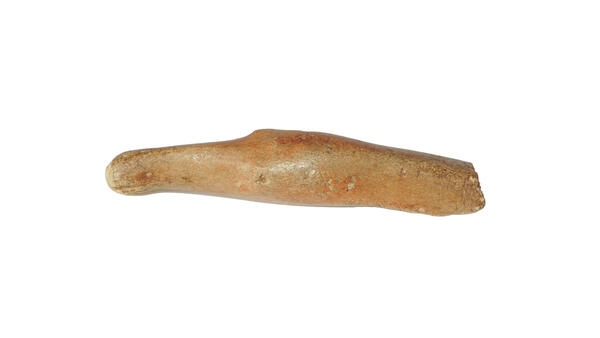
In the Neolithic Age, sculpture of small forms was widespread: craftsmen made small statuettes out of bone and stone. Most often they recreated images of animals that surrounded early humans: the bear, the birds, the fish, the seal and especially moose.
In Siberia, the elk was a source of food as well as hides and fur, which were used to make warm clothing. Traditionally, Siberian peoples also worshipped the moose. On a par with the bear, the animal was considered to be the ‘master of the taiga’, and because of its large size and strength, many small nations called it only by respectful names — for example, ‘the older brother of the reindeer, ’ ‘the great beast’. This attitude was due not only to its appearance, but also to how much moose meant in people’s lives: well-being of a family and the whole tribe depended on a successful hunt.
Ethnographer Aleksey Okladnikov wrote: “The particularly important role of moose in the real productive life of northern hunter, therefore, could not not be reflected in their intellectual culture, in their worldview and beliefs, in the cult of moose. The Neolithic cult of the moose in Siberia was quite naturally one of the most vivid and expressive examples of the ancient cult of the beast”.
Inhabitants of Eastern Siberia depicted the animal in petroglyphs and created small sculptures out of different materials: horns, bone, stone, ceramics, wood, and later metal. Despite the important role of the moose in the life of taiga tribes, today researchers disagree on how to interpret its images. According to one assumption, the cloven-hoofed animal was considered a “heavenly”, “light” creature, which is associated with the upper world and on which the well-being of people depended. But there was another version in which the moose stole the sun, which resulted in the onset of night darkness. Similar plots are found in the folklore of northern peoples.
The “Moose head” sculpture was donated to the collection of the Regional Museum of Local Lore in the late 1940s by archaeologist and ethnographer Pavel Khoroshikh. It was discovered on the territory of the burial ground Lokomotiv, which is located in the Sverdlovsky district of Irkutsk.
In Siberia, the elk was a source of food as well as hides and fur, which were used to make warm clothing. Traditionally, Siberian peoples also worshipped the moose. On a par with the bear, the animal was considered to be the ‘master of the taiga’, and because of its large size and strength, many small nations called it only by respectful names — for example, ‘the older brother of the reindeer, ’ ‘the great beast’. This attitude was due not only to its appearance, but also to how much moose meant in people’s lives: well-being of a family and the whole tribe depended on a successful hunt.
Ethnographer Aleksey Okladnikov wrote: “The particularly important role of moose in the real productive life of northern hunter, therefore, could not not be reflected in their intellectual culture, in their worldview and beliefs, in the cult of moose. The Neolithic cult of the moose in Siberia was quite naturally one of the most vivid and expressive examples of the ancient cult of the beast”.
Inhabitants of Eastern Siberia depicted the animal in petroglyphs and created small sculptures out of different materials: horns, bone, stone, ceramics, wood, and later metal. Despite the important role of the moose in the life of taiga tribes, today researchers disagree on how to interpret its images. According to one assumption, the cloven-hoofed animal was considered a “heavenly”, “light” creature, which is associated with the upper world and on which the well-being of people depended. But there was another version in which the moose stole the sun, which resulted in the onset of night darkness. Similar plots are found in the folklore of northern peoples.
The “Moose head” sculpture was donated to the collection of the Regional Museum of Local Lore in the late 1940s by archaeologist and ethnographer Pavel Khoroshikh. It was discovered on the territory of the burial ground Lokomotiv, which is located in the Sverdlovsky district of Irkutsk.
#5
Full name: Zoomorphic sculpture “Moose”
Date: the Neolithic Era
Technique: bone
Place: Irkutsk region, Irkutsk city, the “Lokomotiv” Early Neolithic Cemetery
Copyright: Irkutsk Regional Museum of Local History
Dimensions: 7×1,3×1,2 cm
Date: the Neolithic Era
Technique: bone
Place: Irkutsk region, Irkutsk city, the “Lokomotiv” Early Neolithic Cemetery
Copyright: Irkutsk Regional Museum of Local History
Dimensions: 7×1,3×1,2 cm
#6
Anthropomorphic sculptural image
#7
#8
A sculpture, created in the Neolithic era (about 4600-7500 years ago), depicting a person is stored at the Regional Museum of Local History. The artifact was found in the 1950s, at the excavations of ancient burials near the city of Irkutsk.
In the burials of the Neolithic era, archaeologists often found zoomorphic sculptures that depicted such animals as elk, bear, fish, birds. Also, they found anthropomorphic figures of human silhouettes. They were made of various materials: stone, bone and horn.
The first anthropomorphic sculptures appeared in the Paleolithic era (10-35 millennia ago). Most often, masters depicted women — in archeology, such images were called ‘Paleolithic Venuses’. Similar figurines have been found in various parts of the world, but scientists have not yet established the exact meaning of these statuettes.
There is an assumption that such sculptures were associated with the cult of fertility and the hearth. According to another version, the anthropomorphic figures might represent the spirit of an ancestor, that is, an idol that attracts prosperity to the family and promotes success in hunting and fishing.
Also, some scientists believed that ancient people could create sculptures as a soul retreat for a deceased relative.
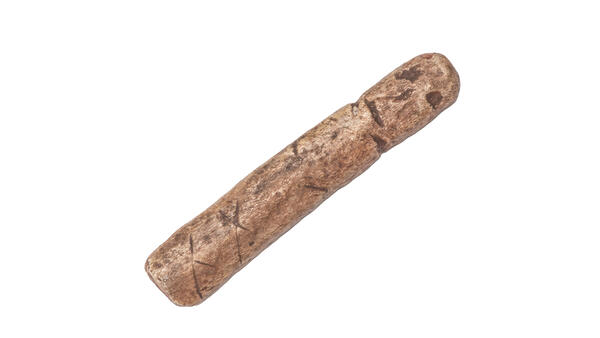
The figurine was donated to the Regional Museum of Local History by Pavel Khoroshih, an archaeologist from Irkutsk. The figure is made of bone, on which the ancient craftsman scratched out facial features: one can distinguish eyes, mouth and nose. The size of the piece is quite small: the length is about six centimeters, and the width is just over one centimeter.
The sculpture was found on the bank of the Kaya River, opposite the Medvedevo village, in 1950. This archaeological site was discovered by the scientist Mikhail Ovchinnikov in 1892. He found fragments of pottery, a horn and part of a skull that belonged to an animal on the site. However, the site was not explored until the 1950s, when Pavel Khoroshih together with his colleague Sergei Filippov went to the Kaisky Mountain for excavations. They have found the burial of a woman and a teenager from the Neolithic era on its southern slope. There was an accompanying inventory in the burial, including a figurine from the museum’s exposition.
In the burials of the Neolithic era, archaeologists often found zoomorphic sculptures that depicted such animals as elk, bear, fish, birds. Also, they found anthropomorphic figures of human silhouettes. They were made of various materials: stone, bone and horn.
The first anthropomorphic sculptures appeared in the Paleolithic era (10-35 millennia ago). Most often, masters depicted women — in archeology, such images were called ‘Paleolithic Venuses’. Similar figurines have been found in various parts of the world, but scientists have not yet established the exact meaning of these statuettes.
There is an assumption that such sculptures were associated with the cult of fertility and the hearth. According to another version, the anthropomorphic figures might represent the spirit of an ancestor, that is, an idol that attracts prosperity to the family and promotes success in hunting and fishing.
Also, some scientists believed that ancient people could create sculptures as a soul retreat for a deceased relative.
The figurine was donated to the Regional Museum of Local History by Pavel Khoroshih, an archaeologist from Irkutsk. The figure is made of bone, on which the ancient craftsman scratched out facial features: one can distinguish eyes, mouth and nose. The size of the piece is quite small: the length is about six centimeters, and the width is just over one centimeter.
The sculpture was found on the bank of the Kaya River, opposite the Medvedevo village, in 1950. This archaeological site was discovered by the scientist Mikhail Ovchinnikov in 1892. He found fragments of pottery, a horn and part of a skull that belonged to an animal on the site. However, the site was not explored until the 1950s, when Pavel Khoroshih together with his colleague Sergei Filippov went to the Kaisky Mountain for excavations. They have found the burial of a woman and a teenager from the Neolithic era on its southern slope. There was an accompanying inventory in the burial, including a figurine from the museum’s exposition.
#9
Full name: Anthropomorphic sculptural image
Date: about 5500-2600 years BC
Date: about 5500-2600 years BC
Technique: bone, grinding, carving
Place: Modern territory of Irkutsk region, the bank of the Kaya River
Copyright: Irkutsk Regional Museum of Local History
Dimensions: 6,1×1,1×0,5 cm
Place: Modern territory of Irkutsk region, the bank of the Kaya River
Copyright: Irkutsk Regional Museum of Local History
Dimensions: 6,1×1,1×0,5 cm
#10
Ichthyomorphic sculptural image
#11
#12
During excavations at Neolithic sites, archaeologists would often find art objects, including small sculptures shaped like real and imaginary animals. They were made out of stone, bone, horn, or clay. Researchers speculated that these items may have been used as cult objects, jewelry, charms, fishing gear, or simply children’s toys.
The ancient masters of Siberia recreated in the figures images of animals that lived around: moose, bears, seals, birds. One of the most common options was fish — it was associated with the important role of fishing. In the Holocene epoch, about 12,000 years ago, global climate changes began, due to which large representatives of fauna disappeared: mammoths and woolly rhinoceroses. As a result, early humans had fewer sources of food and had to look for other ways of living — so fishing spread. At the same time ancient people began to make bone harpoons, hooks and stone sinkers.
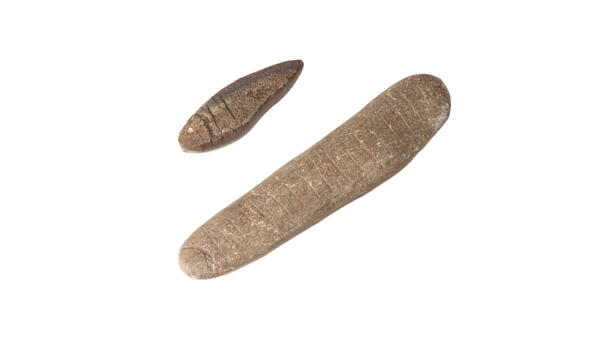
The elongated sculpture from the collection of the Irkutsk Museum of Local History was found in 1949 by archaeologist Pavel Khoroshikh. He participated in excavations at ancient sites on the right bank of the Angara River, near the village of Shchukina. It was destroyed when the Irkutsk Hydroelectric Power Plant was built there.
The exact purpose of this “stone fish” is still unknown. Figurines with a hole could be used as baits for fishing. But, most likely, such objects were associated with religious cults: they were often found in burial sites. Some researchers have suggested that the fish figures were amulets: it was believed that fish represents procreation, and caviar symbolizes a large number of offspring.
Ancient objects that have no obvious economic purpose, including images of fish, are generally considered to be examples of prehistoric art. Even if the sculptures were a technical device and had no symbolic meaning, they were a result of creative activity and provide an opportunity to reflect on the worldview and spiritual culture of the indigenous population of Siberia.
The ancient masters of Siberia recreated in the figures images of animals that lived around: moose, bears, seals, birds. One of the most common options was fish — it was associated with the important role of fishing. In the Holocene epoch, about 12,000 years ago, global climate changes began, due to which large representatives of fauna disappeared: mammoths and woolly rhinoceroses. As a result, early humans had fewer sources of food and had to look for other ways of living — so fishing spread. At the same time ancient people began to make bone harpoons, hooks and stone sinkers.
The elongated sculpture from the collection of the Irkutsk Museum of Local History was found in 1949 by archaeologist Pavel Khoroshikh. He participated in excavations at ancient sites on the right bank of the Angara River, near the village of Shchukina. It was destroyed when the Irkutsk Hydroelectric Power Plant was built there.
The exact purpose of this “stone fish” is still unknown. Figurines with a hole could be used as baits for fishing. But, most likely, such objects were associated with religious cults: they were often found in burial sites. Some researchers have suggested that the fish figures were amulets: it was believed that fish represents procreation, and caviar symbolizes a large number of offspring.
Ancient objects that have no obvious economic purpose, including images of fish, are generally considered to be examples of prehistoric art. Even if the sculptures were a technical device and had no symbolic meaning, they were a result of creative activity and provide an opportunity to reflect on the worldview and spiritual culture of the indigenous population of Siberia.
#13
Full name: Ichthyomorphic sculptural image
Date: 5500-2600 years BC
Date: 5500-2600 years BC
Technique: stone, grinding, carving
Place: The territory of the modern Irkutsk region, the right bank of the Angara River, near the village of Shchukina
Copyright: Irkutsk Regional Museum of Local History
Dimensions: 8,2×1,6×0,7 cm
Place: The territory of the modern Irkutsk region, the right bank of the Angara River, near the village of Shchukina
Copyright: Irkutsk Regional Museum of Local History
Dimensions: 8,2×1,6×0,7 cm
#14
Maral tush beads
#15
#16
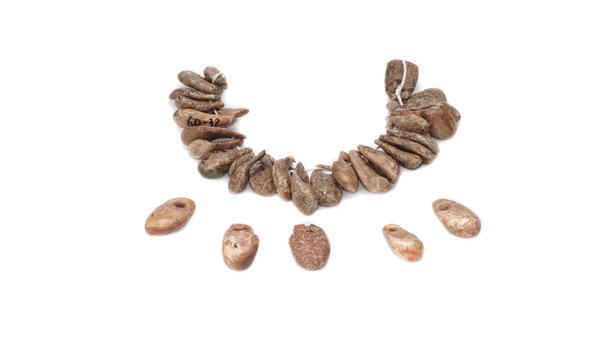
The beads from the Regional Museum of the Local History collection were discovered by the Irkutsk archaeologist Alexey Okladnikov in the 1950s. At that time, he was working at the excavations of ancient burials near the Isakovo village in the Bratsky region of the Irkutsk region. The jewelry found was made from the tushes of a maral, a large deer.
The village of Isakovo gave the name to a separate culture, identified and studied by Okladnikov. He attributed it to the Neolithic era (the end of the 4th millennium BC). In his opinion, people of the Isakovo culture lived in the taiga, and therefore their main occupation was hunting. They also knew how to make ceramic dishes, tools and jewelry.
In the Isakovo culture single grave dominated: one deceased person was placed in different poses in the graves, for example, sitting or lying on his back. Archaeologists found inventory-items inside the burials that, as it was believed, could be needed by the deceased person in the afterlife. They were laid out and placed on red spots of ochre — most likely, the dye was part of a magical ritual.
There were ceramics, stone and bone tools placed in the graves: spearheads, daggers, knives, scrapers, points and needles. Dead persons before the burial were often provided with objects that probably played a decorative or sacred role: archaeologists found pendants made of the maral tushes and incisors in the graves of the Isakov culture. The headdress was decorated with boar tushes.
Alexey Okladnikov believed that the representatives of the Isakov culture were gradually replaced by the Serovites (citizens of Serovo town) — they made ceramics in a similar way, but slightly changed their tools. Contemporary researchers do not distinguish between the Isakovo and Serov cultures.
Okladnikov’s finds mark an important milestone in the development of archaeology, including research into primitive art in Siberia. Scientists suggest that the first examples of art appeared 30-40 thousand years ago. And some researchers even tend to believe that art appeared in the world in earlier forms as early as 300 thousand years ago.
Small sculptures — images of humans, animals or abstract images, beads, pendants and other items that were not intended for use in the household, were classified as primitive objects of art. Ancient mobile art samples were made of stone, bone, clay, and later-of metal.
The village of Isakovo gave the name to a separate culture, identified and studied by Okladnikov. He attributed it to the Neolithic era (the end of the 4th millennium BC). In his opinion, people of the Isakovo culture lived in the taiga, and therefore their main occupation was hunting. They also knew how to make ceramic dishes, tools and jewelry.
In the Isakovo culture single grave dominated: one deceased person was placed in different poses in the graves, for example, sitting or lying on his back. Archaeologists found inventory-items inside the burials that, as it was believed, could be needed by the deceased person in the afterlife. They were laid out and placed on red spots of ochre — most likely, the dye was part of a magical ritual.
There were ceramics, stone and bone tools placed in the graves: spearheads, daggers, knives, scrapers, points and needles. Dead persons before the burial were often provided with objects that probably played a decorative or sacred role: archaeologists found pendants made of the maral tushes and incisors in the graves of the Isakov culture. The headdress was decorated with boar tushes.
Alexey Okladnikov believed that the representatives of the Isakov culture were gradually replaced by the Serovites (citizens of Serovo town) — they made ceramics in a similar way, but slightly changed their tools. Contemporary researchers do not distinguish between the Isakovo and Serov cultures.
Okladnikov’s finds mark an important milestone in the development of archaeology, including research into primitive art in Siberia. Scientists suggest that the first examples of art appeared 30-40 thousand years ago. And some researchers even tend to believe that art appeared in the world in earlier forms as early as 300 thousand years ago.
Small sculptures — images of humans, animals or abstract images, beads, pendants and other items that were not intended for use in the household, were classified as primitive objects of art. Ancient mobile art samples were made of stone, bone, clay, and later-of metal.
#17
Full name: Maral tush beads
Date: about 5500-2600 years BC
Date: about 5500-2600 years BC
Technique: a maral tush
Copyright: Irkutsk Regional Museum of Local History
Dimensions: 2,1×1,2×0,5 cm
Copyright: Irkutsk Regional Museum of Local History
Dimensions: 2,1×1,2×0,5 cm
#18
Wild hog tusks with marks of processing
#19
#20
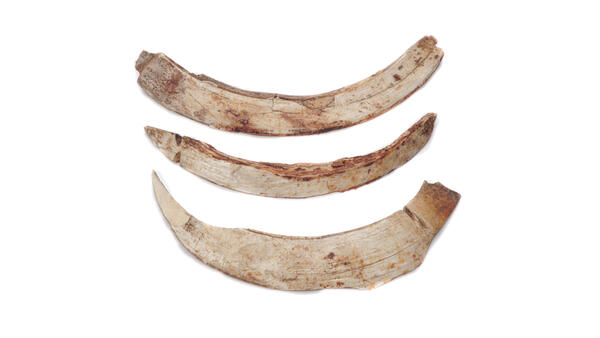
Wild hog tusks from the collection of the Regional Museum of Local History were found inside an ancient burial near the village of Isakovo in the Bratsky district of the Irkutsk region. Archaeologists have established that the burial was made in the Neolithic era — about 4600-7500 years ago. The excavations were led by Irkutsk archaeologist Alexey Okladnikov — he donated some of the found objects to the museum.
It was important for representatives of ancient cultures, what position the dead were buried in and what was put in their grave. These data gave an idea of the beliefs of the inhabitants of Siberia. The position of the skeleton from the Isakov burial ground was supine, with the arms extended along the body, and the left one was bent at the elbow. Archaeologists found hog tusks at both sides of temporal bones of the skull, which had their sharp ends turned towards the forehead.
A polished knife was located in the chest area of the skeleton. Beads from the tusks of a Manchurian deer, a large East Siberian deer, lay on the wrist of the left hand in the form of a bracelet. On the left pelvic bone, archaeologists found a beaver’s incisor tooth and fragments of a bone product, and next to them — stone tools that resembled an adze, presumably for woodwork. Arrowheads and destroyed bone plates were also found in the burial.
Scientists suggest that the hog’s tusks served as a talisman that protected the owner and drove away evil spirits from him. The teeth that were placed in burials were split into two parts, usually they were placed at the temples of the deceased. Undivided tusks were very rare.
Most often, hog tusks were found in the graves of the Kitoi, Isakovo and Serovo cultures — they were described in detail by Alexey Okladnikov in the middle of the 20th century. Based on the material of many burial grounds, the archaeologist studied the funeral rites of each culture and offered his chronological concept of how the lifestyle of the Baikal population had developed in the Neolithic era. He wrote that the earliest stages were the Glazkov and Kitoi culture, and they were replaced by later societies: Khin, Isakovo and Serovo.
In the following years, Okladnikov’s colleagues revised and adjusted this diagram.
It was important for representatives of ancient cultures, what position the dead were buried in and what was put in their grave. These data gave an idea of the beliefs of the inhabitants of Siberia. The position of the skeleton from the Isakov burial ground was supine, with the arms extended along the body, and the left one was bent at the elbow. Archaeologists found hog tusks at both sides of temporal bones of the skull, which had their sharp ends turned towards the forehead.
A polished knife was located in the chest area of the skeleton. Beads from the tusks of a Manchurian deer, a large East Siberian deer, lay on the wrist of the left hand in the form of a bracelet. On the left pelvic bone, archaeologists found a beaver’s incisor tooth and fragments of a bone product, and next to them — stone tools that resembled an adze, presumably for woodwork. Arrowheads and destroyed bone plates were also found in the burial.
Scientists suggest that the hog’s tusks served as a talisman that protected the owner and drove away evil spirits from him. The teeth that were placed in burials were split into two parts, usually they were placed at the temples of the deceased. Undivided tusks were very rare.
Most often, hog tusks were found in the graves of the Kitoi, Isakovo and Serovo cultures — they were described in detail by Alexey Okladnikov in the middle of the 20th century. Based on the material of many burial grounds, the archaeologist studied the funeral rites of each culture and offered his chronological concept of how the lifestyle of the Baikal population had developed in the Neolithic era. He wrote that the earliest stages were the Glazkov and Kitoi culture, and they were replaced by later societies: Khin, Isakovo and Serovo.
In the following years, Okladnikov’s colleagues revised and adjusted this diagram.
#21
Full name: Wild hog tusks with marks of processing
Date: about 5500–2600 years BC
Technique: hog’s tusk, splitting, sawing
Place: Present-day territory of the Bratsky district of the Irkutsk region
Copyright: Irkutsk Regional Museum of Local History
Dimensions: 11×1,3×1,3 cm; 10,3×1×1,1 cm; 10×1,1×0,8 cm
Date: about 5500–2600 years BC
Technique: hog’s tusk, splitting, sawing
Place: Present-day territory of the Bratsky district of the Irkutsk region
Copyright: Irkutsk Regional Museum of Local History
Dimensions: 11×1,3×1,3 cm; 10,3×1×1,1 cm; 10×1,1×0,8 cm
#22
Ochre
#23
#24
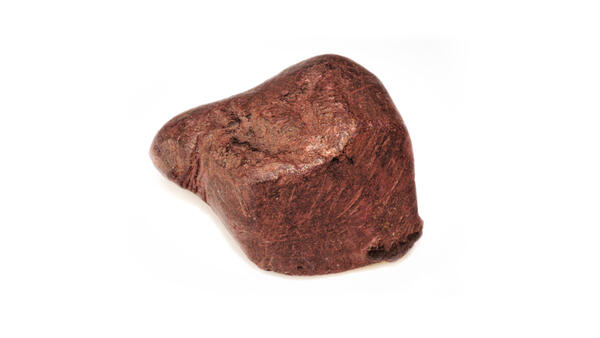
Hematite is a widespread mineral from which ochre, a natural red pigment, is produced. It was the most accessible dye in ancient times, so it was used when performing magical rituals and creating rock carvings: there were animals, hunters and sacred symbols drawn.
Primitive people learned to make paint from red ochre long before they began to scratch the first drawings on the surface of the rocks. For example, archaeologists have discovered a small workshop for the dye production in the Blombos cave in South Africa. It was created more than 70,000 years ago. The specialists ground hematite fragments in special pounders made of clam shells, then mixed it with powdered bones using a quartzite pebble pestle and diluted with water to the desired consistency.
Hematite provided color, crushed bone increased the amount of pigment produced, and the animal fats contained in bones were used as a fixative. However, archaeologists have not found any rock carvings either in or near the Blombos cave. Therefore, scientists have suggested that ochre was most likely used for ritual purposes, mainly for painting bodies.
Red paint was created by all known civilizations of the ancient world, including those on the territory of Siberia, where ochre was used not only for rock carvings, but also in rituals: the dye was sprinkled on the floor of the dwelling and used for burials. Moreover, the ancient inhabitants of Siberia decorated ceramic dishes with ochre and added powder from the dye to the clay before firing.
Over time, ancient people discovered dyes of other colors. Carvings from the Chauvet (France) and Altamira (Spain) cases are among the first examples of polychrome ancient painting. Several pigments of different colors were used for it: red, black, white, less often yellow. Scientists have established that these images were created 20-35 thousand years ago.
The dye is still used today: Africa and Australia indigenous peoples cover their bodies and hair with ochre to protect them from overheating, insect bites, and also to disinfect wounds.
Primitive people learned to make paint from red ochre long before they began to scratch the first drawings on the surface of the rocks. For example, archaeologists have discovered a small workshop for the dye production in the Blombos cave in South Africa. It was created more than 70,000 years ago. The specialists ground hematite fragments in special pounders made of clam shells, then mixed it with powdered bones using a quartzite pebble pestle and diluted with water to the desired consistency.
Hematite provided color, crushed bone increased the amount of pigment produced, and the animal fats contained in bones were used as a fixative. However, archaeologists have not found any rock carvings either in or near the Blombos cave. Therefore, scientists have suggested that ochre was most likely used for ritual purposes, mainly for painting bodies.
Red paint was created by all known civilizations of the ancient world, including those on the territory of Siberia, where ochre was used not only for rock carvings, but also in rituals: the dye was sprinkled on the floor of the dwelling and used for burials. Moreover, the ancient inhabitants of Siberia decorated ceramic dishes with ochre and added powder from the dye to the clay before firing.
Over time, ancient people discovered dyes of other colors. Carvings from the Chauvet (France) and Altamira (Spain) cases are among the first examples of polychrome ancient painting. Several pigments of different colors were used for it: red, black, white, less often yellow. Scientists have established that these images were created 20-35 thousand years ago.
The dye is still used today: Africa and Australia indigenous peoples cover their bodies and hair with ochre to protect them from overheating, insect bites, and also to disinfect wounds.
#25
Full name: Ochre (hematite)
Date: 5500-2600 BC
Technique: hematite
Place: The territory of present-day Irkutsk
Copyright: Irkutsk Regional Museum of Local History
Dimensions: 2,1×1,8×1,3 cm
Date: 5500-2600 BC
Technique: hematite
Place: The territory of present-day Irkutsk
Copyright: Irkutsk Regional Museum of Local History
Dimensions: 2,1×1,8×1,3 cm
#26
Ministry of Culture of the Russian Federation
read morehide
00:00
00:00
1x
Sculptures, Beads, Tusks, Ochre
Collection
0
 Point your smartphone camera to open in the app
Open in app
Share